
Table of Contents
- What You'll Need Before You Start
- Safety Gear and Why It Matters
- Step-by-Step: How to Remove Rust from a Smoker Firebox
- Chemical Rust Removers vs. Mechanical Removal
- Surface Rust vs. Structural Pitting: When to Repair or Replace
- How to Prevent Rust on Smokers
- Best High Heat Paint for Smoker Firebox
- How to Season a Smoker Firebox After Rust Removal
- Frequently Asked Questions
Last Updated: September 16, 2026
What You'll Need Before You Start
Smoker firebox rust is a maintenance fact of life, not a sign that your pit is finished. Learning how to remove rust from smoker firebox steel starts with gathering the right tools before you touch the metal.
Here's what to have on hand:
- Wire brush (hand-held and drill-mounted)
- Steel wool, fine and medium grade
- Sandpaper (80, 120, and 220 grit)
- Degreaser and clean rags
- Safety goggles, respirator, and work gloves
- High-heat spray paint rated for 1,200°F or higher
- Heat-resistant coating or food-safe oil for seasoning
Safety Gear and Why It Matters
Rust removal throws fine metal particles and chemical vapors into the air. A respirator and safety goggles are not optional.
Step-by-Step: How to Remove Rust from a Smoker Firebox
Removing rust from a smoker firebox takes about two to three hours for surface rust and a full weekend if pitting is involved. The process moves from the least aggressive method to the most aggressive, so you only remove what you must.
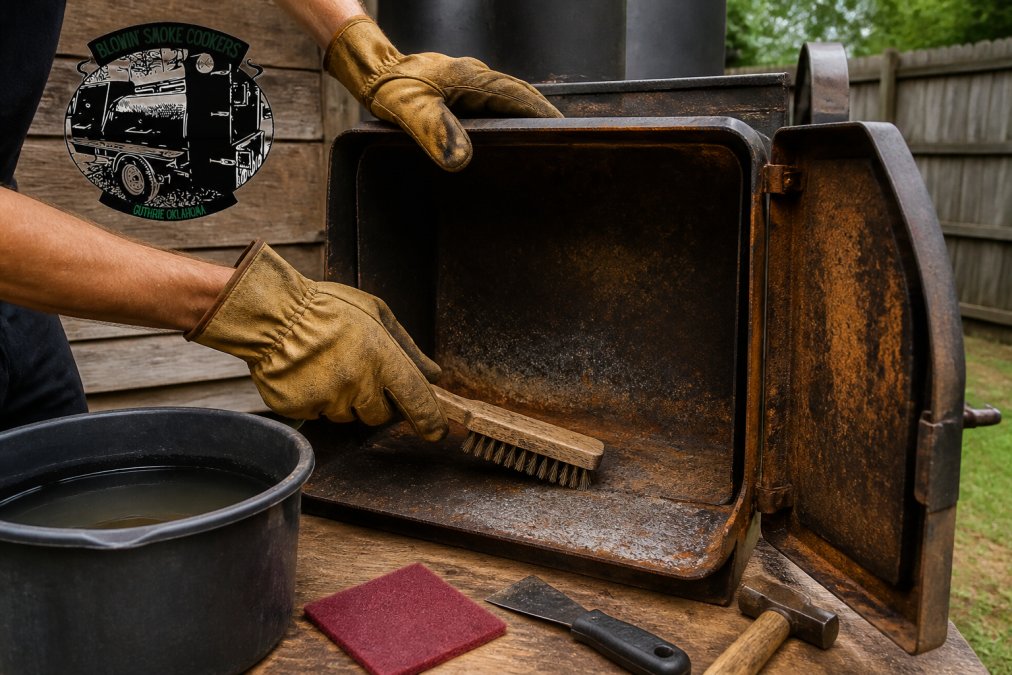
Step 1: Empty and Degrease the Firebox
Scrape out all ash and leftover fuel first. Ash holds moisture against the steel and accelerates corrosion. Spray the interior with a degreaser, let it sit, then wipe it down and let the metal dry completely. Rust removal on a greasy surface wastes your time because the grease shields the rust from your tools.
Step 2: Remove Surface Rust with Wire Brush and Steel Wool
Start with a hand wire brush on light surface rust. Move to a drill-mounted wire brush for larger areas. Follow with medium steel wool, then fine steel wool, working with the grain where the metal has a visible direction. Finish with 120-grit sandpaper to feather the edges of any remaining discoloration.
Step 3: Treat Pitting and Stubborn Corrosion
Pitting requires more patience. Apply a chemical rust remover, or work the area with 80-grit sandpaper followed by progressively finer grits. Clean the pit thoroughly, then fill deep pits with a metal primer before painting. If pitting has eaten more than a third of the way through the steel, stop and assess whether repair is worth it.
Chemical Rust Removers vs. Mechanical Removal
Method |
Best For |
Drawback |
|---|---|---|
Wire brush and steel wool |
Surface rust, light corrosion |
Slow on deep pitting |
Sandpaper |
Feathering edges, small areas |
Labor intensive |
Chemical remover |
Tight corners, heavy corrosion |
Residue must be fully neutralized |
Pressure washer |
Large flat exterior panels |
Forces water into seams if misused |
The environmental angle matters here too. Chemical rust removers contain acids that should never be rinsed into storm drains or onto garden beds. Collect runoff and dispose of it according to the label, and choose mechanical removal when it will do the job. A EPA guide to household hazardous waste explains safe disposal options for these products.
Surface Rust vs. Structural Pitting: When to Repair or Replace
Surface rust is cosmetic and removable. Structural pitting is a safety issue that determines whether the firebox can be saved.
How to Prevent Rust on Smokers
Preventing rust on smokers comes down to moisture control, thermal management, and matching your routine to the metal your firebox is made from. Smoker firebox rust needs water and oxygen, so your job is to deny it both, but how you do that depends on the steel.
The two mechanisms behind firebox rust
Firebox corrosion almost always traces to one of two patterns:
SNS 60 Smoker Cabinet Trailer →
- Ash hold. Ash is hygroscopic, it pulls humidity out of the air and holds it against the steel. A firebox left with ash in it after a cook is sitting in a damp blanket until the next use.
- Thermal cycling. Every heat-up and cool-down expands and contracts the steel. That cycling stresses paint films and seasoning layers, and any crack or chip lets moisture reach bare metal. Thin-gauge fireboxes cycle harder and fail faster than heavy plate.
Metal-specific prevention
- Mild steel (the most common firebox material). Season the interior with a high-smoke-point food-safe oil after every deep clean, and touch up exterior paint chips immediately. Mild steel rusts fast once bare, so the goal is to never leave it bare.
- Cast iron. Cast iron fireboxes and grates hold seasoning well but crack if heated unevenly. Re-oil after every cook, avoid sudden temperature swings, and never soak cast iron in water.
- Stainless steel. Stainless resists surface rust but is not rust-proof. It can still pit from chlorides and from embedded carbon steel particles left by a wire brush that was previously used on mild steel. Keep a separate brush for stainless, and wipe it down rather than letting ash sit.
A maintenance routine that actually holds
- Empty ash after every cook, not every few cooks. This is the single biggest cause of recurring rust and the easiest problem to fix.
- Leave the firebox door cracked between cooks so air circulates and any residual moisture escapes.
- Re-oil interior surfaces after cleaning with a food-safe oil.
- Touch up any paint chips immediately, before bare steel is exposed.
- Apply a rust inhibitor to exterior surfaces before long storage.
Cleaning frequency
A firebox that sees weekly use needs an ash dump after every cook, a full degrease and re-oil every few months, and a paint inspection at the start of each season. A firebox that sits idle for months needs the same routine plus a heavier oil coat before storage. The schedule matters less than the consistency, a firebox maintained on a rough schedule outlasts one that gets a perfect deep clean once a year.
Best High Heat Paint for Smoker Firebox
The best high heat paint for a smoker firebox is a spray rated for at least 1,200°F, applied over clean, bare, or properly primed steel. Standard paint will blister and peel the first time you fire up the pit. Look for products labeled for grills, wood stoves, and automotive exhaust, and check the can for a stated cure schedule rather than just a temperature rating.
Why high-heat paint fails
Most paint failures on a firebox trace back to one of four causes, and each has a different fix:
- Painting over rust or grease. The coating bonds to the contaminant, not the steel, and lifts within a few cooks. Fix: strip back to bare metal, degrease, and re-apply.
- Skipping the staged cure. High-heat paints need a low-temp bake, a cool-down, then a higher-temp bake to cross-link fully. A coat that only sees one hot fire never fully sets and stays soft. Fix: follow the can's cure schedule exactly, even if it means two separate sessions.
- Exceeding the rated temperature. A 1,200°F paint on a firebox that spikes past that during a hot burn will chalk and flake. Fix: step up to a higher-rated coating, or accept that the interior will need re-seasoning instead of paint.
- Coating too thick. Heavy coats trap solvent, which flashes off during the first burn and blisters the film. Fix: apply several thin coats rather than one wet coat.
Surface prep that makes paint last
Paint adhesion is a prep problem, not a paint problem. After rust removal, wipe the surface with a degreaser and let it flash off completely. Scuff bare steel with 120-grit sandpaper so the coating has a mechanical tooth. If you use a primer, choose one rated for the same temperature as the topcoat, a standard primer under high-heat paint will fail first and take the topcoat with it.
Interior versus exterior
The exterior firebox benefits from high-heat paint over a compatible primer. The interior firebox typically doesn't need paint at all, it needs seasoning. Paint on the inside of a firebox will eventually flake into the cook chamber, and no coating is worth that risk when a polymerized oil layer does the same job of blocking moisture.
Fixing a failed coat
If paint has already bubbled or peeled, don't paint over it. Wire-brush the failed area back to bare metal, feather the edges of the surrounding intact paint with 220-grit sandpaper, degrease, and re-apply in thin coats with a full cure. A localized touch-up usually holds; a firebox-wide failure usually means the original prep or cure was skipped and the whole surface needs to come down to bare steel.
How to Season a Smoker Firebox After Rust Removal
Seasoning a smoker firebox after rust removal rebuilds the protective layer that bare steel needs. This is the step most people rush, and it's the one that determines how long your repair lasts.
- Wipe every interior surface with a thin coat of canola oil or another high-smoke-point food-safe oil.
- Fire the smoker to 250°F and hold it there for one hour.
- Raise the temperature to 350°F for another hour to fully polymerize the oil.
- Let the firebox cool completely, then apply a second thin coat of oil.
- Repeat the heat cycle once more for a durable, non-stick barrier.
Frequently Asked Questions
What is the best way to remove rust from a smoker firebox?
Start by emptying ash and degreasing the metal. For light surface rust, a wire brush, steel wool, or abrasive pad removes most of it. For heavier corrosion, apply a chemical rust remover like naval jelly, let it sit per the label, then scrub and rinse. Sand stubborn spots with 120-grit sandpaper, wipe clean, and apply a high-heat coating within hours to prevent flash rust from returning.
Is it safe to cook in a smoker with surface rust?
Surface rust on the exterior or inside the firebox is generally not a health hazard once you clean and reseason the metal. The real concern is structural pitting, where rust has eaten into the steel and weakened the firebox. If you can poke a screwdriver through a thin spot or see deep flaking, the firebox needs repair or replacement before your next cook.
How do I prevent rust from returning to my smoker firebox?
Moisture is the enemy. Empty ash after every cook, since ash holds water against the steel. Keep the smoker covered when not in use, store it on a raised surface or trailer, and wipe down condensation after temperature swings. Reapply a thin coat of canola oil or a rust inhibitor to bare metal a few times a year, and touch up any chipped high-heat paint before rust gets a foothold.
What is the best high-heat paint for smoker firebox restoration?
Look for a high-heat spray paint rated to at least 1,200°F, often labeled as VHT paint. These coatings are formulated for fireboxes, grills, and exhaust components and cure in stages when the metal heats up. Apply two or three thin coats to bare, rust-free steel, then run the smoker through a curing cycle before cooking. Skipping the cure step is the most common reason paint flakes off.