
Rotating Rack Pit Benefits: Cooking Evenly Every Time
Editorial Team
Nov 22
Last Updated: November 20, 2026
Quick Summary
A rotating rack pit moves food through the hottest and coolest zones of the pit continuously, so every piece gets roughly the same heat exposure. This reduces burnt and undercooked spots, cuts down on manual flipping and lid openings, and makes results more repeatable from batch to batch.
- Food on a rotating grate cycles through every heat zone, so no piece sits in the hot spot too long.
- Fewer lid openings keep the pit temperature steadier and the cook more consistent.
- Balance the load evenly around the grate and space pieces so heat reaches every surface.
- Measure pit temperature at grate level and aim for 225°F to 275°F for poultry and large cuts.
- Probe at least three pieces in different positions and check that they reach USDA safe temperatures.
Want evenly cooked batches every time?Blowin' Smoke Cookers builds heavy-duty rotating rack pits for backyard and competition cooks.
Shop Rotating Rack Pits
Table of Contents
- Why Uneven Heat Ruins Large Cooks
- How a Rotating Rack Pit Promotes Even Cooking
- Static Pit vs. Rotating Rack: What Changes at the Grate
- How to Cook Chicken Evenly on a Rotating Rack
- Rotating Rack Pit Temperature Control and Doneness Checks
- Chicken Cooker Grill Setup, Cleaning, and Troubleshooting
- Choosing a Rotating Rack Pit for Your Next Cook
- Frequently Asked Questions
Why Uneven Heat Ruins Large Cooks
Rotating rack pits are built for people who cook for crowds, and the same problem comes up over and over. Uneven heat ruins large cooks.
Most backyard cooks solve this by pulling pieces off the grate and shuffling them around by hand. That works for a few chicken thighs.
Uneven cooking shows up in a few predictable ways:
- Outer pieces dry out while the center stays underdone
- Skin burns on one side and stays pale on the other
- Pieces finish at different times, so the first ones sit and cool
A rotating rack pit addresses the root cause. Instead of relying on you to find every hot spot, the food moves through the heat for you.
How a Rotating Rack Pit Promotes Even Cooking
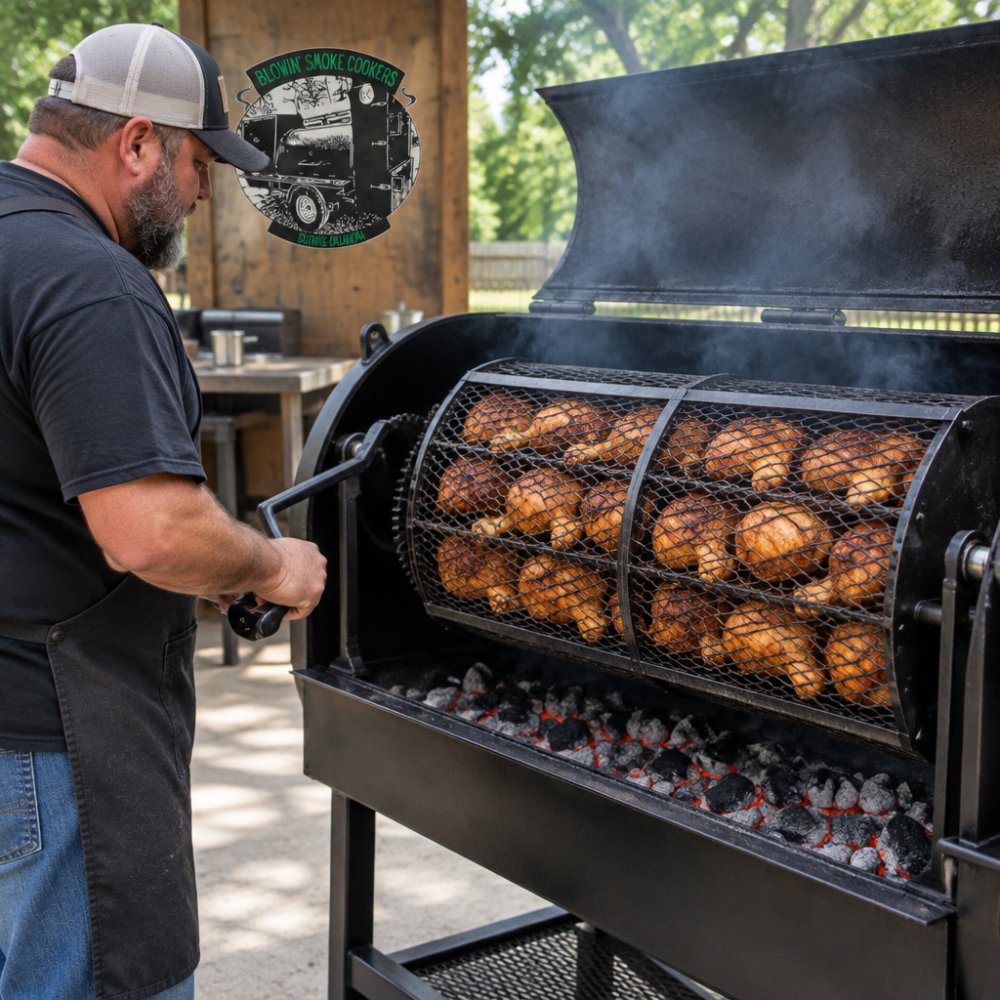
The core idea is simple. Food on a rotating grate passes through the hottest and coolest zones of the pit over and over. Over a full cook, every piece gets roughly the same exposure.
Heat Distribution and Radiant Heat Exposure
Heat in a pit comes from radiant heat off the fire and hot metal, plus rising hot air. Pieces sitting directly over the coals take the most radiant heat. Pieces at the edges take less.
A rotating grate moves each piece in and out of that strongest zone. Because the rotation is continuous, no single piece stays in the hot spot long enough to overcook.
Reducing the Need to Manually Flip Food
Manual flipping is the other big time-saver. Every time you open the lid to turn pieces, heat escapes and the cook gets longer.
Fewer lid openings also mean steadier temperatures. Less heat loss keeps the pit closer to your target, which helps the meat cook at a consistent pace.
The table below sums up how a rotating rack pit compares with a static grate at the cooking surface.
| Factor | Static grate | Rotating rack |
|---|---|---|
| Food position | Fixed spot | Cycles through every zone |
| Lid openings | Frequent | Far fewer |
| Cook attention | Constant | Step away between checks |
| Batch-to-batch results | Varies with cook | More repeatable |
Static Pit vs. Rotating Rack: What Changes at the Grate
On a static grate, the cook depends on you. You place the food, watch it, turn it, and move it around the grate by hand. Results depend on your attention and how many pieces you can babysit at once.
On a rotating rack, the grate does the moving. A few differences matter most:
- Position: Static grates keep food in one fixed spot. Rotating grates cycle food through every zone.
- Lid time: Static setups need frequent lid openings. Rotating setups need far fewer.
- Labor: Static cooks need constant attention. Rotating cooks let you step away between checks.
Static grates still have a place for small, quick cooks. For a big batch, the rotation pays off quickly.
How to Cook Chicken Evenly on a Rotating Rack
Chicken is where a rotating rack pit really shines. It is forgiving, it cooks at a moderate pace, and it is easy to overdo. Here is how to set up a batch.
Loading, Spacing, and Balancing the Rack
Good loading makes the difference between even cooking and lopsided results.
- Place pieces with space between them so heat reaches every surface
- Balance weight around the grate so it rotates smoothly
- Put larger pieces, like thighs, toward the middle zones and smaller pieces near the edges
Our [PRODUCT:1] uses a rotating double-sided grate made of food-grade T304 stainless steel rod.
Browning, Skin Color, and Moisture Retention
Skin color comes from heat exposure and airflow. Leave the lid open a bit longer near the end of the cook for darker, crispier skin. Close it for a golden, more even finish.
Moisture stays in when the pit holds a steady temperature and the food does not sit in one hot spot.
Our [PRODUCT:2] includes a rotating double-sided grate made of food-grade T304 stainless steel rod.
Rotating Rack Pit Temperature Control and Doneness Checks
Even the best rotating rack needs you to manage the fire and verify doneness. Rotation evens out exposure, but it does not set your pit temperature for you. This is the part most guides skip, and it is where even cooking is actually won or lost.
Managing Fire and Airflow for a Steady Pit
A rotating rack works best when the pit holds a stable temperature for the whole cook. Aim for a pit temperature in the 225°F to 275°F range for low-and-slow poultry and large cuts, and hold it there rather than chasing big swings. Adjust in small steps:
- Too hot: Close the intake vent about a quarter of the way and wait 10 to 15 minutes before adjusting again. Metal takes time to respond, and over-correcting causes swings.
- Too cool: Open the intake a quarter turn and clear ash from the fire basket so air can reach the coals. A choked fire runs cool and smoky.
- Smoldering, bitter smoke: Open the exhaust vent wider. A rotating pit still needs airflow across the food; a closed exhaust traps stale smoke and can leave a creosote taste.
Measure pit temperature at grate level with a probe or a dial thermometer clipped near the food. Lid thermometers read the air above the food, which can differ from grate-level temperature, so measuring at grate level gives a more accurate reading.
Watch out: opening the lid to check the fire drops grate temperature fast, and a rotating rack loses its advantage if you are opening the lid every 15 minutes.
Where to Measure Doneness
Probe the thickest part of the largest piece, away from bone and fat. For chicken, insert the probe into the thickest part of the thigh without touching bone; for whole birds, check the thigh and the breast separately because they finish at different rates. For pork and beef, probe the center of the thickest cut.
Take readings from at least three pieces in different positions on the rack, one near the center, one near the edge, and one in between. If the spread is more than about 10°F, your load is unbalanced or the fire is running hot on one side. Rebalance the rack and give it more time before you pull anything.
Verifying Safe Doneness
Use the USDA safe minimum internal temperatures as your floor, not your target for texture:
- Poultry (all parts, including ground): 165°F
- Pork: 145°F with a 3-minute rest
- Beef and lamb (whole cuts): 145°F with a 3-minute rest
Carryover cooking matters on a rotating rack because the food keeps moving through residual heat after you pull it. Large cuts can rise 5°F to 10°F during a 10- to 20-minute rest, so pull poultry at 160°F to 162°F and let it rest covered to reach 165°F.
A probe that stays in the meat through the cook is more reliable than spot-checking with an instant-read, because it shows you the curve and tells you when the rise stalls.
Keeping a Cook Log
Write down the fuel load, the vent settings, the pit temperature every 30 minutes, and the finish time for each batch. After three or four cooks you will know how your pit behaves in different weather and how long a given load takes. That log is the fastest way to turn a rotating rack's repeatability into consistent results.
Chicken Cooker Grill Setup, Cleaning, and Troubleshooting
A clean, well-set-up pit cooks more evenly and lasts longer. The steps below cover setup, safe operation, cleaning, and the problems that actually show up on a rotating rack.
Setup Checklist
- Level the pit on stable ground, at least 10 feet from walls, railings, and anything flammable. A rotating rack with an open fire needs clearance on all sides.
- Check that the rotating grate turns freely by hand before loading. It should spin with light pressure and no grinding.
- Set up the charcoal pan and adjust the brackets for the heat level you want. A full basket runs hotter and longer; a partial basket gives you more control on shorter cooks.
Load and Motor Limits
Every rotating rack has a working load limit, and exceeding it is the most common cause of uneven rotation and motor strain. Keep the load balanced front to back and side to side, and stay within the manufacturer's rated capacity.
Watch out: grease and drippings collect in the bottom pan and around the rotation path. A grease fire on a rotating pit spreads fast because the fire is under moving food.
Cleaning After Every Cook
- Scrape the grate while it is still warm, before grease sets.
- Remove grease and drippings from the bottom pan and wipe down the interior.
- Empty ash once it cools completely, and check that airflow vents are clear.
Common Troubleshooting
- Uneven browning: Check that the load is balanced and the grate rotates freely. A rack that hesitates in one spot leaves food over the hot zone too long.
- Dropping temperature: Limit lid openings, check the fuel supply, and clear ash from the fire basket.
- Stuck or grinding grate: Remove debris from the rotation path, check for bent parts, and confirm the load is within the rated limit.
Food-grade stainless steel rod grates are listed as rust-resistant, but they still need scraping and a wipe-down after each cook.
Choosing a Rotating Rack Pit for Your Next Cook
Choose a rotating rack pit based on how much you cook and how often.
Look at a few practical factors before you buy:
- Capacity: Match the grate size to your typical batch
- Build quality: Look for heavy-gauge steel and a grate that rotates smoothly
- Fuel: Confirm the model fits the fuel you use
[PRODUCT:1] and [PRODUCT:2] are both listed in our catalog with rotating double-sided grates.
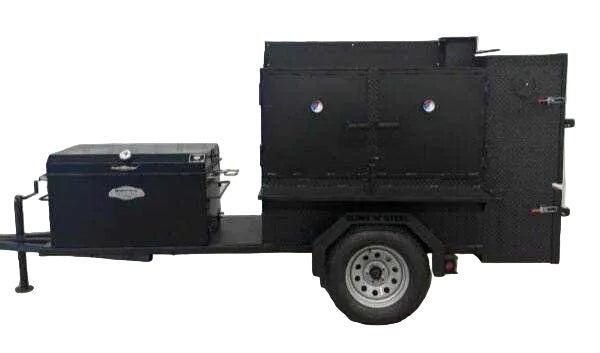
If you are not sure which model fits your cooking, contact Blowin' Smoke Cookers and describe what you cook and how often.
Ready to cook more evenly? Talk to Blowin' Smoke Cookers about a rotating rack pit built for the batches you actually cook.
Frequently Asked Questions
How does a rotating rack pit help food cook more evenly?
A rotating rack pit moves food through the cooking zone so each piece spends comparable time closer to and farther from the heat source. Instead of one side of the grate running hotter, the rotation averages out hot and cool spots across the load. This reduces the number of manual turns you need and helps large batches of chicken finish at similar levels of doneness, which is the practical advantage most cooks care about.
What foods are best suited to a rotating rack pit?
Poultry, especially whole birds and bulk cuts of legs and thighs, is the most common use because it benefits from steady, even heat and needs frequent turning on a static grate. Large cuts that take hours to cook can also benefit. Delicate items that burn quickly or need constant attention, such as thin fish fillets, are less suited to a rotating setup. Match the load to the rack and balance it so the weight stays even.
Does a rotating rack reduce hot spots in a smoker?
Rotation reduces the effect of hot spots by moving food through different heat zones during the cook, so no single piece sits in the hottest area for its entire cook time. It does not eliminate temperature differences inside the pit, so you still need to monitor the fire and placement. Checking doneness with a probe thermometer in several spots confirms that the rotation is delivering the uniform results you expect.
How do you clean and maintain a rotating grill rack?
After each cook, scrape the grate while it is warm and remove rendered fat and ash that can collect around the rotating mechanism. Check that the rotation moves freely and that the fasteners remain tight. Stainless steel rod grates resist rust, but they still benefit from regular cleaning to prevent grease buildup that can cause flare-ups. Keep the firebox and charcoal pan free of ash to maintain consistent airflow and temperature control.
