
Table of Contents
- How Long Do Steel Smokers Last? The Real Lifespan Expectancy
- What Determines How Long a Steel Smoker Lasts?
- 1/4 Inch vs 3/8 Inch Steel Smoker: Does Thickness Matter?
- How to Prevent Rust on Smokers: The #1 Lifespan Killer
- Your Smoker Maintenance Guide: Climate-Specific Storage Protocols
- Signs of Wear: When to Repair vs Replace Your Smoker
- Conclusion
- Frequently Asked Questions
Last Updated: September 8, 2026
How Long Do Steel Smokers Last? The Real Lifespan Expectancy
A well-built steel smoker is an investment that can serve you for a decade or more. The honest answer is that a heavy-gauge unit typically provides 10 to 20 years of service, while thin-walled budget models often fail in 3 to 5 seasons. The difference comes down to material thickness, build quality, and rust prevention.
A well-built steel smoker can be a 15-year veteran, while a rusted shell is a common outcome for others. This guide breaks down the variables that control lifespan and gives you a maintenance routine that protects your investment.
The most destructive force for any steel smoker is oxidation.
What Determines How Long a Steel Smoker Lasts?
The primary variable determining lifespan is the gauge thickness of the steel in the cooking chamber and firebox. Thicker metal takes longer to rust through and resists warping from high heat.
Smokers with fully welded seams have fewer crevices where moisture collects. The quality of the initial finish, whether powder coating or high-heat paint, dictates how quickly the elements reach the bare steel.
The environment plays a massive role. A smoker stored outdoors in a humid coastal climate faces a far more aggressive corrosion timeline than one kept in a dry garage.
1/4 Inch vs 3/8 Inch Steel Smoker: Does Thickness Matter?
Yes, thickness is the single most important factor. A 1/4 inch steel smoker is the industry standard because it offers a balance of thermal retention and durability that thin metal cannot match.
Thin metal, often 16 or 14 gauge (roughly 1/16 inch), is prone to hot spots and warping, and it can rust through in just a few short years. In contrast, a 1/4 inch plate steel chamber acts as a heat sink, stabilizing temperatures and resisting metal fatigue.
Steel Thickness |
Typical Lifespan |
Thermal Stability |
Repair Ease |
|---|---|---|---|
16-14 gauge (thin) |
3-5 years |
Poor, prone to hot spots |
Difficult, warps easily |
1/4 inch plate |
10-15+ years |
Excellent, holds steady temps |
Moderate, can be patched |
3/8 inch plate |
20+ years |
Superior, massive heat sink |
Difficult, requires heavy welding |
For most backyard enthusiasts and competition cooks, 1/4 inch steel is the sweet spot. It provides durability without the excessive weight and cost of 3/8 inch plate. Units like the SNS 24 Patio Smoker are built with this philosophy.

How to Prevent Rust on Smokers: The #1 Lifespan Killer
Rust is the enemy of longevity, but the best defense is a proactive rust prevention routine that starts on day one. The process is straightforward: manage the seasoning, control moisture, and address paint chips immediately.
The seasoning layer of polymerized oil is your first line of defense (acs.org). After every cook, run a thin coat of oil over the exterior and interior while the smoker is still warm. For high-heat applications, use flaxseed oil or crisco, which polymerize into a hard film. Avoid standard vegetable oil, which can turn gummy.
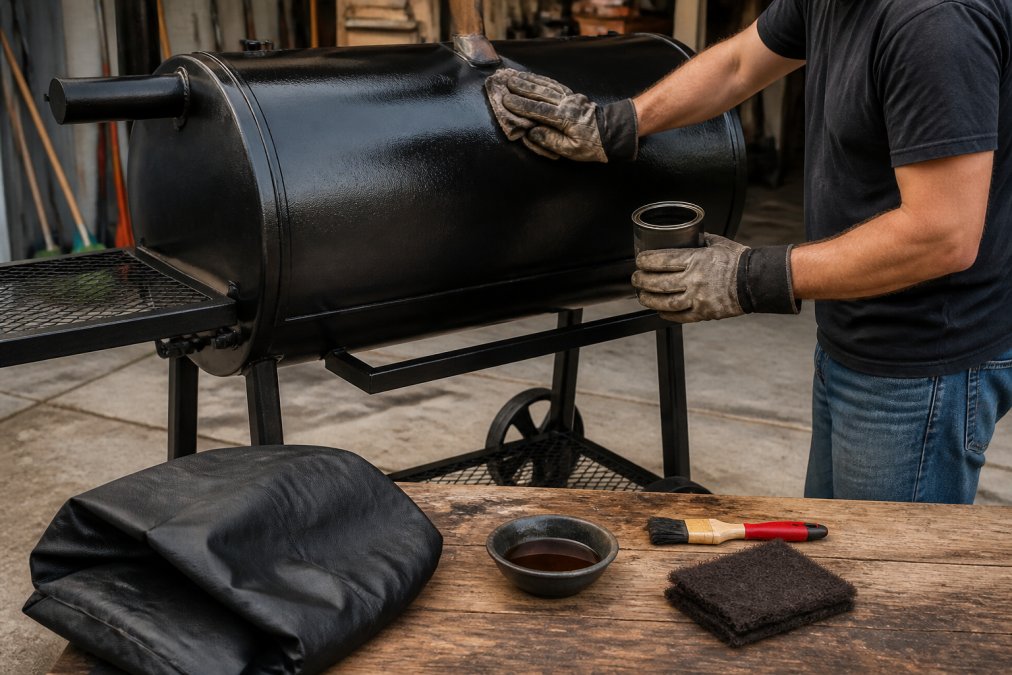
The Material-Specific Approach to Corrosion Prevention
The type of steel and its finish dictate your prevention strategy.
- Bare Carbon Steel (e.g., A36 or 1018): This is the most common steel in smokers. It rusts quickly if left unprotected. Your primary defense is a robust seasoning layer. For the exterior, consider a high-temperature silicone-based paint (rated to 1200°F) which offers superior moisture resistance compared to standard BBQ paint. For the interior, a thick polymerized oil layer is non-negotiable.
- Stainless Steel (e.g., 304 or 430): While more corrosion-resistant, stainless steel is not immune. It is susceptible to pitting corrosion in coastal environments where salt air is present. For stainless, avoid abrasive cleaners that scratch the surface, as these scratches become nucleation points for rust. Use a dedicated stainless steel cleaner that leaves a protective film.
- Powder-Coated Steel: The powder coating is your primary barrier. The moment it chips, the exposed steel is vulnerable. For touch-ups, use a cold-galvanizing spray (zinc-rich primer) on the bare metal before applying a matching high-heat paint. This provides sacrificial protection that paint alone cannot.
The Sealant and Inhibitor Arsenal
Here is a practical protocol used by pitmasters in high-humidity zones:
- Annual High-Heat Paint Refresh: Once a year, before the cooking season, inspect the exterior. Sand down any rust spots to bare metal, apply a rust-inhibiting primer like Rust-Oleum High Heat Primer, and then apply a top coat of Rust-Oleum High Heat Enamel (rated to 1200°F). This is not just cosmetic; it seals micro-cracks where moisture penetrates.
- Fluid Film or Boeshield T-9 for Undercarriage: The underside of the cooking chamber and the firebox bottom are the most neglected areas. These areas are prone to condensation and ground splash. Apply a lanolin-based Fluid Film or a wax-based Boeshield T-9 to these areas. These products creep into seams and provide a self-healing barrier that resists moisture wicking.
- The Grease Management Rule: Acidic grease is a catalyst for corrosion. After every cook, scrape the interior and wipe down the firebox. A quarterly deep clean with a degreaser like Simple Green (diluted) on the exterior prevents grease from breaking down your paint or powder coating.
A dedicated rust prevention strategy includes a quarterly inspection for corrosion resistance failures, such as bubbling paint or orange streaks, and touching them up with high-heat paint before they become structural issues.
By understanding your smoker's specific material and applying the correct sealants and inhibitors, you move from passive maintenance to an active defense against the #1 lifespan killer.
Your Smoker Maintenance Guide: Climate-Specific Storage Protocols
Your maintenance guide must adapt to your local climate. The core principle is simple: keep the steel dry and allow airflow to prevent condensation.
For humid or coastal climates, always use a high-quality grill cover that is waterproof but breathable. A non-breathable cover traps moisture, accelerating rust. Elevate the smoker on pavers or a cart to prevent ground moisture from wicking up.
In dry climates, the primary threat is ash and grease buildup, which can attract pests and hold moisture during rare rain events. Regardless of location, a routine of ash removal and grease management after each cook prevents acidic buildup. For year-round cooks, a bi-annual deep clean is essential to check for gasket replacement needs and re-season the interior.
Signs of Wear: When to Repair vs Replace Your Smoker
Even with perfect care, components will eventually wear out. The key is to distinguish between cosmetic issues, rebuildable components, and fatal structural damage. You must differentiate between the structural steel chassis and the electronic component layer, which have vastly different lifespans and repair costs.
The Two Lifespan Clocks: Structural vs. Component
Every smoker has two independent 'lifespan clocks' ticking. The structural clock is set by the steel gauge and your rust prevention. The component clock is set by the quality of the electronics and frequency of use.
- Structural Steel Clock: This is the 10-20 year clock we discussed earlier. It is governed by rust and metal fatigue. If this clock fails, the smoker is typically a total loss.
- Component Clock: This is the 3-7 year clock. It is governed by the thermal cycling of heating elements, the degradation of silicone gaskets on controller housings, and the corrosion of electrical contacts. If this clock fails, it is almost always a repair, not a replacement.
- Heating Elements: A typical 1500W heating element has a lifespan of 3-5 years under regular use. The failure mode is usually a break in the internal resistance wire, which causes the element to short out. The symptom is a smoker that heats unevenly or trips your GFCI breaker. This is a $30-$60 part and a 30-minute repair.
- Temperature Controllers (PID Controllers): These are the brains of the operation. They are susceptible to moisture ingress and capacitor failure. A failing controller will show erratic temperature readings or fail to hold a set point. Replacing a PID controller is a $100-$200 repair, but it is far cheaper than replacing the whole smoker.
- Probes and Wiring: The thermocouple probes and the wiring harness are often the first to corrode, especially in humid climates. A faulty probe will give you inaccurate readings, leading to overcooked meat. This is a $15-$30 fix.
The Structural Failure Threshold
The line is crossed when rust compromises the structural integrity of the unit. If you can push a screwdriver through a rusted section of the cooking chamber floor or firebox wall, the metal has lost its strength. Welding thin, rusted metal is often futile, as corrosion spreads beneath the new weld.
Issue |
Fix |
Action |
|---|---|---|
Surface rust on exterior |
Grind, treat, and repaint |
Repair |
Worn door gasket |
Replace with high-temp gasket |
Repair |
Failing heating element (electric) |
Replace with OEM or compatible element |
Repair |
Erratic PID controller readings |
Replace controller unit |
Repair |
Rust through firebox floor |
Evaluate extent of oxidation |
Replace if extensive |
Warped cooking grates |
Replace with heavy-duty grates |
Repair |
Structural failure in frame |
Check for metal fatigue |
Replace |
Corroded wiring harness |
Replace with marine-grade wiring |
Repair |
The Cost-Benefit Decision Matrix
A practical rule of thumb used by repair shops is the 50% rule: if the repair cost exceeds 50% of a comparable new smoker, it is time to replace (extension.iastate.edu). This rule must be applied to the two clocks separately.
- If the component clock fails (e.g., a $200 controller on a $1500 smoker), the repair is 13% of the replacement cost. Always repair.
- If the structural clock fails (e.g., a rusted-out firebox on a $1500 smoker), the repair might cost $800 in labor and materials, which is over 50%. In this case, replacement is the better economic choice.
If facing a full replacement, consider the long-term cost. A budget smoker that lasts 3 years often costs more per cook than a heavy-duty smoker that lasts 15. For those ready to upgrade, the Meadow Creek SQ36 Offset Barbecue Smoker offers welded stainless steel grates built for decades of service, while our SNS 60 Smoker Cabinet Trailer uses 1/4 inch diamond tread steel for demanding catering environments.

Conclusion
Steel smokers last as long as you are willing to care for them, but the ceiling for that lifespan is set at the factory by the gauge of steel used. Thin metal guarantees a short life, while steel smokers last for decades when built from 1/4 inch plate and protected from moisture.
The challenge is resisting the urge to save money upfront on a lighter unit that will fail in a few seasons. We recommend investing in equipment with heavy-duty steel construction and a design that facilitates easy cleaning and airflow management.
At Blowin' Smoke Cookers, we stock reverse flow smokers and catering trailers built with the durability required for competition and catering success. Explore our selection of Sling n Steel and Meadow Creek products to find a rig that will be your partner for the next 20 years.
Frequently Asked Questions
What is the average lifespan of a steel offset smoker?
A well-built steel offset smoker with 1/4 inch or thicker plate steel can last 15 to 20 years or more with proper care. Thin-gauge smokers from big-box stores often show significant rust and structural issues within 3 to 5 years. The difference comes down to material thickness, welded seams, and how consistently you protect the steel from moisture. Annual maintenance and covered storage dramatically extend the lifespan expectancy of any steel smoker.
Does steel thickness affect how long a smoker lasts?
Yes, steel thickness directly impacts durability. A 1/4 inch steel smoker resists warping and rust penetration far better than a smoker built from 18-gauge or 16-gauge sheet metal. Thicker steel also holds heat more steadily, reducing thermal stress on welds. For backyard enthusiasts who want a patio smoker that lasts a lifetime, 1/4 inch plate steel is the practical starting point. Thinner metal heats faster but corrodes through much sooner, especially in humid climates.
How does rust impact the longevity of a BBQ smoker?
Rust is the primary reason steel smokers fail. Surface oxidation is cosmetic, but unchecked rust creates pitting that weakens the cooking chamber and firebox. Over time, oxidation can burn through 1/4 inch steel, compromising structural integrity and creating hot spots that ruin temperature control. Regular rust prevention, including seasoning the interior and maintaining a protective finish on exterior surfaces, stops corrosion before it starts. Catching rust early and treating it with high-heat paint keeps a quality smoker in service for decades.
Are stainless steel smokers more durable than carbon steel?
Stainless steel offers superior corrosion resistance compared to carbon steel, which is why it lasts longer with less maintenance. However, stainless is significantly more expensive and does not season as effectively, which can affect the flavor profile of your barbecue. Carbon steel smokers, particularly those built from 1/4 inch plate, are the standard for competition and catering because they combine excellent heat retention with a naturally seasoned interior. With a proper smoker maintenance guide, a carbon steel pit will outlast cheaper stainless models.