
Table of Contents
- What a Reverse Flow Smoker Is and How It Works
- Reverse Flow vs Standard Offset Smoker: Key Differences
- Reverse Flow Smoker Pros and Cons for Backyard Use
- Heat Distribution, Temperature Control, and Cooking Performance
- Best Offset Smoker for Backyard Parties: Capacity and Real-World Fit
- Total Cost of Ownership and Durability for Backyard Cooks
- Is a Professional Reverse Flow Smoker Right for You?
- Frequently Asked Questions
Last Updated: October 10, 2026
What a Reverse Flow Smoker Is and How It Works
A reverse flow smoker is a barbecue cooker that uses a baffle plate inside the cooking chamber to redirect heat and smoke from the firebox. Instead of hot gases flowing directly across the food, they travel under the baffle, then back over it before exiting through a rear chimney. This design creates more even temperature distribution and reduces hot spots compared to traditional offset smokers.
Wood or charcoal burns in the firebox, and heat enters the main cooking chamber but hits the baffle plate first. The baffle forces air to travel the full length of the chamber beneath it, then rise and flow back over the food before exiting, distributing heat evenly across the cooking grates.
This design delivers measurable benefits: fewer cold spots where meat cooks slower, fewer hot zones where it dries out, and smaller temperature swings whether you're smoking brisket for eight hours or ribs for four.
The trade-off is complexity and cost, but for serious backyard cooks, that investment pays dividends in consistency.
Reverse Flow vs Standard Offset Smoker: Key Differences
The core difference comes down to heat distribution. In a standard offset smoker, heat travels directly from the firebox across the cooking grates and out the chimney.
A reverse flow smoker eliminates that gradient by forcing heat to travel the full length of the chamber before rising. Most backyard cooks notice this immediately: temperature readings stay within a tighter range across the grates instead of swinging widely.
Standard offset smokers require more active management with constant damper adjustments because heat can spike suddenly. Reverse flow designs are more forgiving, the baffle plate acts as a thermal buffer, smoothing out temperature swings from firebox adjustments.
In a standard offset, hot smoke rushes past the food quickly. A reverse flow chamber holds smoke longer, allowing deeper penetration and more smoke character without becoming acrid.
The learning curve is steeper at first, but once you dial in the baffle dynamics, you spend less time babysitting temperature, a real advantage for weekend warriors hosting large gatherings.
Reverse Flow Smoker Pros and Cons for Backyard Use
Advantages for Backyard Cooks
Temperature consistency is the biggest win, a reverse flow smoker holds temperature within a tight band, eliminating hot and cold zones and delivering more even doneness across a full brisket or rack of ribs.
Fuel efficiency improves because you use less wood or charcoal to maintain your target temperature.
Reverse flow design appeals to newer pitmasters: you can make damper mistakes and recover more easily, with slower temperature swings.
Smoke flavor develops more fully, the longer residence time means meat absorbs smoke more evenly.
Capacity options range widely. Models like the Cabinet Smoker SNS 72 handle 60-75 Boston butts on a single cook, making them viable for catering side hustles or large family gatherings.

Drawbacks to Consider
Cost is real. A quality reverse flow smoker starts around $2,700 and climbs quickly. The Meadow Creek SQ36 at $2,725 is an entry point, but cabinet models like the SNS 72 run $5,699. That's a serious investment for a backyard hobby.

Space requirements are substantial. Reverse flow smokers are bulky. The SNS 72 measures 92 inches long and 75 inches tall. You need a dedicated patio area or a permanent spot in your yard. If you're in a small lot, this might not fit.
Cleaning complexity increases: the baffle plate design creates more nooks for ash accumulation.
The learning curve is steeper at the start, you need to understand baffle dynamics and airflow patterns before achieving the gentler control of a dialed-in reverse flow.
Repair access can be trickier, the baffle plate design makes internal repairs harder.
| Aspect | Reverse Flow | Standard Offset |
|---|---|---|
| Temperature Consistency | ±25°F typical | ±50°F typical |
| Fuel Efficiency | Higher | Lower |
| Learning Curve | Moderate | Steep |
| Maintenance Burden | Higher | Lower |
| Smoke Flavor | Deep, even | Variable |
| Entry Price | $2,700+ | $1,500+ |
Heat Distribution, Temperature Control, and Cooking Performance
Reverse flow design solves the fundamental problem of offset smokers, uneven heat. The baffle plate redirects airflow so temperature readings stay consistent across the entire cooking surface, critical for large cooks where all meat must finish evenly.
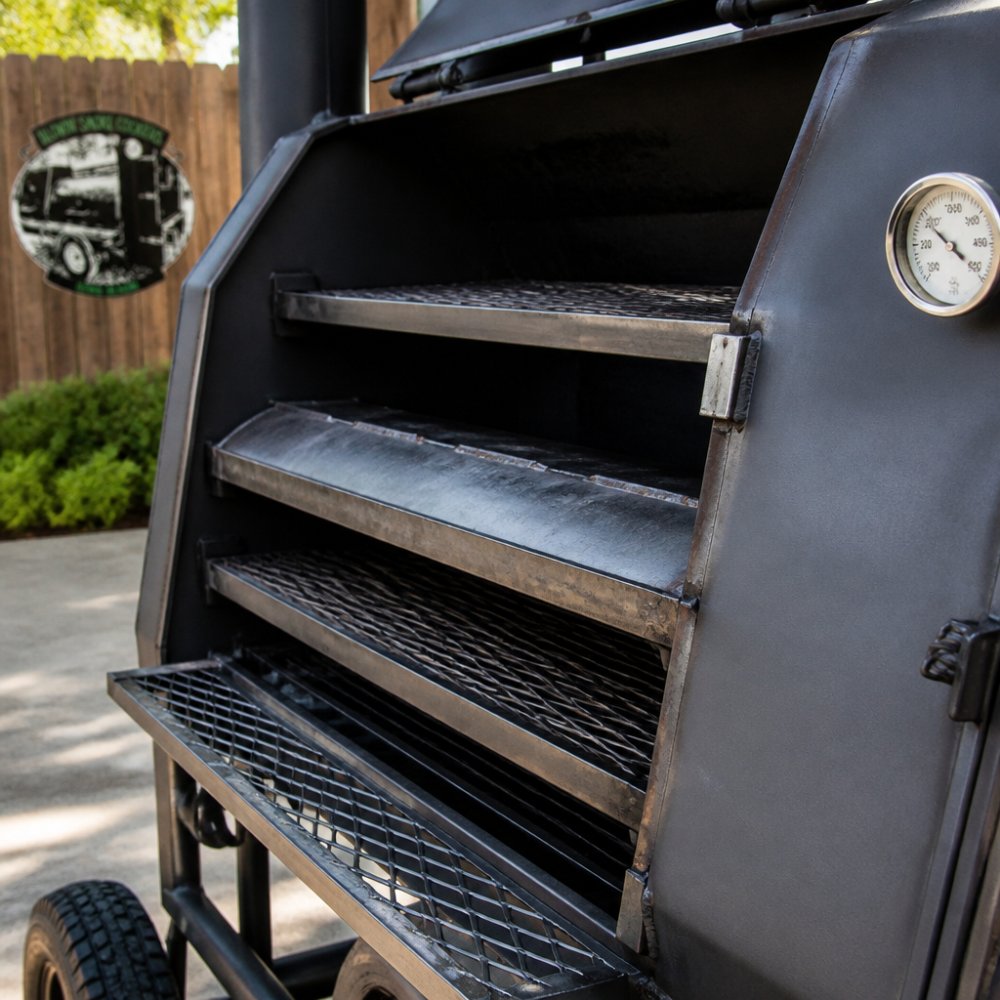
Temperature recovery is faster with reverse flow, opening the door to spritz your brisket causes quicker recovery to target temperature, losing less cooking momentum.
Cooking speed is slightly slower in a reverse flow, but the payoff is consistency, a brisket finishes more evenly, a worthwhile trade for backyard cooks.
Hot spots still exist but are far less pronounced, you may notice a difference between hottest and coolest zones, manageable without constant adjustment.
Airflow control becomes more intuitive, the baffle acts as a shock absorber for damper changes, producing smaller temperature swings.
Best Offset Smoker for Backyard Parties: Capacity and Real-World Fit
Capacity needs depend on your crowd size and frequency. For a family of six cooking twice a month, the Meadow Creek SQ36 at $2,725 handles 5-6 pork butts or 2 whole briskets comfortably. That's plenty for a weekend gathering.
If you're hosting monthly parties of 20-30 people, you need more. The SNS Barrel 40 at $3,199 offers a middle ground. It holds more than the SQ36 without requiring the footprint of a cabinet model.

For serious entertaining or catering work, the Cabinet Smoker SNS 72 at $5,699 makes sense. It handles 60-75 Boston butts on one cook. That capacity lets you feed 100+ people without running multiple batches.
Space constraints matter: the SQ36 fits a standard patio, the Barrel 40 requires more room, and the SNS 72 needs a dedicated area with a concrete pad.
Cabinet Smoker SNS 72 Smoker Cabinet →
The SQ36 is most movable if you might relocate it, the Barrel 40 has casters for repositioning, and cabinet models are permanent installations.
Total Cost of Ownership and Durability for Backyard Cooks
Purchase price is only the first expense, understanding the full cost picture helps you decide whether the premium over a standard offset is justified.
Year-One Setup Costs
A quality reverse flow ranges from $2,700 to $5,699.
Expect to spend on essentials:
- A heavy-duty cover protects the unit from weather and extends paint life
- Dual thermometers or a digital temperature probe for accurate monitoring
- Grate replacements or upgrades if needed
- Ash tools, gloves, and cleaning supplies
Some buyers add a concrete pad for stability and longevity, extending the smoker's life by preventing rust from ground moisture.
Annual Operating Costs
Fuel: A typical weekend cook uses 15-25 pounds of charcoal or wood. Reverse flow smokers are more fuel-efficient than standard offsets because the baffle reduces temperature swings, meaning less adjustment and less wasted heat. Expect to use 10-15% less fuel than a standard offset at the same frequency.
Cleaning labor: 30-45 minutes per cook is required to maintain the unit properly.
Durability and Longevity
Reverse flow smokers from established manufacturers are built to last with proper care, with heavy-gauge steel and quality grates resisting warping and rust.
Common wear items include thermometer seals, grates, gaskets and door seals, and paint touch-ups (annually as needed).
Major repairs are rare if the unit is maintained.
Resale Value and Exit Strategy
Resale value matters: reverse flow smokers from known manufacturers hold a significant portion of their purchase price after five years.
Climate and Seasonal Costs
In humid or coastal climates, rust prevention requires more frequent maintenance including annual paint touch-ups and more frequent cover replacement.
The 10-Year Total Cost Comparison
For a regular cook (26 times per year) using a Meadow Creek SQ36:
| Category | 10-Year Cost |
|---|---|
| Purchase price | $2,725 |
| Accessories and setup | $400 |
| Fuel | $4,000-5,000 |
| Maintenance and repairs | $800-1,200 |
| Cleaning labor (at $25/hour) | $3,120-4,680 |
| Subtotal | $11,045-14,005 |
| Resale value (60% recovery) | -$1,635 |
| Net cost | $9,410-12,370 |
For comparison, a standard offset smoker would have different long-term costs, with potentially higher fuel consumption, more frequent temperature swings, and lower resale value. The reverse flow premium reflects these differences.
Is the Premium Worth It?
If you cook regularly and prioritize consistency, fuel efficiency, and durability, the premium offers significant benefits. If you cook occasionally, a standard offset may be a suitable choice.
For serious backyard cooks, the reverse flow premium is justified. For casual users, it may not be.
Is a Professional Reverse Flow Smoker Right for You?
The answer depends on your cooking frequency, space, and what you value most. Rather than a yes-or-no verdict, reverse flow makes sense for specific backyard profiles.
For Occasional Cooks (4-8 times per year)
If you smoke fewer than twice a month, a reverse flow smoker may be overbuilt. The upfront cost and maintenance burden may not justify themselves at this frequency. A mid-range offset smoker can deliver good results at a lower cost.
For Regular Weekend Cooks (2-4 times per month)
At this frequency, fuel savings from better temperature control add up, and the learning curve offers benefits. The consistency matters when hosting regular gatherings. The Meadow Creek SQ36 fits this profile well as an entry point to reverse flow.
For Serious Enthusiasts (weekly or catering work)
At 50+ cooks per year, fuel efficiency compounds into real savings and temperature consistency becomes a competitive advantage. The larger models handle volume without quality loss, and time saved on temperature management offers significant benefits.
For Competition or High-Volume Entertaining
For BBQ contests or feeding 50+ people, reverse flow offers significant advantages, judges often score on consistency, bark quality, and color uniformity, all areas where reverse flow excels. Cabinet models can eliminate the need for multiple cooks or batch runs.
The Space and Commitment Test
Before deciding, consider: Do you have 8-10 feet of dedicated space? Can you commit to 30-45 minutes of cleaning per cook? Will you cook in all seasons and maintain rust prevention? Do you have reliable access to quality fuel?
The ROI Calculation
For regular cooks, fuel savings through better temperature control compound over time, and resale value is significantly higher. For occasional cooks, the math may not work. For weekly cooks, it's compelling.
Frequently Asked Questions
How does a reverse flow smoker work compared to a traditional offset smoker?
A reverse flow smoker uses a baffle plate inside the cooking chamber to redirect smoke and heat. Instead of flowing directly from the firebox across the grates, heat travels under the baffle plate, then reverses direction and moves back over the meat before exiting. This creates more even temperature distribution across the cooking surface. Traditional offset smokers have heat flowing directly from the firebox to the smokestack, which often creates hot spots near the firebox and cooler zones near the exit.
What are the main pros and cons of a reverse flow smoker for backyard cooking?
Pros include even heat distribution, easier temperature maintenance, less active fire management, and consistent results across the entire cooking surface. Cons include higher upfront cost, larger footprint, longer warm-up time, and a steeper learning curve for temperature tuning. For backyard entertaining, the even heat and stable temperatures are major advantages, though the investment is significant compared to budget models.
Is a professional reverse flow smoker worth it if I'm just hosting backyard parties?
It depends on how often you cook and how many guests you typically serve. If you host large gatherings regularly and want consistent, hands-off cooking, the investment pays off through reliability and capacity. The Cabinet Smoker SNS 72 holds 60-75 Boston butts or 30-40 briskets, making it ideal for feeding crowds. However, if you cook occasionally or for small groups, a smaller offset like the Meadow Creek SQ36 ($2,725) delivers solid performance at a lower price point.
How long do professional reverse flow smokers last with regular backyard use?
Professional-grade reverse flow smokers built with heavy steel construction can last for many years with proper maintenance. Regular cleaning, rust prevention, and seasonal care extend durability significantly. Blowin' Smoke Cookers' models use heavy-duty steel construction and insulated fireboxes designed for year-round use. Proper cover storage during off-season and regular inspection of seals and hinges are key to longevity.