
Table of Contents
- Why Mobile BBQ Catering Trailer Features Matter
- 1. Reverse-Flow Temperature Control and Heat Retention
- 2. Heavy-Duty Steel Construction and Durability
- 3. Cooking Capacity: Smokers, Grills, and Cooking Stations
- 4. Ventilation and Smoke Management Systems
- 5. Food Trailer Layout for Catering Efficiency
- 6. Food Preparation and Counter Space
- 7. Refrigeration and Food Storage Solutions
- Frequently Asked Questions
Last Updated: October 21, 2026
Why Mobile BBQ Catering Trailer Features Matter
A mobile BBQ catering trailer is only as good as the equipment inside it. The difference between a profitable event and a logistical nightmare often comes down to whether your setup handles the cooking load, maintains consistent temperatures, and keeps your team moving efficiently through service.

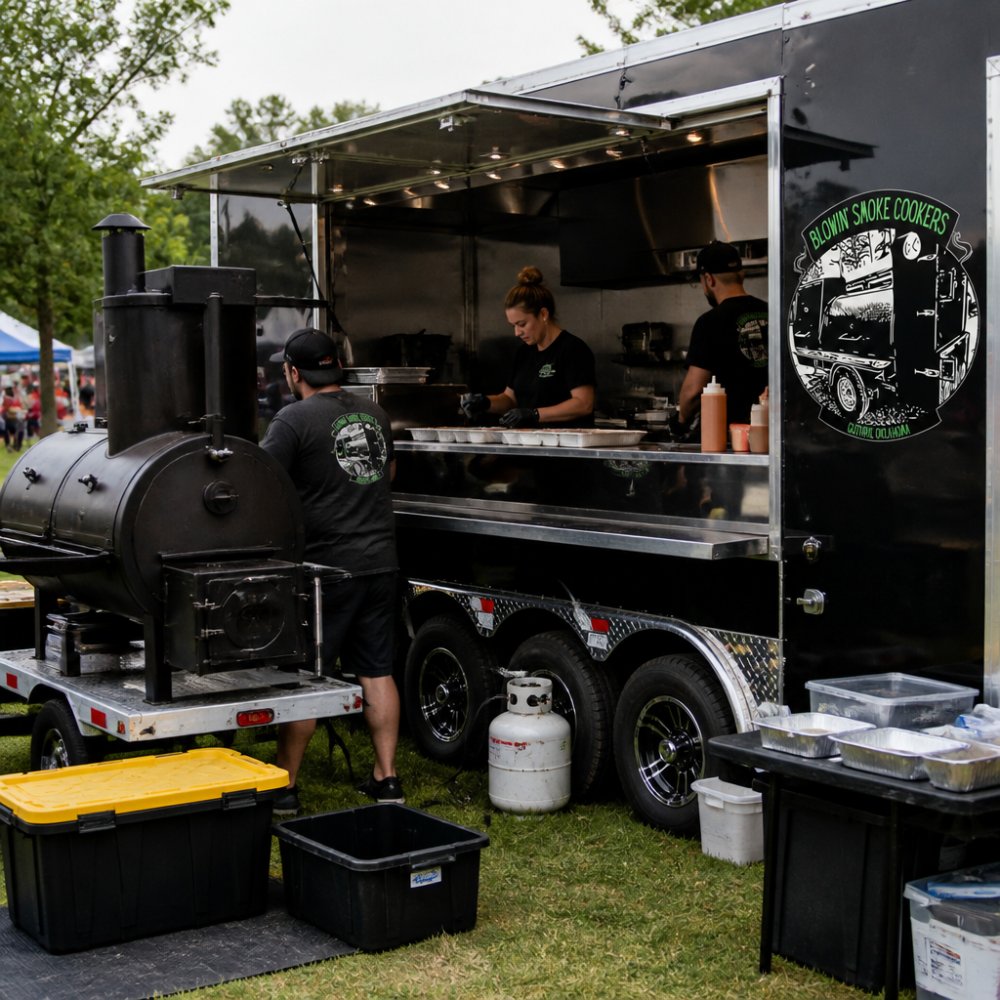
At Blowin' Smoke Cookers, we've worked with professional caterers and pitmasters who've learned this lesson the hard way. The right mobile BBQ catering trailer features don't just make your job easier, they directly impact your bottom line. You can serve more guests, expand your menu options, and finish events without equipment failures that cost you time and reputation.
The features that matter most aren't always the flashiest ones. They're the ones that solve real problems: holding temperature under pressure, moving food through prep and cooking without bottlenecks, keeping everything accessible during service, and lasting through years of heavy use. Food Safety News guidance on mobile food service emphasizes that proper equipment design prevents contamination and ensures compliance with health codes, a critical consideration for any catering operation.
Below, we'll walk through the 10 features that separate a functional trailer from one that actually scales your business.
1. Reverse-Flow Temperature Control and Heat Retention
Reverse-flow technology is the foundation of temperature stability in professional smokers. Instead of heat rising directly from the firebox to the cooking chamber, it's forced to the opposite end of the chamber, down under the cooking racks, and back toward the exhaust. This design eliminates hot spots and creates an even cooking environment.
For catering, this matters enormously. You need to hold consistent temperatures across multiple racks of meat for hours. A reverse-flow smoker maintains that stability without constant adjustment. The insulated firebox, typically 30" x 20" x 20" in commercial models, keeps heat contained and prevents temperature swings that waste time and ruin meat.
The cooking racks themselves should be substantial. Look for models with three slide-out racks measuring at least 54" x 28" or larger. This gives you the surface area needed to cook 30+ briskets, 60+ whole chickens, or equivalent volumes of ribs and butts in a single load. The Offset Smoker SNS Barrel 60 Catering Trailer with Sink Package delivers reverse-flow design with a 60" x 31" main chamber and slide-out racks that give you real working space.

2. Heavy-Duty Steel Construction and Durability
Professional catering trailers live hard lives. They're towed to events in all weather, exposed to heat and smoke for hours at a time, and demand reliability that consumer equipment simply can't provide.
The best mobile BBQ catering trailer features start with the materials. 1/4-inch diamond tread steel for the main cooking chamber isn't a luxury, it's a requirement. This thickness resists warping from extreme heat, handles the structural stress of loaded cooking racks, and won't rust through after a few seasons of heavy use. The diamond tread pattern also provides slip resistance and durability that smooth steel can't match.

Your firebox should be similarly strong. An insulated, double-walled construction with 30" x 20" x 20" dimensions creates a dedicated burn chamber that's separated from the main cooking area. This design protects the outer shell from direct flame exposure and extends the life of your entire trailer.
The frame and axles matter just as much as the cooking surfaces. A trailer designed to handle catering loads needs heavy-duty axles rated for the full weight of equipment, fuel, water, and food. The SNS Cabinet 60 Catering Trailer with Sink Package and Standard Grill features 1/4-inch steel construction throughout, designed to withstand years of professional use.
3. Cooking Capacity: Smokers, Grills, and Cooking Stations
Cooking capacity determines how many guests you can serve in a single event. This is where the math becomes real: can you cook enough food to hit your profit target, or will you need multiple trailers?
A professional mobile BBQ catering trailer typically includes three distinct cooking stations: a main smoker chamber, a charcoal grill, and often a specialty station like a fryer or rotisserie. This combination lets you offer variety without compromising on any single item.
The main smoker chamber should hold at least 60 boston butts, 60 whole chickens, 30 spare ribs, or 20-30 briskets. That's the baseline for a 60-inch cabinet model. Larger operations benefit from 72-inch chambers that push capacity to 75 boston butts or 75 whole chickens.
A dedicated charcoal grill should measure at least 30" x 24" with two slide-out racks. This gives you the surface area to grill ribs, chicken halves, and sausages while your smoker handles the longer-cook items. The rib box, a separate compartment typically 24" x 18" x 32" with three racks, lets you hold finished ribs warm without taking up smoker space.
4. Ventilation and Smoke Management Systems
Proper ventilation does two things: it controls smoke flow for consistent cooking and it protects your team and customers from excessive smoke exposure. A poorly ventilated trailer creates a dangerous, uncomfortable environment.
The exhaust system should be sized to handle the volume of smoke your firebox produces. Most commercial trailers use a chimney or stack that's at least 6-8 inches in diameter, positioned to draw smoke evenly across the entire cooking chamber before venting.
OSHA guidelines on workplace ventilation require adequate air quality for staff safety. In a catering trailer, this means your exhaust system must move smoke away from the serving window and prep area where your team is working.
The vent design should also include dampers or adjustable louvers that let you fine-tune smoke flow based on cooking conditions. A tight damper increases heat retention and smoke penetration; an open damper increases airflow and reduces cooking time. This control is what separates a professional setup from a backyard smoker.
Storage for fuel and wood is part of the ventilation equation. A wood storage basket measuring at least 28" x 67" keeps your fuel organized and accessible without taking up prep space.
5. Food Trailer Layout for Catering Efficiency
The physical arrangement of your cooking stations, prep areas, and serving window determines how smoothly your team can move through service. Poor layout creates bottlenecks; good layout lets one person handle what would otherwise require two.
BBQ Pit SNS Cabinet 60 Catering Trailer With Sink Package And Standard Grill →
Start with the serving window. It should be positioned to give customers clear visibility of your offering and easy access to order. A window that's too small creates a line; one that's too large wastes valuable prep space. Most professional trailers use a window that's 3-4 feet wide.
Behind the serving window, you need dedicated prep and plating space. This should be separate from your cooking stations. A stainless steel or food-grade work surface measuring at least 3 feet x 2 feet gives your team room to plate food, portion sides, and manage orders without interfering with active cooking.
The three-compartment sink, required by health codes for food service, should be positioned for easy access but not directly in the traffic flow. A 3-bay sink package with hand wash station, instant hot water, and a 5-gallon water tank covers your sanitation needs without requiring external water hookups. This is standard on models like the SNS Cabinet 60 Catering Trailer with Sink Package and Standard Grill.
6. Food Preparation and Counter Space
Real prep space separates professional operations from hobbyists. You need room to hold raw ingredients, cut and portion food, and manage multiple orders simultaneously without cross-contamination.
A dedicated prep counter should measure at least 3 feet long and 24 inches deep. It should be stainless steel or food-grade plastic that's easy to sanitize between tasks. This is where you cut briskets, portion ribs, and assemble sides while your team is actively cooking.
Storage shelving above and below your prep area keeps frequently used items within arm's reach. A 3-shelf storage cabinet measuring 21" x 30" holds serving utensils, plates, napkins, and condiments. Additional shelving for raw ingredients and supplies prevents clutter and keeps your workspace functional.
Lighting is critical. Your prep area should have dedicated LED lighting, at least 50 foot-candles of illumination. Poor lighting leads to mistakes, slower service, and potential food safety issues. Many professional trailers include recessed LED fixtures that mount in the ceiling and stay out of the way.
The SNS Cabinet 60 Catering Trailer models include built-in storage baskets on the backside for firewood, supplies, or backup equipment. This keeps everything organized and accessible without cluttering your work area.
7. Refrigeration and Food Storage Solutions
Temperature control for raw ingredients is just as important as temperature control for cooking. Warm food storage, cold storage, and backup capacity prevent spoilage and keep your operation compliant with health codes.
A dedicated refrigerator or freezer (typically 36 inches wide) should be part of your trailer setup. This holds raw meats, prepared sides, and backup supplies at proper temperatures.
Beyond the main refrigerator, a warming box with multiple pull-out racks keeps finished food at safe holding temperatures (165°F or higher for hot food) until service.
Cold storage for sides, potato salad, coleslaw, beans, should be separate from raw meat storage to prevent cross-contamination. A second cooler or dedicated shelf in your main refrigerator handles this.
| Storage Type | Capacity | Purpose | Temperature |
|---|---|---|---|
| Main Refrigerator | 36" width | Raw meat, prep ingredients | 32-40°F |
| Warming Box | 5-7 trays | Finished hot food | 165°F+ |
| Cold Cooler | 40-60 qt | Sides, beverages, backup | 32-50°F |
| Freezer | 36" width (optional) | Backup meat, long-term storage | 0°F or below |
When you're evaluating mobile BBQ catering trailer features, focus on the equipment that directly impacts your revenue and reduces operational stress.
At Blowin' Smoke Cookers, we've built our entire lineup around these principles.
National BBQ Association standards for catering equipment emphasize that professional-grade equipment is an investment in food safety and customer satisfaction.
Start with the features that solve your biggest operational challenge, whether that's temperature consistency, cooking volume, or prep efficiency. Build from there.
Frequently Asked Questions
What features should a BBQ catering trailer have?
A professional BBQ catering trailer needs reverse-flow temperature control for consistent cooking, heavy-duty steel construction to handle year-round use, adequate cooking capacity with multiple stations, proper ventilation for smoke management, a three-compartment sink for food safety compliance, refrigeration for ingredient storage, and a serving window for customer access. The layout should minimize staff movement between prep, cooking, and serving areas to maximize throughput during events.
What size trailer do I need for BBQ catering?
Trailer size depends on your target event volume. A 60-inch smoker cabinet with grill combo typically handles 60 Boston butts, 60 whole chickens, and 20-30 briskets per cook cycle. For larger operations, 72-inch models increase capacity to 75 butts and 75 chickens. Consider your GVWR (Gross Vehicle Weight Rating), axles, and brakes when selecting size, heavier trailers may require commercial-grade components.
What equipment do you need in a mobile BBQ catering trailer?
Essential mobile BBQ trailer equipment includes a smoker (cabinet or barrel style), charcoal grill or propane grill, warming cabinet or rib box for holding cooked food, three-compartment sink with hot water for sanitation, food prep counter space, refrigeration unit, water tank and pump system, power generator or electrical hookup, storage for fuel and supplies, and a serving window. Additional options include fish fryers, griddles, and rotisserie attachments depending on your menu.
Do reverse-flow smokers actually maintain steady temperatures better?
Yes. Reverse-flow technology directs heat and smoke under a baffle plate before it reaches the cooking chamber, distributing temperature more evenly across all racks. This eliminates hot spots and cold zones, making it easier to hold tight temperature ranges required for competition results. The insulated firebox and double-walled construction on professional trailers further stabilize temperatures, reducing the fuel and monitoring effort compared to offset designs.
What's the real difference between a cabinet smoker and a barrel smoker for catering?
Cabinet smokers offer a larger, more rectangular cooking chamber (typically 60x30 inches), providing more usable rack space and easier loading/unloading of large cuts. Barrel smokers have a cylindrical design with slightly less total capacity but are often lighter and more portable. For high-volume catering, cabinet models maximize throughput. Both designs come with reverse-flow technology and similar cooking performance when properly insulated and vented.