
Table of Contents
- Why Competition-Grade Accessories Matter for Smoking Success
- Selection Criteria: How We Evaluated These Accessories
- Essential Smoker Accessories Quick Comparison
- 1. Wireless Meat Thermometer for Smoking: Real-Time Temperature Tracking
- 2. BBQ Pit Temperature Probes and Monitoring Systems
- 3. Heat-Resistant Gloves and Long-Handled Tongs
- 4. Rib Racks and Cooking Racks for Capacity Optimization
- 5. Grill Covers and Smoker Protection Equipment
- Frequently Asked Questions
Last Updated: October 6, 2026
Why Competition-Grade Accessories Matter for Smoking Success
Competition BBQ demands precision casual backyard smoking doesn't. First place versus third often comes down to consistency: holding exact temperatures, timing pulls, and managing heat with equipment built for the circuit.
A thermometer drifting 5 degrees might ruin a brisket. Slipping tongs cost time at critical moments. A rib rack that doesn't fit wastes cooking space. These aren't luxuries; they're the difference between competitive results and frustration.
The right accessories turn your smoker into a precision instrument. Below are essential BBQ smoker accessories for competition, the gear that separates winners from the field.
Selection Criteria: How We Evaluated These Accessories
We used three standards: temperature accuracy, durability under extended use, and compatibility with serious smokers.
Temperature accuracy is non-negotiable. Judges evaluate consistency and doneness. If your thermometer reads 225°F when the smoker is at 240°F, your timing is off and meat comes out overdone or underdone.
Durability matters because competition cooks run 12+ hour sessions. Handles break, seals fail, rust creeps in. We prioritized stainless steel or heavy-gauge materials that survive years of competitive use.
Compatibility is often overlooked. A rib rack that doesn't fit your grates is useless; probes that don't work with your thermometer waste money. We evaluated each accessory against common competition smoker sizes and styles.

Essential Smoker Accessories Quick Comparison
| Accessory Type | Best Use Case | Key Feature | Typical Price Range |
|---|---|---|---|
| Wireless Meat Thermometer | Real-time temp monitoring | Multiple probes, remote alerts | $100-$300 |
| Temperature Probe System | Pit and meat tracking | Dual-zone monitoring | $80-$200 |
| Heat-Resistant Gloves | Safe meat handling | High-temp protection, grip | $30-$80 |
| Long-Handled Tongs | Precise meat placement | Extended reach, balance | $25-$60 |
| Rib Racks | Capacity optimization | Vertical stacking | $40-$120 |
| Grill Covers | Equipment protection | Weather resistance, durability | $100-$400 |
1. Wireless Meat Thermometer for Smoking: Real-Time Temperature Tracking
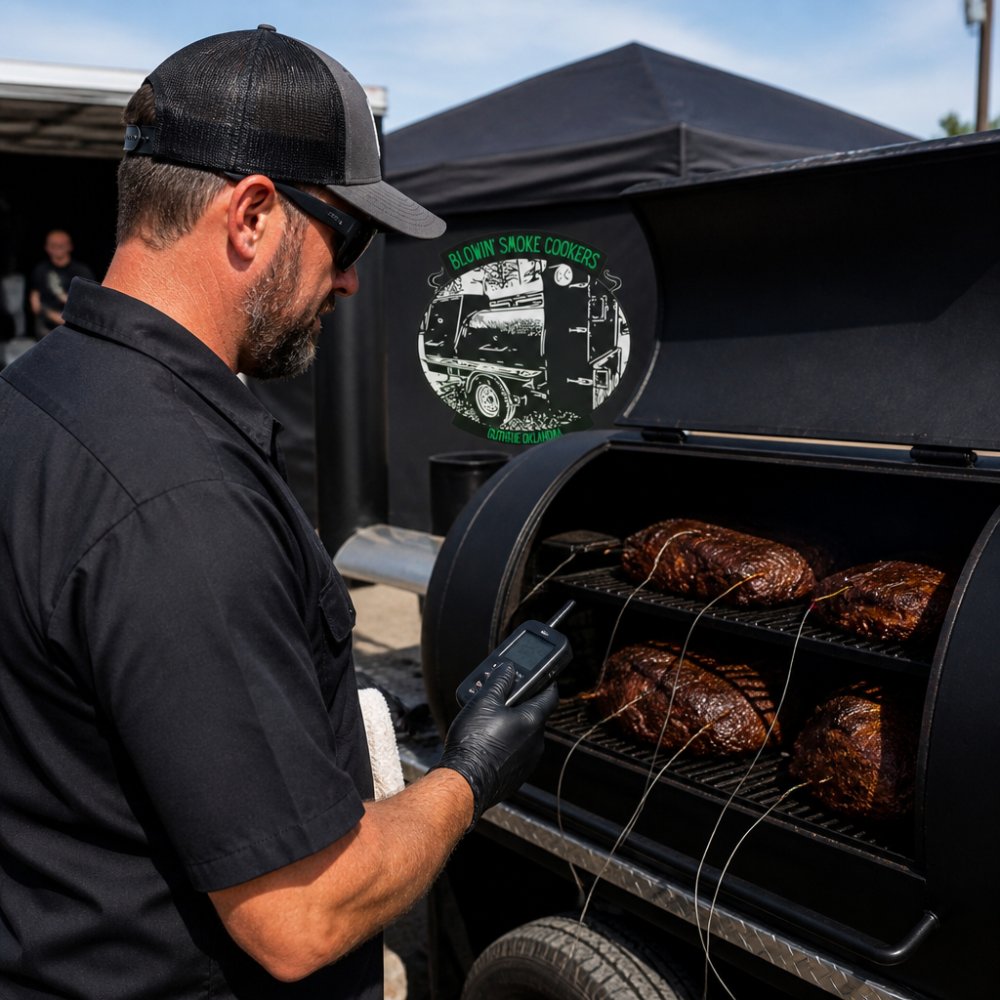
A wireless meat thermometer is the single most important competition BBQ accessory. It removes guesswork from doneness and monitors multiple pieces of meat without opening the smoker door.
Competition cooks rely on wireless systems to track internal meat temperature in real time while managing the fire.
What matters most: accuracy and range. A system drifting 3-5 degrees throws off timing. Look for ±1°F accuracy and at least 100 feet of wireless range.
Competition pitmasters often carry backup thermometers. If your primary unit fails mid-cook, a secondary wireless system keeps you in the game.
2. BBQ Pit Temperature Probes and Monitoring Systems
Pit temperature probes track the smoker's internal chamber temperature, separate from meat probes. This matters because stock gauges often drift 15-20 degrees or more.
Competition rules often require consistent pit temperature. If you're supposed to smoke at 225°F but the smoker runs 245°F, meat cooks faster than planned, you miss your wrapping window, and bark develops unevenly. Judges notice.
A quality pit probe gives the real temperature inside your cooking chamber.
Pit probes are food-grade stainless steel, sealed against moisture, and built for repeated temperature cycling.
For low-and-slow competition cooks, pit temperature stability is everything. Real-time probe feedback lets you adjust air vents and fire management to hold your target tightly.
3. Heat-Resistant Gloves and Long-Handled Tongs
Gloves and tongs are the two accessories you touch on every turn-in, so competition pitmasters treat them as a matched pair. A brisket sliding off a slick glove or a rib torn by pinching tongs is a scoring problem, not a convenience problem.
Heat-Resistant Gloves: Material Trade-Offs
Heat-resistant gloves behave differently once your hands are greasy, wet, or working inside a 275°F chamber.
| Material | Typical Heat Rating | Grip When Wet | Best For |
|---|---|---|---|
| Silicone-coated knit | 425-500°F | Excellent | Pulling wrapped briskets, handling sauced ribs |
| Aramid-lined (Kevlar-style) | 500-600°F | Moderate | Moving hot grates, firebox work |
| Leather | 400-500°F | Poor when saturated | Dry-heat handling, fire management |
| Aluminized fabric | 800°F+ | Poor | Firebox and ash only, not meat handling |
For turn-ins, most pitmasters keep two pairs: a heavy aramid or aluminized pair for firebox and grate work, and a lighter silicone-coated pair for placing meat in the box. The silicone pair grips a sauced rib without leaving fibers behind, and judges inspect appearance first.
Look for a cuff extending at least 4 inches past the wrist; forearm burns happen most when reaching across a hot grate. Reinforced palms and index fingers wear out first, check those seams before every contest.
Long-Handled Tongs: Length, Grip, and Locking
Tongs are where most competitors under-buy. A 12-inch pair works on a backyard kettle, but on a 60-inch offset or cabinet smoker with deep slide-out racks, you need 16- to 20-inch tongs to reach the back without leaning into radiant heat.
SNS Cabinet 60 Wagon Competition Smoker →
Three specs separate competition-grade tongs from casual versions:
- Length: 16 inches minimum for offsets and cabinets; 18-20 inches for deep wagon-style cookers.
- Spring tension: Moderate tension lets you hold a 15-pound packer brisket one-handed without hand fatigue over a 12-hour cook. Too stiff and your grip fails by hour eight.
- Locking mechanism: A reliable ring-pull or tab lock keeps tongs compact during transport and prevents them from springing open inside your knife bag.
Scalloped tips grip bark better than smooth edges, but aggressive teeth can tear a brisket slice. Many pitmasters use scalloped tongs for placement and a flat-edge pair for plating so the turn-in box stays clean.
Competition Workflow: When Each Tool Comes Out
- Prep: Nitrile gloves for trimming raw meat, then a fresh pair before seasoning.
- Cook: Aramid or aluminized gloves for grate moves and firebox adjustments; long tongs for rotating and spritzing.
- Wrap: Silicone-coated gloves for handling hot foil or butcher paper.
- Turn-in: Fresh silicone gloves plus clean tongs reserved only for boxing. Never use the same tongs that touched the firebox.
That last point is a common deduction: cross-contamination between fire-management and turn-in tools shows up as smudges or off-flavors, and judges notice.
4. Rib Racks and Cooking Racks for Capacity Optimization
Rib racks stack ribs vertically, multiplying capacity without adding smoker size. The standard 3-2-1 method (3 hours unwrapped, 2 wrapped, 1 sauced) requires consistent spacing and airflow around each rack.
Competition rib racks are built from heavy-gauge stainless steel or cast iron.
Rib racks let you cook more meat per session. If your smoker holds 30 ribs flat, a quality rack system might fit 60 or more, critical when cooking multiple competition entries.
Look for racks with:
- Non-stick or seasoned surfaces to prevent sticking
- Feet that elevate ribs off the grate for smoke circulation
- Handles or grips for safe handling during cooks
- Compatibility with your specific smoker model
Blowin' Smoke Cookers' competition smokers like the SNS Cabinet 60 Wagon Competition Smoker come with slide-out cooking racks measuring 57" × 28", designed for optimal airflow and capacity.
5. Grill Covers and Smoker Protection Equipment
Most guides treat covers as storage items. For competition cooks, a cover is transport armor. Your smoker rides on a trailer or truck bed between contests, and the damage that costs points usually happens on the road.
What Actually Breaks During Competition Season
Among traveling teams, failures show up in three places:
- Lid and door seals, road vibration and UV exposure dry out gaskets, and a leaking seal means temperature swings you can't tune out with vents.
- Wheels and casters, grit and moisture work into bearings, and a smoker that won't roll straight on uneven contest ground is a setup problem before it's a cooking problem.
- Cooking chamber interior, dust, leaves, and insects settle in through open vents during transport, and cleaning that out at 5 a.m. before a cook is time you don't have.
A fitted cover addresses all three. A loose tarp does not.
Fit by Smoker Type
Cover sizing is where most buyers get it wrong, because "fits most offsets" rarely fits yours.
| Smoker Type | Cover Considerations |
|---|---|
| Offset horizontal | Needs extra length for firebox, plus a chimney cutout or slack panel |
| Cabinet vertical | Tall profile with door handles that can snag; look for reinforced corners |
| Pellet grill | Must accommodate the hopper and controller box, not just the cook chamber |
| Kettle | Simple dome fit, but check for handle clearance |
| Wagon-style competition | Custom measurement required, wheels, tongue, and stack all change the footprint |
For wagon-style cookers, measure the full footprint including tongue and extended stack, then add a few inches of slack. A cover tight on the tongue tears at the seam within a season.
Material and Ventilation Trade-Offs
Heavy-duty vinyl and treated canvas are the two common options. Vinyl sheds water and wipes clean but traps heat and moisture without vents. Canvas breathes better but absorbs water and gets heavy.
Most traveling teams land on a vinyl or polyester cover with mesh ventilation panels near the top plus corner tie-down straps. Vents let trapped moisture escape after a cook; straps keep the cover from flapping at highway speed.
Between-Contest Maintenance
A cover only helps if the smoker goes in dry. Letting a hot smoker cool covered traps steam against the lid and accelerates rust at the seams. The routine: cool fully, wipe the exterior, leave the cover off an hour in dry weather, then cover and strap.
Check the cover monthly. UV degradation shows first as a chalky surface, then cracks at fold points. A cracked cover lets water in and holds it against the metal, worse than no cover at all.
Frequently Asked Questions
What accessories do competition BBQ teams use most often?
Competition teams prioritize wireless meat thermometers for real-time temperature monitoring, heat-resistant gloves for safe handling, long-handled tongs for precise meat placement, and rib racks to maximize cooking capacity. A quality BBQ pit temperature probe system is essential for maintaining the tight temperature control required to win judging. Most teams also pack backup thermometers, extra gloves, and a complete smoker tool set to handle any situation during an event.
How do I choose a wireless meat thermometer for smoking?
Look for thermometers with multiple probes so you can monitor different meat types simultaneously. Temperature accuracy within 1-2 degrees is critical for competition. Range matters too, you need reliable signal from your smoking area to the pit. Wireless models with app connectivity let you track temperatures from your phone, freeing you to focus on fire management. Battery life should support long cooks without replacement. Stainless steel probes resist corrosion from smoke and moisture.
What makes a BBQ pit temperature probe different from a meat thermometer?
Pit temperature probes measure the smoker's internal air temperature, while meat thermometers measure the internal temperature of the meat itself. Competition requires both: pit probes help you maintain consistent smoker temperature for even cooking, while meat thermometers tell you when meat reaches the exact doneness judges expect. Many serious competitors use dual-probe systems that monitor both simultaneously, allowing real-time adjustments to fire and airflow.
Which smoker accessories work with both offset and cabinet smokers?
Universal accessories include wireless thermometer probes, heat-resistant gloves, long-handled tongs, and grill covers designed for your specific smoker size. Rib racks and cooking racks are model-specific, so verify dimensions before purchase. Tool sets vary by smoker type; offset smokers benefit from ash pan tools and firebox rakes, while cabinet smokers work better with slide-out rack organizers. When selecting accessories, check compatibility with your smoker's grate size and internal configuration.