
Last Updated: October 23, 2026
Quick Summary
The essential features for high volume BBQ smokers are slide-out racks sized for your largest planned cook, reverse flow heat distribution, heavy 1/4-inch steel construction with an insulated firebox, and integrated grease management. Match commercial capacity to your biggest single event, not your average weekend, and check recovery time and trailer running gear before buying.
- Plan meat volume by counting racks first, then checking the depth and width of each one.
- The Avery Cabinet Smoker holds 150 Boston butts in a 60" x 72" chamber with six racks.
- Reverse flow flattens the temperature gradient so racks finish together instead of hours apart.
- Preheat a heavy cabinet 45 to 60 minutes before loading, then load fast in one pass.
- Inspect the axle, lights, and hitch on a trailer smoker before every season.
Table of Contents
- Cooking Capacity and Rack Configuration
- Commercial BBQ Smoker Capacity: Matching Cookers to Crowds
- Reverse Flow Smoker Benefits for Large Loads
- Maintaining Temperature in Large Smokers
- Construction Materials and Heat Retention
- Grease Management and Cleanout Systems
- BBQ Smoker Trailer Features That Hold Up on the Road
- Conclusion
- Frequently Asked Questions
Cooking Capacity and Rack Configuration
Cooking capacity is the first spec that separates serious high volume BBQ smokers from patio units, and it is usually measured in meat volume rather than square inches. At Blowin' Smoke Cookers, we tell buyers to start with the number of pork butts, briskets, or chickens they need to serve at their biggest event, then work backward to rack configuration.
Slide-Out Racks and Meat Volume Planning
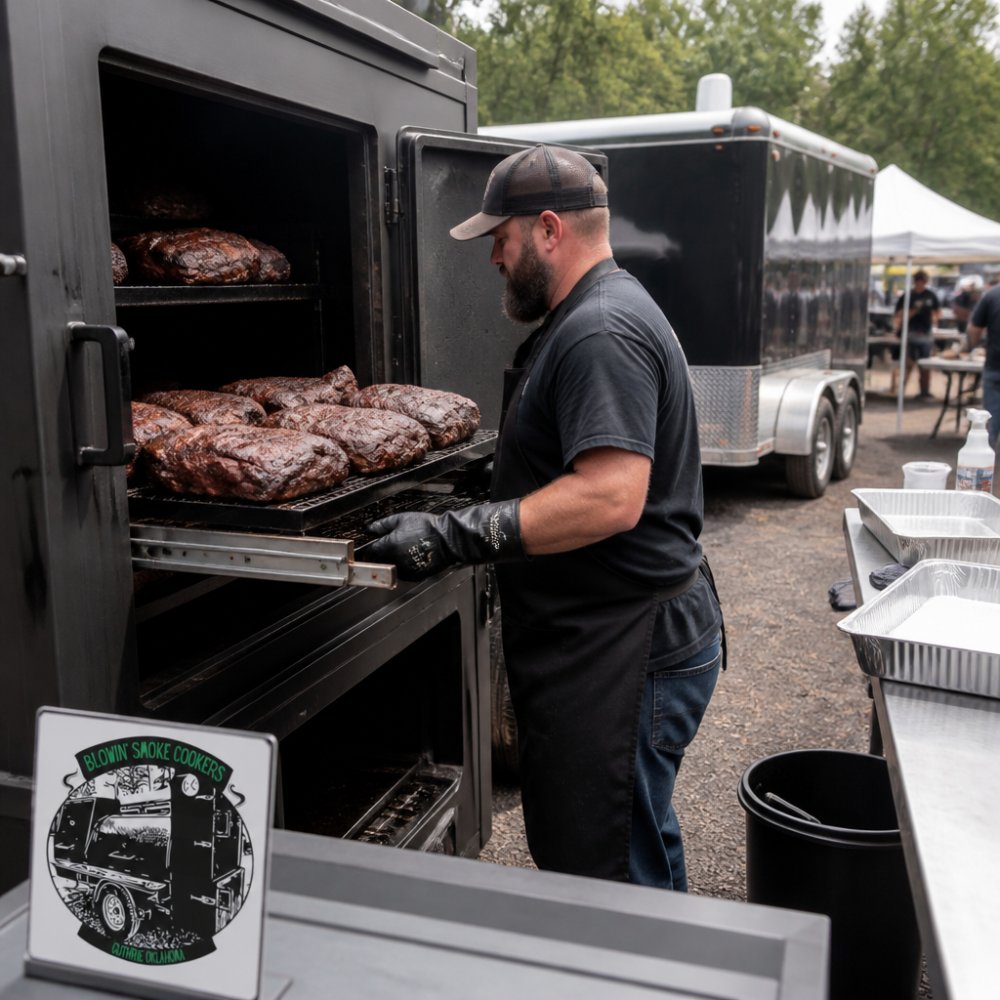
Slide-out racks change how a cook day feels. Instead of reaching over a hot door into a fixed chamber, you pull a loaded rack forward, load it, and slide it back.
Plan meat volume by counting racks first, then checking the depth and width of each one. A smoker with six deep racks holds far more than one with three shallow shelves, even if the cabinets look similar from the outside.
Commercial BBQ Smoker Capacity: Matching Cookers to Crowds
Commercial BBQ smoker capacity is the point where a cooker stops being a hobby purchase and starts being production equipment. The right match depends on your largest single event, not your average weekend.
Reading a Capacity Spec Sheet
Capacity specs are written in different units by different builders, so read them carefully. Some list Boston butts, some list whole chickens, some list spare ribs, and some list all four. Compare like with like before you commit.
Here is how the four main capacity figures line up across a few cabinet models we carry:
Model |
Boston Butts |
Whole Chickens |
Spare Ribs |
Briskets |
|---|---|---|---|---|
Avery Cabinet Smoker |
150 |
Not listed |
Not listed |
75 |
SNS Beast Cabinet Smoker |
90 |
90 |
40-50 |
40+ |
SNS 72 Cabinet Smoker |
60-75 |
60-75 |
40 |
30-40 |
SNS 60 Cabinet Trailer |
60 |
60 |
30 |
20-30 |
The Avery's 150-butt chamber is built for restaurants and large catering events, with a 60" x 72" main chamber and six cooking racks measuring 29" x 69". If your volume sits closer to 60 butts, the SNS 72 or the SNS 60 trailer covers it with room to spare.
Reverse Flow Smoker Benefits for Large Loads
Reverse flow smoker benefits show up most clearly when the load is heavy. In a reverse flow design, smoke travels across the chamber, down and back beneath a plate, then up through the cooking area.
For large loads, even heat means fewer hot spots and less rotating of racks mid-cook. It also tends to hold temperature stability better when you open the door to load or check meat, which is exactly when big cooks go wrong.
Why Reverse Flow Matters More at High Volume
On a small patio smoker, a 25-degree hot spot is an annoyance. On a 72-inch cabinet loaded with 60 pork butts, the same hot spot means the butts on one side finish hours before the butts on the other, and you either pull them early or hold them wrapped while the rest catch up.
The mechanism is the plate. Smoke and heat leave the firebox, run the full length of the chamber under a steel baffle, turn at the far end, and travel back across the cooking grates before exiting the stack.
What to Check on a Reverse Flow Build
Not every reverse flow cabinet is built the same, and the differences matter at volume:
- Baffle thickness and fit. A thin or poorly fitted plate lets heat short-circuit straight up into the chamber, which defeats the purpose. Look for a plate that spans the full chamber and seals against the walls.
- Stack placement. The exhaust should sit at the firebox end, opposite the turn, so the smoke has to complete the full loop. A stack mounted mid-chamber pulls smoke out before it finishes the path.
- Drip clearance. The plate doubles as a drip surface. On a high-volume cook, grease runs off the plate toward the drain, so the plate needs a slope and a clear path to the grease pan rather than pooling in the middle.
Reverse Flow vs. Direct Flow for Big Cooks
A direct flow cabinet moves smoke straight from firebox to stack across the meat. It is simpler, cheaper to build, and fine for small loads where the cook can rotate racks. For 50-plus pounds of meat in a single load, the rotation burden grows faster than most cooks expect, and reverse flow removes most of it.
Read more about the specific benefits of reverse flow smokers if you want the full breakdown before choosing a cabinet.
Maintaining Temperature in Large Smokers
Maintaining temperature in large smokers comes down to three things: thermal mass, airflow control, and how fast the pit recovers after the door opens. A big chamber holds more heat, but it also loses more every time you load it. Recovery time is the number most buyers never ask about, and it is the one that decides whether a cook day runs smoothly.
Recovery Time and Digital Controller Reliability
Recovery time is how long a smoker takes to climb back to target temperature after you open the door. On a large cabinet, a short recovery window keeps the cook on schedule.
Digital controllers help, but reliability varies. Pellet units like the SNS Pellet Vault run a USA-made PID algorithm with settings in 5 degree increments and a 160°F-350°F range, so the controller holds a steady setpoint instead of swinging.
For a deeper look at holding steady heat, see our guide on how to maintain steady smoker temperatures.
The Avery Cabinet Smoker 150 Pork Butt Capacity →
Construction Materials and Heat Retention
Construction materials decide heat retention more than any other feature. Thin steel sheds heat fast and warps under load. Heavy steel holds temperature and keeps its shape through years of use.
Most of the cabinets we carry use 1/4" steel for the main chamber, and several run double-walled, insulated fireboxes. Insulation thickness matters because an insulated firebox keeps the fire burning efficiently and pushes steady heat into the chamber rather than out through the walls.
Thermal Mass and Recovery Time
The number most buyers never ask about is recovery time: how long the chamber takes to climb back to target after the door opens.
A 1/4" steel chamber holds far more heat energy than a 14-gauge patio body, so when you open the door to load 60 butts, the walls give heat back to the air instead of the whole chamber crashing.
Insulation: Where It Goes and Why
Insulation is not evenly distributed, and where a builder puts it tells you what the smoker is designed for:
- Insulated firebox. Keeps the fire efficient and protects the chamber wall from direct flame. Standard on most production cabinets.
- Insulated chamber walls. Less common, adds weight and cost, but pays off on long holds and cold-weather cooks where the chamber has to fight ambient temperature.
- Insulated doors. Often overlooked. An uninsulated door is a large radiant surface, and on a big cabinet the door area is a meaningful share of total wall area.
Materials Trade-offs at Volume
Heavy steel is the right call for high volume, but it comes with real trade-offs. A 1/4" cabinet weighs substantially more than a thin-wall unit, which matters on a trailer where axle rating and tongue weight are already tight. Stainless components resist rust, but stainless grates and hardware expand differently than carbon steel under heat, which is why builders pair them carefully rather than mixing freely.
What to Inspect Before You Buy
Ask the builder two questions: how thick is the chamber steel and is the firebox double-walled and insulated. Then check the welds at the firebox-to-chamber joint, because that is where heat stress concentrates on a high-volume cabinet. A heavy build with a weak joint fails faster than a lighter build with good welds.
Why professional smokers hold heat better explains the build-quality side in more detail.
Grease Management and Cleanout Systems
Grease management is the feature buyers overlook until the first big cook, then never ignore again. A large volume of meat renders a large volume of fat, and where that fat goes decides how unpleasant cleanup is and whether a flare-up ruins the cook.
Integrated grease management systems route drippings into a dedicated pan or drain away from the fire. The SNS Pellet Vault, for example, uses a grease pan measuring 33" wide by 20" deep by 2" tall.
Look for these three things:
- A grease pan or drain sized for your largest cook
- A slide-out ash pan for the firebox
- Removable burn pots or cleanout access on pellet units
BBQ Smoker Trailer Features That Hold Up on the Road
BBQ smoker trailer features matter most to caterers, because a breakdown mid-event is a disaster no brisket can fix.
Start with the running gear. Rubber torsion axles, easy-to-lube bearings, and DOT-compliant LED lights with reflectors and a VIN plate are the baseline for road use.
The SNS 60 Smoker Cabinet Trailer shows what a road-ready build looks like in a real model, with a 1/4" diamond tread cabinet, three slide-out racks, and an insulated firebox.

Conclusion
Choosing among high volume BBQ smokers comes down to matching capacity, heat retention, and road-worthiness to the way you actually cook. Get one of those wrong and the other two cannot save the cook. At Blowin' Smoke Cookers, we carry heavy-duty reverse flow cabinets and trailers built for competition and catering work, including the 150-butt Avery Cabinet Smoker, the SNS Beast, and the Meadow Creek lineup.
Frequently Asked Questions
What features distinguish a commercial-grade BBQ smoker from a backyard model?
Commercial-grade cookers typically use 1/4-inch steel in the cook chamber and firebox, add double-walled or insulated fireboxes, and run slide-out racks instead of fixed grates. They also carry larger capacity ratings, integrated grease pans, and trailer-ready lighting and axles. A backyard model may cook well for a family, but it usually lacks the thermal mass and rack configuration that high volume bbq smokers need to hold temperature through a long cook.
Why is reverse flow technology important for high volume BBQ smokers?
In a reverse flow design, smoke travels under a plate to the far end of the chamber before rising back across the meat. That longer path evens out heat distribution across a wide cooking surface, which matters when you fill six racks at once. The trade-off is slower warm-up, but the payoff is temperature stability on long cooks and more consistent smoke penetration from end to end.
How do professional pitmasters maintain temperature consistency in large-scale smokers?
They start with thermal mass: heavy steel and an insulated firebox slow temperature swings. From there, a PID controller or a well-sealed intake damper handles the fine adjustments. Pitmasters also preheat the chamber, keep the firebox door closed, and watch recovery time after opening the door rather than chasing the number every few minutes. Probe ports let them check meat without dumping heat.
What capacity requirements should caterers look for in a high volume smoker?
Work backward from your largest event. A cooker rated at 60 Boston butts covers a mid-size catering job, while a 150-butt cabinet handles restaurants and large charity cooks. Check rack dimensions, not just a headline number, and confirm the smoker has enough warming box space to hold finished product. Spare ribs, briskets, and whole chickens each load differently, so plan meat volume by cut.
