
Table of Contents
- Food Trailer Cost at a Glance: New, Used, and Custom
- Food Trailer vs Food Truck Cost: Which Fits Your Budget?
- Custom BBQ Catering Trailer Build Cost: What Drives the Price
- Mobile Kitchen Startup Costs Beyond the Trailer
- Total Cost of Ownership: Depreciation, Maintenance, and Resale
- Financing Options and Regional Price Variance
- Conclusion
- Frequently Asked Questions
Last Updated: September 13, 2026
Food Trailer Cost at a Glance: New, Used, and Custom
How much does a food trailer usually cost? Between $10,000 and $40,000 before equipment, depending on whether you buy used, new, or custom-built. If you want to know how much does a food trailer usually cost, start with the shell, not the smoker. The trailer itself is only the first line item on a much longer invoice.
A used trailer with basic plumbing might run $8,000 to $15,000 (sba.gov). A new pre-fabricated unit with a service window and three-compartment sink typically lands between $15,000 and $25,000. Custom fabrication with a reverse flow smoker, ventilation hood system, and full kitchen layout pushes past $50,000.

BBQ Pit SNS Cabinet 60 Catering Trailer With Sink Package And Standard Grill
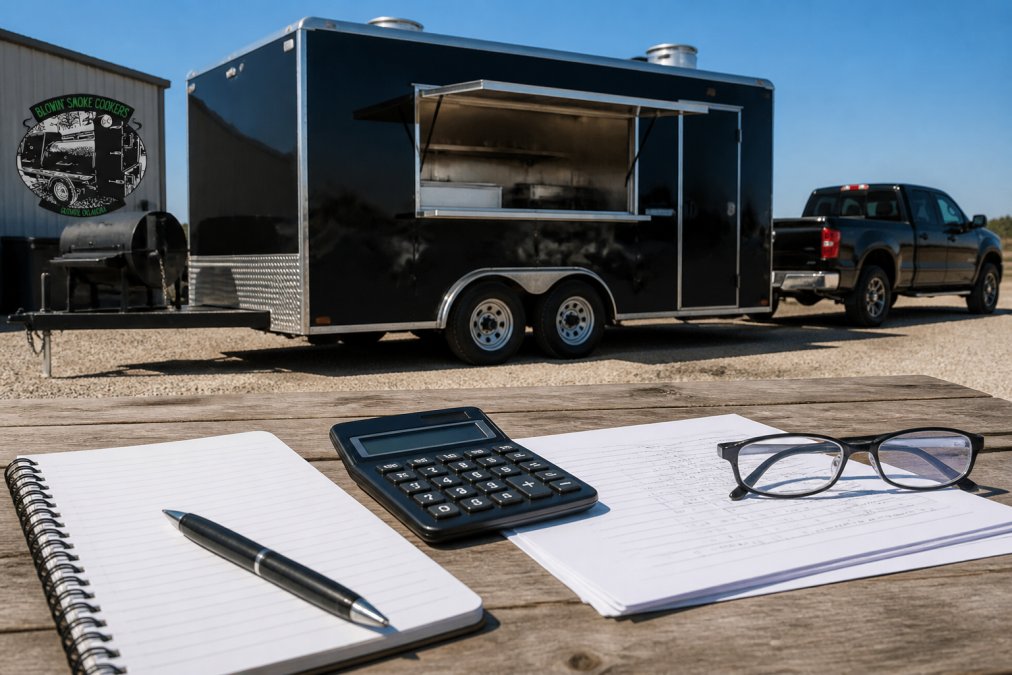
A shiny new black food trailer parked on a gravel lot with a large service window open, stainless steel counters visible inside, and a tow vehicle attached, under a clear blue sky
That gap between $8,000 and $50,000 is where most first-time buyers get surprised. The trailer is the cheap part.
New Trailer Pricing Tiers
New trailers come in three rough tiers. Entry-level units under $15,000 give you a shell, a service window, and basic wiring. Mid-range models from $15,000 to $25,000 add a fresh water tank, waste water tank, propane system, and commercial-grade equipment prep. Premium builds above $25,000 include custom fabrication, a full ventilation hood system, and made-to-order kitchen layouts.
Used Market: What You Save and What You Risk
Used trailers save you money upfront and cost you later. A used unit at $10,000 may need $5,000 in plumbing and electrical repairs before it passes health department compliance (the FDA). Inspect the frame, axles, and propane system before you buy. Rust under the flooring and corroded wiring are the two most expensive problems to fix.
Food Trailer vs Food Truck Cost: Which Fits Your Budget?
A food trailer costs less than a food truck at every stage. Trailers avoid engine maintenance, transmission repairs, and commercial vehicle insurance rates. Trucks cost more to buy and more to keep running.
Upfront Purchase Price
A food trailer vs food truck cost comparison usually favors the trailer by a wide margin. Trucks carry a drivetrain, so you pay for a vehicle and a kitchen. Trailers are towed by a vehicle you may already own.
Operating Expenses and Towing Requirements
Trailers add towing costs. You need a tow vehicle rated for the trailer's gross vehicle weight rating, plus fuel and maintenance on that vehicle. Trucks fold those costs into one machine. For most mobile food businesses, the trailer still wins on total overhead costs.
Factor |
Food Trailer |
Food Truck |
|---|---|---|
Upfront cost |
Lower |
Higher |
Engine maintenance |
None |
Ongoing |
Towing required |
Yes |
No |
Insurance |
Lower |
Higher |
Kitchen space |
More |
Less |
Custom BBQ Catering Trailer Build Cost: What Drives the Price
Custom BBQ catering trailer build cost depends on four things: smoker size, sink package, ventilation, and finish. A custom build lets you match the trailer to your menu instead of working around a generic layout.
Blowin' Smoke Cookers builds made-to-order units like the Custom Ultimate Smokehouse 72 Option #3 at $18,700, which includes a 72-inch main chamber, 36-inch griddle, and four-bay sink package. Step up to the Custom Ultimate Smokehouse 72 option #5 with sandwich prep at $32,999 and you add a warming box, XL charcoal grill, and expanded prep space.


For caterers who want a turnkey trailer without the full custom price, the BBQ Pit SNS Cabinet 60 Catering Trailer with sink package starts at $10,499.
Mobile Kitchen Startup Costs Beyond the Trailer
Mobile kitchen startup costs add up fast once the trailer is in your driveway. Permits, licensing fees, insurance, a commissary kitchen contract, and a point of sale system all land before your first sale. Budget for these separately from the trailer, because they do not scale down when you buy a cheaper shell.
A common pattern among first-time operators is to spend 100% of their capital on the trailer and then discover they need another $4,000 to $12,000 in cash before the health department will let them open the service window. The line items below are the ones that surprise people.
Permits, Licensing, and Health Department Compliance
Health department compliance varies by state and county, and this is the single biggest source of regional price variance in the entire startup budget. Most jurisdictions require some combination of:
- A food handler or food manager certification for each operator (often $15 to $100 per person, renewed every two to five years) (the CDC)
- A mobile food unit or food establishment license (commonly $100 to $1,000 annually, with some metros charging more)
- A plan review or construction review fee before the trailer is approved (frequently $200 to $800, and sometimes charged again if you remodel)
- A fire marshal inspection and, in many jurisdictions, a separate fire suppression system certificate
- A commissary or base-of-operation letter of agreement filed with your license application
Fees differ widely by jurisdiction, so confirm current amounts with your local health department rather than assuming a national average. The practical takeaway: a trailer built to one county's code may need plumbing, ventilation, or sink modifications to pass in another. If you plan to cross state lines for events, ask the health department in each state you will operate in whether they honor your home license or require a temporary event permit on top of it.
Commissary Kitchen, Insurance, and Hidden Fees
Many areas require a commissary kitchen for food prep, warewashing, and waste disposal. Monthly commissary access commonly runs $200 to $800 depending on the metro and how many hours you need. Some commissaries charge by the hour instead of by the month, which is cheaper in the off-season and brutal during a busy festival week.
Insurance is the next line item. General liability coverage for a mobile food operation typically starts in the low hundreds per month, and commercial auto or inland marine coverage for the trailer itself is separate. If you tow with a personal vehicle, confirm with your insurer that business use is covered, a personal auto policy often excludes commercial towing.
Other costs that never appear on the trailer invoice:
- Point of sale hardware and software (a card reader plus monthly software fees)
- Fire extinguisher servicing and hood cleaning on the schedule your jurisdiction requires
- Propane refills, which scale with your menu and event calendar
- Generator fuel or a shore power connection, plus a generator if you do not have one
- Business entity registration, a business bank account, and bookkeeping
- Initial inventory: food, packaging, gloves, sanitizer, and smallwares
First-Year Operating Reserve
Beyond one-time startup costs, plan a cash reserve for the first 90 days of operation. A common pattern is that new operators underestimate how much they will spend on propane, food waste, event fees, and repairs before revenue stabilizes. A reserve equal to two to three months of fixed costs, commissary, insurance, loan payment, and storage or parking, keeps a slow opening month from ending the business.
Build a one-page startup budget before you shop for a trailer. List the trailer, equipment, compliance, insurance, commissary, and a 90-day reserve as separate lines. When you see the total, you can decide whether to buy new, buy used, or convert a cargo trailer instead of guessing.
Total Cost of Ownership: Depreciation, Maintenance, and Resale
How much does a food trailer usually cost over time? Total cost of ownership is where trailer buyers win or lose, and it is the number most buying guides never calculate. Purchase price is a one-time event. TCO is what you actually spend to own and operate the trailer over three to five years, and it determines whether the asset pays you back or quietly drains your margin.
A Simple TCO Framework
Add these five buckets over your ownership period:
- Acquisition, purchase price, sales tax, delivery or pickup, and any immediate repairs
- Compliance and fixed overhead, licensing, insurance, commissary rent, storage or parking
- Consumables and utilities, propane, generator fuel, water, cleaning chemicals, packaging
- Maintenance and repairs, scheduled service plus a reserve for breakdowns
- Financing cost, interest and fees if you borrowed, or the opportunity cost if you paid cash
Buckets two through four, combined, can rival or exceed the trailer payment in a busy year. That is the part first-time buyers miss.
Depreciation and Resale Value
Depreciation on a well-built trailer is slower than on a truck, and resale value holds if the frame and equipment stay in good condition. A trailer that costs $20,000 today may resell for $12,000 to $15,000 in five years with consistent maintenance, roughly 25% to 40% depreciation, versus the steeper curve a used commercial truck typically follows.
What protects resale value:
- A known builder with a documented build sheet and serial number
- Stainless steel work surfaces and a commercial-grade hood rather than residential substitutes
- Service records for the propane system, fire suppression system, and axles
- A clean title and no outstanding liens
- Equipment that matches what the next buyer's menu needs, a reverse flow smoker or a griddle holds value better than a one-off custom layout
What kills resale value: rust under the flooring, corroded wiring, an expired fire suppression certificate, and any unpermitted plumbing or electrical work. Buyers and lenders both walk away from trailers with compliance problems.
Maintenance and Repair Reserve
Annual maintenance on the propane system, fire suppression system, and axles is part of the TCO equation. A reasonable planning assumption is to set aside 3% to 5% of the trailer's purchase price each year for maintenance and repairs. On a $20,000 trailer, that is $600 to $1,000 per year, enough to cover an axle service, a regulator replacement, or a hood cleaning, but not a full rewire.
Common failure points and rough timing:
- Tires and bearings, every season or two, especially if the trailer sits between events
- Propane regulator and hoses, inspect annually, replace on the schedule your jurisdiction requires
- Fire suppression system, inspection and certification on a fixed interval, plus a hydro test on the tank over a longer cycle
- Hood and duct cleaning, required on a schedule set by your fire code
- Water pump, heater, and plumbing, the most common mid-season failure on used trailers
The Regional Cost Variable
TCO is not the same number in every market. A trailer built in a high-cost metro area costs more than the same build elsewhere, and local licensing fees swing the total by thousands over a few years. Commissary rent is the most location-sensitive line: dense urban markets charge more per hour and often have waitlists, while rural markets are cheaper but may require longer tows to events, which raises fuel and wear costs. Before you commit to a build, price out commissary access, storage, and event fees in the market you actually plan to serve, not the market where the trailer is cheapest to buy.
Is a Trailer an Asset or a Liability?
A food trailer is an asset when it produces revenue faster than it depreciates and when its resale value stays within reach of its purchase price. It becomes a liability when the build is too custom to resell, when compliance costs were never budgeted, or when the operator financed the trailer without a 90-day operating reserve. The trailer itself is rarely the problem. The unbudgeted TCO around it usually is.
The trailer price is the headline. The real number is trailer plus equipment plus compliance plus first-year operating expenses plus a maintenance reserve. Budget the whole picture before you sign.
Financing Options and Regional Price Variance
Financing options for food trailers include equipment loans, SBA-backed loans, and seller financing. Regional price variance is real: a trailer built in a high-cost metro area costs more than the same build elsewhere, and local licensing fees swing the total by thousands.
The trailer price is the headline. The real number is trailer plus equipment plus compliance plus first-year operating expenses. Budget the whole picture before you sign.
Conclusion
The hardest part of buying a food trailer is not picking the trailer. It is estimating the full cost before you commit, because permits, equipment, and compliance can double your startup capital. Blowin' Smoke Cookers builds heavy-duty steel reverse flow smokers and catering trailers designed for professional pitmasters and caterers, with made-to-order options, American-made construction, and the durability to survive a full season of events. Get started with Blowin' Smoke Cookers and build a trailer that pays for itself.
Frequently Asked Questions
How much should a food trailer cost?
A new, fully-equipped food trailer typically costs between $10,000 and $35,000, depending on size, equipment, and customization. Entry-level models start around $10,499 for a basic catering trailer with a sink package and grill. Larger custom builds with commercial smokers, griddles, and full kitchen packages can reach $32,999 or more. Used trailers may sell for $5,000 to $20,000, but factor in potential repairs and equipment upgrades.
Is it cheaper to have a food truck or a food trailer?
Food trailers generally cost less upfront than food trucks because they skip the engine, transmission, and drivetrain. A comparable food truck often runs $40,000 to $80,000, while a food trailer with similar cooking capacity may cost $10,000 to $35,000. You still need a tow vehicle, which adds $20,000 or more if you do not already own one. Trailers also have lower insurance and maintenance costs since there is no engine to service.
What are the hidden costs of starting a food trailer business?
Beyond the trailer, budget for permits and licensing fees ($500 to $2,000 annually), health department compliance inspections, commissary kitchen rent ($200 to $800 per month), insurance ($1,000 to $3,000 per year), a point of sale system, initial inventory, propane, and a tow vehicle if needed. Fire suppression systems and waste water tank setup can add $1,500 to $4,000. These mobile kitchen startup costs often total 20% to 30% of the trailer price.
How much does it cost to outfit a trailer with professional BBQ equipment?
Outfitting a trailer with commercial-grade BBQ equipment depends on the smoker size and kitchen layout. A custom BBQ catering trailer build with a 60-inch reverse flow smoker, sink package, and roof starts around $18,500. A 72-inch cabinet with griddle, four-bay sink, and warming box runs $18,700 to $32,999. Custom fabrication, ventilation hood systems, and equipment installation add to the total, so request a quote for your specific menu and capacity needs.