
Table of Contents
- What Separates a Competition BBQ Smoker From a Backyard Cooker
- Reverse Flow Smoker Benefits: Why Pitmasters Prefer This Design
- How to Choose a Competition Smoker: Key Specs That Decide Wins
- BBQ Smoker Temperature Control Tips for Tight Competition Ranges
- Comparison Table: Competition Smoker Specs and Pricing
- Top Competition Smoker Models for the 2026 Circuit
- Transportability, Maintenance, and Safety for High-Volume Use
- Frequently Asked Questions
Last Updated: September 11, 2026
What Separates a Competition BBQ Smoker From a Backyard Cooker
A competition BBQ smoker is a heavy-gauge, reverse-flow cooking system built to hold steady temperatures for 12 or more hours across a full contest cook. The difference from a backyard cooker comes down to three things: thermal mass, airflow control, and capacity under load. The best competition bbq smoker features 2026 pitmasters rely on all solve that same problem: they hold heat, not hope.
Judges score on appearance, texture, and taste, and a brisket that stalled at 165°F because your firebox ran cold will lose every time. Below, we break down the specs that decide wins, then compare competition-grade models.
Reverse Flow Smoker Benefits: Why Pitmasters Prefer This Design
Reverse flow smoker benefits start with even heat distribution. Smoke travels under a baffle plate along the chamber, then reverses direction and passes over the food before exiting the stack. That longer path evens out hot spots and produces a cleaner, more consistent convection current across the grate.
The practical payoff is temperature stability. A USDA Food Safety and Inspection Service guidance on safe smoking temperatures notes that safe barbecue depends on holding consistent internal temperatures, and reverse flow makes that easier to achieve without constant fire management. You also get better heat retention because the baffle plate acts as thermal mass, absorbing heat and releasing it slowly.
- Even heat distribution from end to end
- Reduced hot spots near the firebox
- More consistent smoke ring development
- Less fuel wasted chasing temperature swings
Where it falls short: reverse-flow cookers take longer to come up to temperature and cost more to build. For a quick weeknight cook, that trade-off rarely makes sense.
How to Choose a Competition Smoker: Key Specs That Decide Wins
Choosing a competition smoker comes down to matching build quality and capacity to how you cook. Two specs separate a smoker that survives the circuit from one that quits mid-season.

Steel Gauge, Thermal Mass, and Build Quality
Heavy-gauge steel and thermal mass are the foundation of temperature stability. Competition-grade smokers typically use 1/4-inch rolled steel for the main chamber and firebox, which resists warping and holds heat through overnight cooks.
Steel thickness matters most at the firebox: a thin one radiates heat away and forces constant feeding. Double-walled, insulated fireboxes solve this.
Cooking Surface Area and Meat Capacity
Cooking surface area determines how many categories you can run at once. A full competition cook means four meats: chicken, ribs, pork, and brisket. Capacity figures tell you whether a smoker handles all four without juggling racks.
Capacity Metric |
Entry Competition Smoker |
Full-Size Competition Smoker |
|---|---|---|
Boston butts |
30 |
60-75 |
Whole chickens |
30 |
60-75 |
Spare ribs |
15-20 |
30-40 |
Briskets |
12-15 |
20-40 |
BBQ Smoker Temperature Control Tips for Tight Competition Ranges
BBQ smoker temperature control tips matter because competition cooks target a narrow band, typically 225°F to 275°F, and hold it for hours. The pitmaster's job is managing airflow, not babysitting the fire. Teams that consistently walk understand the physics of their pit, how oxygen feeds the coal bed, how draft pulls heat across the chamber, and how thermal mass buffers every adjustment.
Damper Regulation and Airflow Management
Airflow management is the single biggest lever you control. Intake dampers feed oxygen to the fire; exhaust dampers control draw. Small adjustments, made early, prevent large swings later.
- Set the intake damper first, then fine-tune with the exhaust
- Make adjustments in small increments and wait 10-15 minutes before reacting
- Use a digital thermometer with probe ports to track grate-level temperature, not lid temperature
- Keep the firebox door closed; every opening dumps heat and spikes oxygen
Experienced teams run the exhaust damper wide open and throttle the fire with the intake. Restricting exhaust traps stale smoke and creosote, which shows up as bitterness on the bark.
Firebox Management for Specific Competition Cuts
Advanced airflow modification starts with matching your fire to the cut. A brisket wants a long, slow coal bed producing thin blue smoke for 12 to 16 hours. Ribs want a slightly hotter, cleaner fire for a 5- to 6-hour cook. Chicken wants the hottest, cleanest fire so the skin renders instead of turning rubbery.
- Brisket: Build a large coal base early, then feed splits every 45-60 minutes. Target 250°F at grate level and resist opening the chamber. The stall is normal; wrap when bark sets.
- Pork butt: Similar to brisket but more forgiving. A slightly wider band (240-275°F) works because the collagen renders across a broader range.
- Ribs: Run 250-275°F with a cleaner fire. Too much smoldering fuel produces heavy smoke that overwhelms the rub.
- Chicken: Push 300-325°F for the last 30 minutes to crisp skin. This is the one category where a hotter fire is an advantage, not a risk.
Baffle Tuning and Probe Port Placement
Once you know your pit's tendencies, small modifications tighten control further. A baffle tune, adjusting the gap between the baffle plate and the firebox opening, changes how heat distributes across the chamber. Widening the gap pushes heat toward the stack end; narrowing it concentrates heat near the firebox. Most builders ship a factory setting favoring even distribution, but teams on a single grate often tune for a specific hot zone.
Probe ports matter more than most guides admit. Drilling ports at grate level on both ends lets you monitor the temperature gradient without opening the door. A 10-degree difference end to end is normal on a well-tuned reverse-flow pit; a 40-degree difference means your baffle or damper settings need work.
Insulation and Heat Retention Under Load
Insulation and heat retention separate a pit that holds temperature from one that fights you all night. A double-walled, insulated firebox slows radiant heat loss, meaning fewer fuel additions and smaller temperature swings when ambient temperature drops. On a 40°F contest night, an uninsulated firebox can demand fuel every 30 minutes; an insulated one stretches that to 60-90 minutes.
The chamber matters too. A 1/4-inch rolled steel chamber absorbs heat and releases it slowly, buffering spikes and dips from wind, rain, and opening the door to wrap. Thin-walled cookers have no buffer, every gust shows up on the thermometer.
Comparison Table: Competition Smoker Specs and Pricing
Competition smoker specs vary widely, so here's a direct comparison of models built for the 2026 circuit.
Model |
Price |
Chamber / Grates |
Best For |
|---|---|---|---|
SNS Cabinet 60 Wagon |
$5,499 |
60"x30" cabinet, 3 racks |
High-volume competition and catering |
SNS Competition Wagon |
$4,799 |
1/4" tank, 60"x30" |
Competition teams needing mobility |
SNS Wagon with Grill |
$5,699 |
Smoker plus 33"x24" charcoal grill |
Teams cooking multiple categories |
SNS 60 Cabinet with Rotating Rack Pit |
$8,399 |
60"x30" cabinet, fryer stand |
Full catering operations |
SNS 72 Cabinet Smoker |
$5,699 |
92"x30"x75" box, 3 racks |
Maximum meat capacity |
SNS 40 Vertical Cabinet |
$5,400 |
30"x40" chamber, 3 racks |
Compact patios and concession trailers |
Meadow Creek TS70P Offset |
$4,255 |
3/16" tank, 2 grates |
Backyard-to-competition crossover |
Meadow Creek TS120P |
$5,830 |
11+ sq ft cooking area |
Stationary patio cooking |
Meadow Creek TS120 Trailer |
$8,705 |
Single-axle trailer, warming box |
Mobile chefs and caterers |
Top Competition Smoker Models for the 2026 Circuit
The top competition smoker models for 2026 combine heavy-gauge steel, reverse-flow draft, and enough capacity to run four categories.

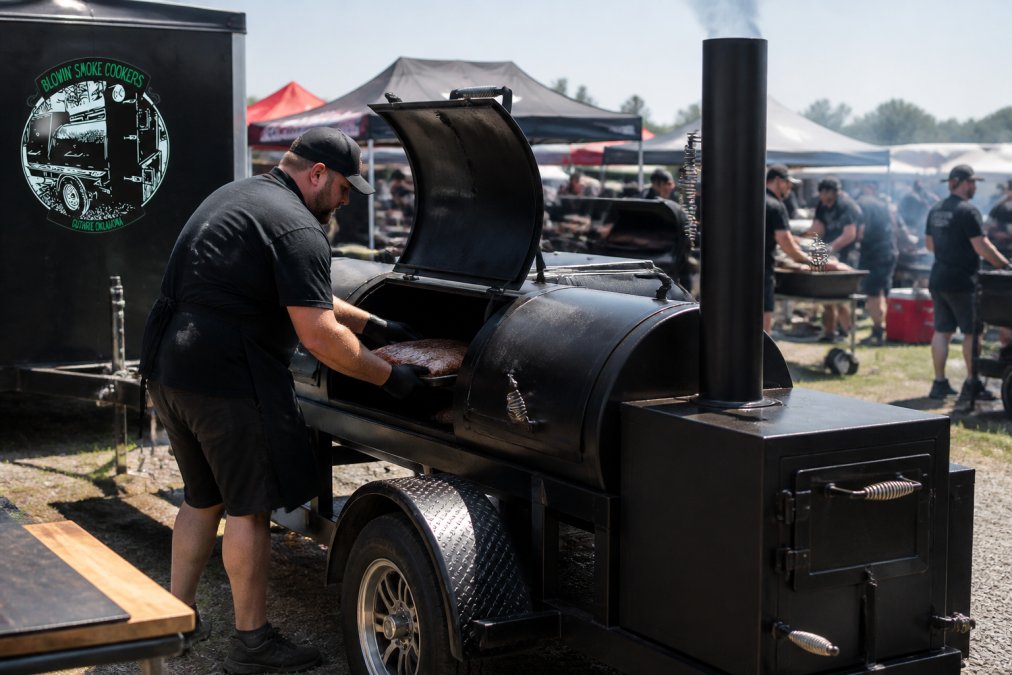
SNS Cabinet 60 Wagon Competition Smoker
The SNS Cabinet 60 Wagon Competition Smoker is available at $5,499. The main cabinet measures 60"x30" with three slide-out racks, and the insulated firebox (30"x20"x20") holds heat through an overnight brisket cook. Capacity tops out at 60 Boston butts, 30 spare ribs, or 20-30 briskets.
The one drawback: at this size, you need a trailer or a dedicated pit area. It's not a smoker you move solo.
Meadow Creek TS120 Barbeque Smoker Trailer
For mobile caterers, the Meadow Creek TS120 Barbeque Smoker Trailer at $8,705 comes with T304 stainless grates, a warming box, and a slide-out ash pan. The single-axle trailer with 13" highway wheels and LED lights is built for the road.
Where it falls short: it's a serious investment, and the 1,275-pound net weight demands a capable tow vehicle.
Transportability, Maintenance, and Safety for High-Volume Use
Transportability and long-term maintenance decide whether a smoker survives a full circuit season. The real test is what happens after 50 high-heat competition cycles, a dozen trailer loads, and a season of rain, ash, and grease.
Competition-Specific Transportability and Trailer Logistics
Competition-specific transportability means more than wheels: a chassis that doesn't flex when loaded, casters that lock on uneven grass, and a footprint that fits a standard 6x12 enclosed trailer alongside your tents, tables, and coolers.
- Locking casters: Look for 8-inch heavy-duty casters with total-lock brakes on stationary cabinet units. Cheap 4-inch casters sink into soft ground at contests and roll when you're trying to load meat.
- Trailer axles: Rubber torsion axles absorb road shock better than leaf springs and keep the cook chamber from bouncing on highway expansion joints. A single-axle trailer with 13-inch highway wheels is the practical minimum for a 1,200-pound-plus cooker.
- Loading logistics: Measure your trailer door opening before you buy. A 60-inch cabinet on a wagon frame often needs a ramp and two people; a trailer-mounted unit rolls on and off with one.
- Tie-down points: Weld-on D-rings beat strap-over-the-frame setups. Straps that rub against a hot firebox or sharp corner will fail on a long haul.
Many teams running two or more categories use a dedicated pit trailer with the smoker permanently mounted, a warming box, and a prep table on the tongue. That eliminates loading entirely and cuts contest setup time by 30-45 minutes.
Long-Term Maintenance After 50+ Competition Cycles
High-volume use exposes weak points a backyard cook never sees. After a full season of overnight cooks, here's what needs attention:
- Gaskets and door seals: Firebox and chamber door gaskets compress and harden after 20-30 high-heat cycles. Inspect them every 10 cooks and replace when you see smoke escaping around the door. A failed seal costs you temperature control and fuel.
- Damper hardware: Intake and exhaust dampers seize from creosote buildup. Lubricate the pivot points with a high-temp food-safe lubricant every 15-20 cooks.
- Grate condition: Stainless grates hold up well but still warp if you thermal-shock them. Let grates cool before spraying them down.
- Firebox interior: Look for pitting and scale on the firebox floor. A wire brush and a fresh coat of high-temp paint at the end of the season extends life significantly.
- Wheel bearings: Trailer-mounted units need bearing inspection and repacking at least once per season, more if you tow long distances.
Ash management is the daily habit that protects everything else. Empty the ash pan after every cook, wet ash is corrosive and eats through a firebox floor faster than heat. A slide-out ash pan makes this a two-minute job instead of a shovel-and-vacuum project.
Regulatory Compliance and Safety for Public Venues
Regulatory compliance and safety matter more at contests than in a backyard. Public venues and sanctioned events often require grease-rated fire extinguishers, minimum clearance from structures and combustibles, and trailer-mounted units meeting road-safety standards for lighting and towing.
A NFPA overview of outdoor cooking fire safety recommends keeping cookers clear of structures and combustibles, and trailer-mounted units should meet NHTSA trailer lighting and safety standards for road use. Beyond those basics, most sanctioned contests require a Class K or ABC extinguisher within reach of the pit, and some venues inspect propane or electrical connections if you run a warmer or lights.
Food safety is the other half of compliance. A USDA Food Safety and Inspection Service guidance on safe smoking temperatures is the reference most judges and organizers point to for internal temperature targets. Holding brisket, pork, and chicken at safe internal temperatures through turn-in is non-negotiable, a temperature log or a calibrated probe thermometer is standard equipment on a serious team's trailer.
Advanced Airflow Modification for the Long Haul
Once your pit has a season on it, modifications that seemed unnecessary when new start paying off. Extra probe ports let you monitor both ends of the chamber without opening the door. A baffle tune tightens the temperature gradient. A taller exhaust stack improves draft on still, humid mornings when smoke lingers.
None are required to cook. All are the difference between a pit that holds 250°F on autopilot and one that demands attention every 20 minutes for 14 hours. Teams that win consistently treat their smoker as a system to be tuned, not a box to be fed.
Frequently Asked Questions
What specific features define a competition-grade BBQ smoker?
Competition-grade smokers share several features that backyard cookers often lack. Look for 1/4-inch heavy-gauge steel construction for thermal mass and heat retention, an insulated firebox to stabilize temperature, reverse flow draft for even heat distribution, and slide-out cooking grates for quick access. Probe ports for digital thermometers, tight gasket seals, and a slide-out ash cleanout pan are also standard. These features help pitmasters maintain consistent temperatures across long cooks, which matters when barbecue judging criteria reward uniformity and smoke ring development.
Why is reverse flow technology preferred in competition BBQ?
Reverse flow smoker benefits come down to temperature consistency. In a reverse flow design, smoke travels under a baffle plate from the firebox to the far end of the chamber, then reverses back across the cooking grate. This longer path evens out hot spots that plague traditional offset smokers. The result is uniform heat distribution from end to end, which means every rack of ribs or brisket cooks at the same rate. Pitmasters using reverse flow smokers spend less time rotating meat and more time focused on timing and flavor.
Are pellet smokers or offset smokers better for competition BBQ?
Both can win, but they suit different cooking styles. Offset stick burners, like the Meadow Creek TS70P, produce a pronounced smoke ring and let you adjust airflow management in real time using dampers. Pellet smokers offer set-and-forget convenience with PID controllers, but some competition circuits restrict or discourage them. The majority of top circuit teams still cook on charcoal or wood-fired offsets and cabinet smokers because barbecue judging criteria reward authentic smoke flavor and bark development that stick burners deliver.
How do I maintain temperature stability during a long competition cook?
Start with a smoker that has an insulated firebox and heavy-gauge steel, since thermal mass smooths out temperature swings. Use a digital thermometer with multiple probes to monitor grate-level temps, not just the lid gauge. Keep dampers adjusted in small increments rather than wide open or closed. Pre-heat your fuel with a charcoal chimney to avoid temperature drops when adding splits. Finally, practice airflow modification by sealing gaps with high-temp gasket tape, which reduces uncontrolled air leaks that cause spikes.
What should I look for in a competition smoker's build quality?
Steel thickness is the first thing to check. Competition smokers typically use 1/4-inch plate steel for the firebox and at least 3/16-inch for the cook chamber, which provides rust resistance and heat retention over years of high-volume use. Look for food-grade stainless steel cooking grates that won't corrode, positive-lock latches that seal tight, and welded rather than bolted seams. A slide-out ash pan and a built-in water pan are practical additions that extend the smoker's working life and simplify cleanup between contest turns.