
Table of Contents
- Choosing a Catering Trailer for BBQ: Start With Your Cooking Capacity
- Food Trailer vs. Food Truck: Which Mobile Kitchen Fits Your Events?
- Mobile BBQ Kitchen Layout Best Practices for Workflow
- BBQ Trailer Health Department Requirements You Must Plan For
- Ventilation, Power, and Propane: Utility Systems on a Trailer
- Towing and Transport: Matching the Trailer to Your Vehicle
- Maintaining a Professional BBQ Smoker Trailer for the Long Haul
- Insurance, Resale Value, and Your Final Decision
- Frequently Asked Questions
Last Updated: September 7, 2026
Choosing a catering trailer for bbq locks in your workflow, menu, and event capacity for years. A catering trailer is a mobile kitchen, not just a smoker on wheels, and your choices determine whether you serve 50 guests or 500 with confidence. Below, we walk through the decisions that matter most, from cooking surface area to health code compliance.

Most first-time buyers start with the trailer and work backward. Your cooking capacity should dictate everything else, including trailer size, towing requirements, and budget.
Choosing a Catering Trailer for BBQ: Start With Your Cooking Capacity
Cooking capacity is the single most important specification when choosing a catering trailer for bbq, because it determines how many guests you can serve. Measure your needs in cooking surface area, not trailer length. A typical event serving 150 to 200 people requires roughly 1,000 to 1,200 square inches of primary cooking surface, plus space for sides, warming, and finishing (extension.iastate.edu).
Ask yourself what you plan to cook: brisket and pork butt for low-and-slow smoking, or a mix of grilled chicken, burgers, and vegetables? Competition teams often need separate zones for different meats to avoid flavor transfer, while event caterers need flexibility.
Food Trailer vs. Food Truck: Which Mobile Kitchen Fits Your Events?
A food trailer is towed to the event site and parked, while a food truck is a self-contained vehicle you drive. For BBQ, the trailer format usually wins because smokers are heavy, and you don't want that weight permanently mounted to a vehicle chassis.
Food trailers offer more flexible layouts since you're not working around a cab and engine. Food trucks make sense if you move between multiple service locations daily and need to reposition quickly.
Option |
Setup |
Best For |
Trade-off |
|---|---|---|---|
Food trailer |
Towed and parked on site |
Event catering, competition BBQ |
Needs a tow vehicle |
Food truck |
Self-contained, drive to site |
Daily street vending, multiple stops |
Payload capacity limits smoker size |
The real question is whether your business model is built around booked events or spontaneous street traffic. Event catering and competition BBQ favor the trailer's flexibility.
Mobile BBQ Kitchen Layout Best Practices for Workflow
A well-planned mobile BBQ kitchen layout separates the cooking zone, prep area, and service window so staff move in one direction without crossing paths. The classic mistake is placing the prep station between the smoker and the service window.
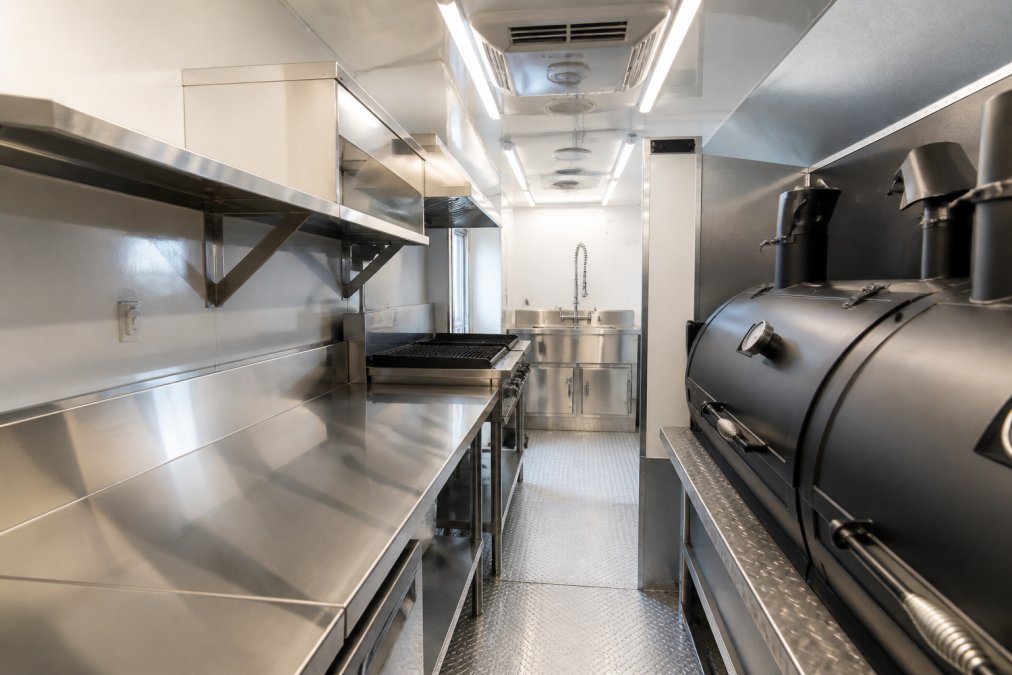
Design your workflow as a straight line: raw product enters at the prep station, moves to the smoker or grill, rests and holds near the cooking surface, then exits through the service window. Gull wing doors and side access panels create additional serving and prep surfaces while also improving ventilation.
Plan for a grease trap under the cooking area, fresh and waste water tanks sized to your event volume, and a propane system that feeds both the smokers and any fryer stands.
BBQ Trailer Health Department Requirements You Must Plan For
Health department requirements for a catering trailer vary by state and local jurisdiction, and they are non-negotiable for any commercial operation. Contact the health department where you'll operate most often and request their mobile food unit checklist.
Most jurisdictions require a three-compartment sink or approved dishwashing method, a hand-washing sink with hot water, and food-grade prep surfaces. Many also mandate a fire suppression system over cooking equipment, plus a properly sized ventilation system and grease trap.
The safest approach is to buy a trailer already configured for commercial use. Retrofitting a backyard smoker trailer to meet commercial codes is often more expensive than buying commercial grade from the start.
Ventilation, Power, and Propane: Utility Systems on a Trailer
Ventilation, power, and propane are the three utility systems that keep a mobile kitchen operational, and each needs to be sized for your actual cooking load. Most first-time buyers under-spec these systems because they shop by trailer length instead of by the BTU output of their planned cook.
Ventilation: Match the Hood to the Smoker's BTU Output, Not Its Width
A vent hood must capture the grease-laden vapors produced by your largest cooking surface at full output. The common mistake is buying a hood that matches the smoker's width but lacks the CFM rating to pull the smoke out. Commercial exhaust hoods are rated to move a minimum of 100 CFM per linear foot of hood opening, but a heavy stick-burner can demand more (osha.gov). If you cook with wood or charcoal, you need a hood rated for solid-fuel appliances with a spark-arresting filter. Look for a Type 1 hood, designed for grease-laden vapors, rather than a Type 2 hood meant only for heat and steam. The fire suppression system is wired into the hood's controls and should automatically shut off the gas supply when it discharges.
Power: Calculate Your Load, Then Add a Safety Margin
The most common electrical failure point is a trailer wired for 30 amps when the equipment demands 50. List every appliance that will run simultaneously during a busy service window, add up the amperage draw, then add a 20 percent safety margin. A trailer with 50-amp service can run on a 30-amp pedestal with a dogbone adapter only if you manage the load manually, but a trailer wired for 30 amps cannot safely step up to a 50-amp feed. If you run a generator as backup, size it to your peak load.
Propane: Size the Supply for the Longest Cook, Not the Shortest
Propane system components must be secured for transport. LP tank holders should be mounted to the trailer frame, not just strapped in place. NFPA 58 governs propane installation on vehicles, and most local health departments expect tanks mounted outside the cooking area, accessible regulators, and piping protected from road vibration (nfpa.org).
The Utility Audit You Should Run Before You Order
Before you sign off on a build, write down your longest expected cook time, largest expected guest count, and most power-hungry simultaneous appliance load. Ask the builder to confirm the vent hood CFM rating, electrical service amperage, and total propane tank capacity in BTUs. If the builder cannot give you those three numbers in writing, you are not comparing apples to apples.
Towing and Transport: Matching the Trailer to Your Vehicle
Towing capacity is the first number to check, and it's not just the rated maximum your vehicle can pull. You also need to account for the trailer's loaded weight, including the smoker, water tanks, propane, equipment, and product. A trailer that weighs 8,000 pounds loaded requires a vehicle rated well above that, with the correct hitch class and weight distribution setup.
Check the trailer's axle rating and payload capacity before you commit. Fresh and waste water tanks add significant weight when full, and that weight sits on the axles. A trailer that handles fine empty can become unstable when loaded.
Porch trailers, which have a lower deck for the cooking area, offer better weight distribution for heavy smokers. If you're new to towing a loaded catering trailer, practice maneuvering in an empty parking lot before your first paid event.
Maintaining a Professional BBQ Smoker Trailer for the Long Haul
A professional BBQ smoker trailer is a significant investment, and regular maintenance protects both its performance and its resale value. Most owners clean the grill, but few have a systematic schedule that prevents the two most common killers of a mobile BBQ unit: grease fires and frame corrosion.
The Grease Trap Is the Most Important Component You Never Think About
Grease buildup is the primary enemy. The grease trap is a fire-safety device that prevents hot grease from flowing into your waste water tank and solidifying into a blockage. Clean it after every event, not just when it looks full. Use a plastic scraper to remove the bulk, then wipe the interior with a degreaser and hot water. Do not pour boiling water into a trap still connected to the waste water tank, as the heat can warp gaskets. Inspect the gasket and lid seal monthly; a worn gasket allows grease to seep into the trailer floor, creating an odor that attracts pests.
The Weekly Deep-Clean Checklist for Active Service
When the trailer is in active service, set a weekly deep-clean schedule. Scrape the grates, then burn off residual grease at high temperature for 15 minutes before applying a food-safe grill cleaner. Pull the drip pans and baffles inside the smoker body; in a reverse-flow smoker, the baffle accumulates carbonized grease that insulates the metal and reduces heat transfer. Scrape it with a putty knife, then check the firebox for ash buildup, which accelerates rust when damp. Finally, wipe down stainless surfaces, including areas behind the prep table and under sinks.
The Monthly Ventilation and Fire Suppression Inspection
Check the vent hood and ductwork for grease accumulation monthly. Most commercial hoods use baffle filters that can be removed and run through a dishwasher; a clogged filter reduces airflow and shortens the motor's lifespan. If you see yellow-brown residue in the ductwork, that is condensed grease vapor and a fire risk. The fire suppression system needs professional inspection annually, but do a visual check monthly to confirm nozzle caps are in place and the pressure gauge is in the green.
The Chassis and Frame Inspection
Inspect tires, bearings, and brakes before each towing season, and check electrical connections, lights, and hitch components. Look for rust on the trailer frame and smoker body, especially in wet climates. Pay special attention where the smoker body meets the trailer frame; vibration can wear through paint, exposing bare metal. Touch up chips with high-temp paint before rust takes hold. Repack wheel bearings at least once a year. Check tires for dry rot and sidewall cracking; trailer tires age out in five to seven years regardless of mileage.
The Seasonal Shutdown Procedure
If you store the trailer for the off-season, run the smoker one last time to burn off residual grease, then clean interior surfaces and leave the cooking chamber door slightly ajar for airflow. Drain the fresh water tank completely and open faucets to release pressure. Add non-toxic RV antifreeze to the waste water tank and sink traps if stored in an unheated space. Cover the smoker body with a breathable cover, not a plastic tarp, which traps moisture and accelerates rust. Disconnect propane tanks and store them upright in a ventilated area. Finally, chock the wheels and lower the jack stands to take weight off the tires.
Insurance, Resale Value, and Your Final Decision
Insurance for a catering trailer is separate from your business liability policy and protects you when the trailer is on the road and parked at an event. Trailer coverage typically includes physical damage, theft, and liability while towing.
Resale value depends on build quality, brand reputation, and condition. A trailer with commercial grade construction and documented maintenance holds its value far better than a generic build.
When you're ready to make the final decision, revisit your original assumptions. Confirm the cooking capacity matches your busiest events, the layout supports your workflow, and the utility systems are sized correctly. A catering trailer that fits your cooking style is an asset that pays for itself.
For serious caterers and competition teams, Blowin' Smoke Cookers offers catering trailers built with heavy duty steel reverse flow design, available as an authorized distributor of Sling n Steel Custom Smokers and Meadow Creek BBQ Products. Explore our catering trailer lineup and find the mobile kitchen that matches the way you cook.
Frequently Asked Questions
What are the essential health department requirements for BBQ trailers?
Health department rules vary by state and county, but most require a three-compartment sink for washing dishes, a hand-washing sink with hot water, and a grease trap. You will also need proper food storage areas that maintain safe temperatures and a fire suppression system over any cooking surface. Contact your local health department before you buy, because retrofitting a trailer to meet code costs more than planning for it from the start.
How do I determine the right smoker capacity for my catering volume?
Count the main dishes you plan to serve, not just the number of guests. A good rule is roughly half a pound of cooked meat per person. For a 50-person event, you need about 25 pounds of cooked meat, which means you need smoker space for roughly 35 to 40 pounds of raw product. That fits comfortably in a trailer with 60 inches of cooking surface, while larger events demand a 72-inch or dual-unit setup.
What are the advantages of reverse flow technology in catering trailers?
Reverse flow smokers route heat and smoke from the firebox under the cooking chamber before it rises and exits through the stack. This creates even temperatures across the entire cooking surface, with far fewer hot spots near the firebox. For catering, this consistency matters because you cook large batches at once. You get predictable results rack after rack, which helps you hold a steady temperature during long event cooks.
What maintenance is required for professional-grade BBQ catering trailers?
Plan a cleaning schedule around each event, not just when the trailer looks dirty. Grease buildup is a fire hazard and attracts pests. Wipe down the interior after every cook, empty and clean the grease trap regularly, and check the fire suppression system monthly. Inspect the trailer frame, axle, and tires before each towing season. Look for rust on the steel body and touch up any scratches immediately to prevent structural damage.
What are common problems with used food trailers?
Used trailers often hide problems in three areas: the frame and axle, the electrical system, and hidden grease buildup. Check the frame for rust or cracks, especially near the hitch and axle mounts. Test every outlet and light, since moisture damages wiring. Look behind the cooking equipment for old grease that was never cleaned. A trailer that looks good on the outside can still need expensive repairs before it passes a health inspection.
How do I choose between a custom-built trailer and a pre-fabricated model?
A custom build lets you design the layout around your specific menu and cooking style, which improves your workflow at events. Pre-fabricated models cost less and are ready sooner, but you may need to adapt your cooking process to the existing layout. If you plan to cater for years, the custom route often pays off through faster service and better use of limited trailer space. For a first trailer, a standard model with a sink package is a solid starting point.