
Table of Contents
- Smoker Trailer Design Basics: Start With the Cook, Not the Paint
- Reverse Flow Smoker Mechanics and Firebox Configuration
- Steel Thickness, Trailer Frames, and Axle Capacity
- BBQ Catering Trailer Layout Best Practices
- Essential Equipment for Professional BBQ Trailers
- How Much Does a Food Trailer Usually Cost?
- Designs to Avoid: Compliance, Insulation, and Maintenance Mistakes
- Conclusion
- Frequently Asked Questions
Last Updated: September 18, 2026
Smoker Trailer Design Basics: Start With the Cook, Not the Paint
Custom BBQ trailer design starts with the cook, not the color scheme. Before you pick a paint finish or awning, decide what you're cooking, how much, and where the trailer will sit on event day.
Three questions settle most design decisions:
- How many people are you feeding per event?
- Do you need a charcoal grill, or a smoker only?
- Will you cook on site, or hold food in a warming box?
Reverse Flow Smoker Mechanics and Firebox Configuration
Reverse flow works because a baffle plate runs the length of the chamber, forcing heat under the food and back across the top for steadier temperature control and less rack turning.
Steel Thickness, Trailer Frames, and Axle Capacity
Many catering-grade smokers use 1/4-inch steel for the cooking chamber, which resists warping and holds temperature.
Component |
What to Check |
Why It Matters |
|---|---|---|
Cooking chamber |
1/4-inch steel |
Holds heat, resists warping |
Firebox |
Insulated, double wall |
Less fuel, steadier temps |
Axle |
Rated above loaded weight |
Prevents mid-event failure |
Frame |
Full-penetration welds |
Survives years of towing |
Hitch |
Matched to loaded tongue weight |
Safe highway handling |
BBQ Catering Trailer Layout Best Practices
Good bbq catering trailer layout puts the cooking platform, prep area, and sink in a work triangle: cook, plate, wash. If those zones are far apart, your crew walks miles over a single event.

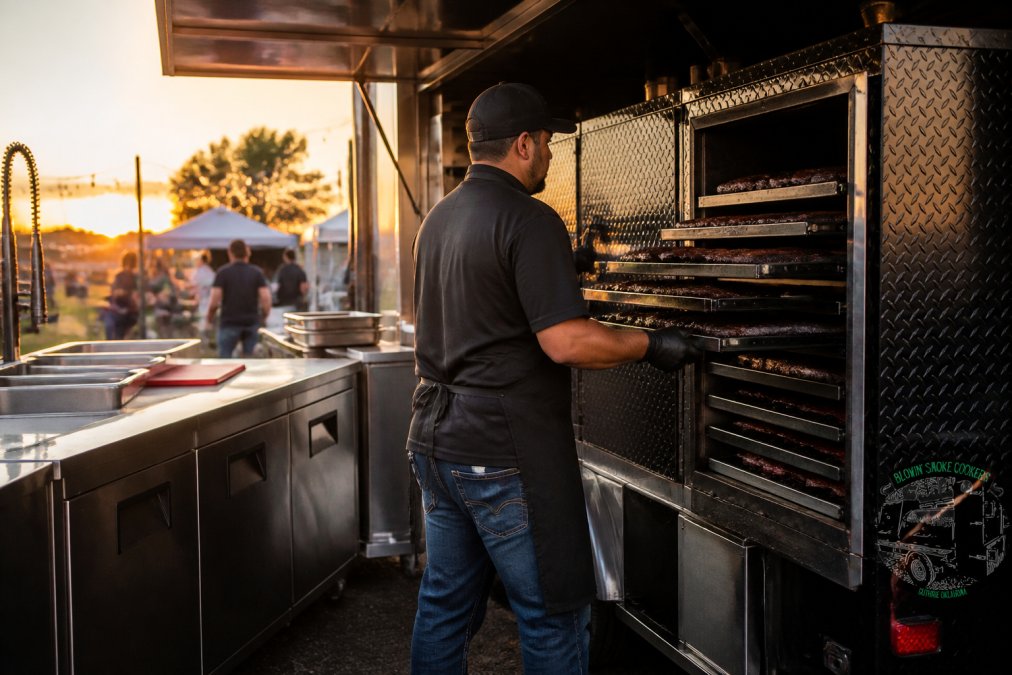
BBQ Pit SNS Cabinet 60 Catering Trailer →
Start With Working Dimensions, Not a Floor Plan
Most layout mistakes trace back to guessing at counter heights and aisle widths. A few dimensions do most of the work:
- Cooking platform height: 32 to 36 inches from the deck to the top of the rack rail. That range keeps a loaded brisket or pork butt at a lift height your crew can repeat for hours without back strain.
- Aisle width: 30 to 36 inches of clear walking space between the pit and the prep counter. Anything narrower and two people can't pass with a full pan.
- Prep counter depth: 24 to 30 inches. Deep enough for a cutting board and a full-size hotel pan, shallow enough that you're not reaching across a gulf to plate.
- Slide-out rack travel: measure the rack's full extension and add clearance. A rack that slides into the aisle blocks the work triangle every time it's open.
The Three Layout Configurations That Actually Work
Linear (galley) layout. Pit on one end, prep in the middle, sink and hand wash on the far end. Best for trailers 16 feet and under and easiest to keep balanced over the axles; the trade-off is your crew walks the length of the trailer on every ticket.
Where the Sink Package Goes
Health departments generally expect the hand wash station separate from the three-bay sink and reachable without crossing the cook line. A common pattern places the three-bay sink downstream of prep, wash, rinse, sanitize, with the hand wash station at the entry to the cooking zone.
Grease, Ventilation, and Weight
Grease management needs its own plan: a tray or drain that doesn't drip onto the deck, positioned so a full tray can be swapped without lifting it over food. Ventilation should pull smoke and heat away from the service window, not across it. Utility storage belongs low and forward to keep weight off the rear, and an awning over the prep zone keeps rain out of the food.
Essential Equipment for Professional BBQ Trailers
The equipment list for a professional trailer goes beyond the pit. Essential equipment for professional bbq trailers includes the cooking chamber, firebox, warming box, sink package, water tank, and LP storage.
- Warming box for holding finished product
- Wood storage basket sized to a full cook
- LP tank holders and a fryer stand
- Ventilation design that clears smoke away from guests
- Modular configuration so you can add a fryer or griddle later
How Much Does a Food Trailer Usually Cost?
Cost depends on size, steel, and equipment. A food trailer usually costs more as capacity, insulation, and sink packages grow, so price tracks the build sheet.
Trailer |
Price |
Best For |
|---|---|---|
SNS Backyard Trailer 60 |
$5,199.00 |
Weekend cooks going mobile |
SNS Tailgater 60 |
$5,399.00 |
Entry-level catering |
SNS Mega Grill |
$5,299.00 |
High-volume grilling |
SNS Barrel 60 Catering Trailer |
$9,399.00 |
Reverse flow catering |
SNS Deluxe 72 Catering Trailer |
$12,399.00 |
Full-service catering |
SNS Hospitality BBQ Trailer |
$18,499.00 |
Corporate and events |
Custom Beast Cabinet Smoker |
$18,600.00 |
High-capacity catering |
Ultimate Smokehouse 72 |
$26,800.00 |
Large-scale operations |
Designs to Avoid: Compliance, Insulation, and Maintenance Mistakes
The mistakes that hurt most aren't cosmetic. They're compliance, insulation, and maintenance failures that surface after the deposit clears, and almost no design guide covers them.
Compliance: The Part Nobody Puts in the Gallery
Two regulators decide whether your trailer can actually work an event.
- A three-bay sink with hot and cold running water, plus a separate hand wash station
- A potable water tank and a wastewater tank sized to your service volume
- Smooth, cleanable surfaces in food-contact and prep zones
- A grease interceptor or approved grease disposal plan
- Proper refrigeration holding temperatures if you're storing product on board
Insulation and Fuel Efficiency
Insulation is the quiet design decision that pays back every cook. An uninsulated firebox radiates heat, burns more fuel, and swings temperature when wind picks up or ambient temperature drops.
- Less fuel per cook. The firebox holds heat instead of shedding it, so you load wood less often across a long brisket or pork cook.
- Steadier temperatures. Insulation damps the swings that come from wind, rain, and cold-weather events, which means less time chasing the damper.
- Better cold-weather performance. A trailer that runs fine in July can struggle in a January event without insulation.
Maintenance and Longevity
Steel trailers live outdoors, tow thousands of miles, and sit in grease and smoke. A maintenance schedule separates a trailer that lasts a decade from one rusting through in three years.
Seasonal maintenance schedule:
- After every event: Pull and clean the grease tray, wipe down prep and food-contact surfaces, and drain and rinse the wastewater tank.
- Monthly during service season: Inspect the firebox and cooking chamber for rust blooms, touch up any bare steel with high-heat paint, and check door gaskets and seals.
- Before and after towing season: Repack or grease axle bearings, check tire pressure and tread, test all lighting and brake function, and inspect the hitch, coupler, and safety chains.
- Annually: Inspect welds on the frame and chamber for cracks, check the firebox for burn-through, and re-season the cooking chamber interior.
The failures that end events:
- Skipping grease trap cleaning until it clogs mid-event
- Letting bare steel rust instead of touching up the paint finish
- Ignoring axle bearings until a wheel seizes on the road
- Overloading wood storage and shifting weight off the tongue
Conclusion
Getting a custom BBQ trailer right comes down to one habit: spec the cook, the steel, and the compliance first, then style it. Builders who skip that order end up rebuilding.
Frequently Asked Questions
What are the essential components of a professional BBQ catering trailer?
At minimum you need a cooking chamber built from 1/4-inch steel, an insulated firebox, slide-out cooking racks, a charcoal grill, and a three-bay sink package with a hand wash station and hot water. Storage matters just as much: wood baskets, LP tank holders, and prep surfaces keep service moving. The SNS Cabinet 60 Catering Trailer, for example, pairs a 60-inch smoker cabinet with a 3-bay sink package, instant hot water, and a 5-gallon tank and pump, so the cooking and cleaning zones are covered in one unit.
How does reverse flow technology improve BBQ trailer performance?
In a reverse flow smoker, a baffle plate runs under the cooking grates and forces heat and smoke to travel the full length of the chamber before venting at the firebox end. That longer path evens out temperature swings across the grill surface and reduces hot spots near the firebox. For competition and catering cooks who need consistent results across dozens of butts or briskets, that stability matters more than anything else in the design. The SNS Barrel 60 Catering Trailer is built as a reverse flow smoker for exactly this reason.
What are the health department requirements for BBQ food trailers?
Most health departments require a three-bay sink plus a separate hand wash station, hot water, and a holding tank for wastewater. Food contact surfaces typically need to be stainless steel or another approved material, and you should plan for grease management and proper ventilation. Requirements vary by state and county, so confirm with your local health department before finalizing a design. Building the sink package into the trailer from the start is far cheaper than retrofitting one later.
How do you choose the right trailer size for a catering business?
Work backward from your biggest job, not your average one. A 60-inch cabinet smoker like the SNS Cabinet 60 handles around 60 Boston butts, 60 whole chickens, 30 spare ribs, and 20 to 30 briskets, which suits most mid-size catering operations. If you regularly feed crowds of several hundred, a 72-inch or 84-inch chamber makes more sense. Also check towing capacity and axle rating before you commit, since a fully loaded trailer weighs far more than the dry spec sheet suggests.