
Table of Contents
- What You'll Need Before You Buy a Reverse Flow Smoker
- How a Reverse Flow Smoker Works and Why It Matters for Catering
- Catering Smoker Capacity Requirements: Matching Cook Volume to Event Size
- Heavy-Duty Steel Smoker Construction: What to Inspect Before You Commit
- Maintaining Temperature in Large BBQ Smokers During a Full Cook
- Trailer-Mounted vs. Stationary Rigs: Logistics for Mobile Catering
- Total Cost of Ownership and Regulatory Checklist for Catering Smokers
- Frequently Asked Questions
Last Updated: September 19, 2026
What You'll Need Before You Buy a Reverse Flow Smoker
Choosing a reverse flow smoker for catering starts with one question: can this rig hold steady heat through a 12-hour cook while you're also running a service line? At Blowin' Smoke Cookers, we've helped caterers and competition teams match equipment to real event loads.

Box Smoker SNS 72 Smoker Cabinet →
Before you shop, line up five things:
- Your biggest event size in servings, not "average" guests
- Your transport setup (truck, trailer hitch class, storage)
- Your fuel plan (wood, charcoal, or both, and where you buy it)
- Your local health department rules for mobile food units
- Your budget for the whole rig, not just the cook chamber
How a Reverse Flow Smoker Works and Why It Matters for Catering
A reverse flow smoker is an offset cooker that routes heat and smoke under a baffle plate along the bottom of the cooking chamber, then back across the food before it exits the stack. That longer path smooths out hot spots and gives you even heat across the full cooking surface, exactly what you need when 40 briskets have to come off the pit at the same time.
What that buys you in a catering setting:
- Fewer temperature swings between the firebox end and the stack end
- More thermal mass in the steel, so the pit recovers faster when you open the door
- A more consistent smoke profile across every rack
- Less babysitting during long cooks
Catering Smoker Capacity Requirements: Matching Cook Volume to Event Size
Catering smoker capacity requirements come down to one number: how much food you can load, cook, and pull in a single service window. Most caterers underestimate this because they count rack space instead of finished servings. Figure 1/2 pound of cooked meat per guest, then add 15 to 20 percent for seconds and waste, a 200-guest event needs roughly 100 to 120 pounds of finished product.
Reading Capacity Specs in Real Food Volume
Manufacturer capacity lists are usually written in butts, briskets, and chickens, not servings. Translate them before you buy:
Protein |
Typical Count on a Full-Size Pit |
Approx. Servings |
|---|---|---|
Boston butts |
30 |
150-180 |
Whole chickens |
30 |
90-120 |
Spare ribs |
15+ racks |
60-90 |
Briskets |
15 |
150-180 |
Heavy-Duty Steel Smoker Construction: What to Inspect Before You Commit
Heavy-duty steel smoker construction is where cheap pits and commercial-grade pits split apart. The spec that matters most is steel thickness. A 1/4-inch rolled steel cook chamber holds heat, resists warping, and survives years of high-heat cooks. Thinner steel flexes, leaks, and loses temperature every time the door opens.
Walk the pit and check these points:
- Cook chamber thickness: 1/4 inch is the standard for catering work
- Firebox insulation: double-walled and insulated holds heat far better than a single wall
- Door fit and seals: run your hand along the seam; a gap means heat loss
- Welds: look for full-penetration welds, not tack welds
- Rack slides: heavy racks on thin slides will sag under a full load
- Grease management: a proper drain and pan setup keeps you clean and legal
Maintaining Temperature in Large BBQ Smokers During a Full Cook
Maintaining temperature in large BBQ smokers is a fire management job, not a thermostat job. Once you're past a certain chamber size, no controller saves you from a badly built fire. Start with a clean bed of coals and build up, adding splits sized to your firebox, a fire that's too hot forces you to choke the intake, creating dirty smoke and bitter bark.
Fire Management and Fuel Planning for Long Events
Fuel planning is where new caterers get burned. Estimate your burn rate on a test cook before your first paid event: track wood or charcoal used per hour at target temp, then multiply by cook time plus two hours of buffer.
A workable fuel plan looks like this:
- Test cook at target temp for 8 hours, log fuel used per hour
- Multiply by your longest event cook time
- Add 25 percent buffer for weather and door openings
- Buy from a supplier who can deliver on short notice
- Keep a backup fuel source on the trailer
Trailer-Mounted vs. Stationary Rigs: Logistics for Mobile Catering
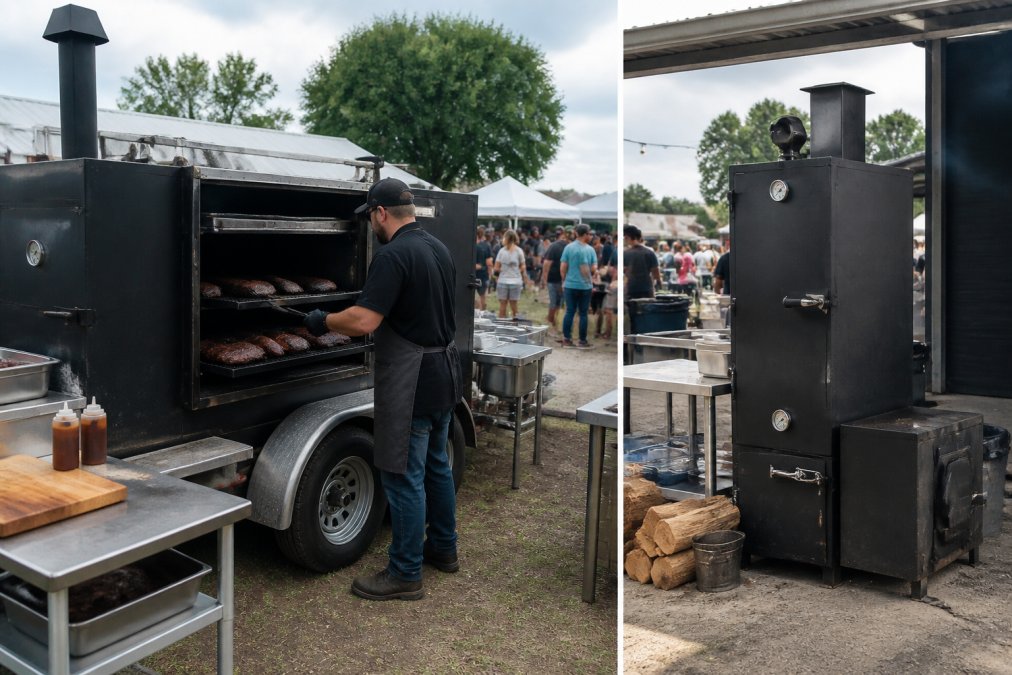
Match the Trailer to Your Tow Vehicle Before You Match the Pit to Your Menu
If the loaded trailer's GVWR exceeds your truck's tow rating, you are outside spec before you load a single brisket.
Hitch class and coupler:
- Class III hitches (commonly rated around 5,000 lb gross trailer weight and 500 lb tongue weight) cover smaller single-axle pits
- Class IV and Class V hitches step up for tandem-axle catering trailers with warming boxes and sink packages
- Confirm the coupler ball size matches your hitch ball, a 2-inch coupler on a 2-5/16-inch ball (or the reverse) is a failure waiting to happen
- Use a weight-distributing hitch when tongue weight approaches the upper end of your truck's rating
Axles, Brakes, and Tires Are Not Optional on a Working Rig
A tandem-axle setup is standard on commercial catering trailers: it spreads load, tracks straighter, and gives you a spare if a tire fails. Confirm the combined axle rating exceeds the loaded trailer weight with margin, and check your state's trailer brake statute, most states require brakes past a certain weight threshold, and many require them on both axles above a higher one.
Tire inspection belongs on every pre-trip checklist:
- Check cold tire pressure against the sidewall max, not the door-jamb pressure of your truck
- Look for sidewall cracking, uneven wear, and date codes older than about six years
- Carry a matched spare and the tools to change it on the shoulder
- Re-torque lug nuts after the first 50 miles of any long haul
Load Securement and Weight Distribution
A reverse flow smoker trailer carries two kinds of load: fixed equipment and loose gear. Secure loose gear, wood splits, propane tanks, folding tables, cambros, so it cannot shift in a hard stop, and distribute weight so tongue weight lands at 10 to 15 percent of total trailer weight. Too little and the trailer sways; too much and you overload the rear axle and lose steering authority.
DOT and Highway Rules That Apply to Catering Trailers
If your combined rig crosses the federal weight thresholds, you may fall under Federal Motor Carrier Safety Administration (FMCSA) rules for commercial motor vehicles, including driver qualification and hours-of-service requirements. Many catering trailers stay under those thresholds, but the only way to know is to weigh the rig and check the current FMCSA thresholds. The FMCSA regulations publishes the current definitions and thresholds.
Even below the federal threshold, state rules apply:
- Trailer registration and plate
- Brake and lighting requirements
- Mirror and width requirements if the trailer is wider than your truck
- Weight station rules on certain highways
Setup and Breakdown at the Venue
- Confirm the venue allows a trailer on site and where it can sit
- Check for overhead clearance, soft ground, and slope
- Know your leveling method, tongue jack, stabilizer jacks, or wheel chocks
- Confirm power access if you run any powered accessories
- Confirm water access or carry your own onboard supply
Stationary pits still make sense for a fixed location with a small catering arm, but if mobile work is your core business, the trailer determines what jobs you can accept.
Total Cost of Ownership and Regulatory Checklist for Catering Smokers
Total cost of ownership for a catering smoker is the number most buyers never calculate, and it decides whether the rig makes money. The sticker price is the smallest line item over a five-year horizon; fuel, maintenance, insurance, permits, and downtime are where the real money goes.
The TCO Framework
Run this math before you sign a build sheet:
- Purchase price including any custom options (warming box, sink package, slide-out racks)
- Annual fuel cost at your real event volume, not a best-case estimate
- Maintenance and replacement parts, gaskets, thermometers, wheels, burners, paint
- Insurance for a mobile food unit and the tow vehicle
- Permits and health department fees, annual, not one-time
- Downtime cost if the pit fails mid-season and you have to rent or decline work
Fuel is usually the largest recurring line: a pit that burns more wood per hour because the firebox is uninsulated or the doors leak will cost more over a season than a heavier pit that costs more up front. Track your burn rate on a test cook, pounds of splits or charcoal per hour at target temp, and multiply by your event hours.
Health Department and Mobile Food Unit Requirements
Most states regulate mobile food units, including catering trailers with a smoker, through the state or local county health department. Requirements vary, but the pattern is consistent:
- Mobile food unit permit, an annual permit to operate the unit, separate from any food handler certification
- Commissary arrangement, most states require you to operate from an approved commissary or base of operations for warewashing, potable water, and waste disposal
- Potable water supply, a minimum onboard water capacity, often with a dedicated handwash sink and a three-compartment sink for warewashing
- Wastewater holding tank, a tank sized to your water supply, with no gray water discharged on the ground
- Handwash station, hot and cold water, soap, and paper towels, accessible to anyone working the pit
- Food handler or food manager certification, required for the person in charge, and often for anyone handling food
- Temperature logs, many jurisdictions require documented holding temperatures for hot and cold product
Equipment Safety and Fire Clearance
The NFPA outdoor cooking guidance covers clearance and fire safety for commercial cooking setups. Build those clearances into your trailer layout from the start, a smoker that has to sit too close to a tent, a propane tank, or a generator is a fire risk and a failed inspection. Confirm clearance distances to combustibles, and keep a fire extinguisher rated for the fuel type on the trailer.
What to Look for in a Purpose-Built Catering Rig
- Onboard sink package with hot water
- Insulated firebox for fuel efficiency
- Heavy 1/4-inch steel cook chamber
- Slide-out racks you can load and pull fast
- Warming box for holding product during service
- Replaceable, off-the-shelf wear parts
Blowin' Smoke Cookers builds rigs with these features because caterers asked for them. As an authorized distributor of Sling n Steel Custom Smokers and Meadow Creek BBQ Products, we stock equipment made for competition and catering work, not weekend hobby use.
Frequently Asked Questions
What size reverse flow smoker do I need for professional catering events?
Match capacity to your largest expected headcount. A 60-inch chamber rig like the SNS Barrel 60 handles roughly 30 Boston butts, 30 whole chickens, 15 briskets, and 15 racks of spare ribs, which suits events up to about 200 guests. For bigger jobs, step up to a 72-inch cabinet that holds 60 to 75 butts. Always size for your busiest booking, not your average one.
How does steel thickness impact heat retention in catering smokers?
Quarter-inch rolled steel is the benchmark for catering rigs because the metal itself acts as thermal mass. It absorbs heat from the firebox and releases it slowly, so chamber temperatures recover faster after you open the door and hold steadier through wind, rain, and long cooks. Thinner steel swings wildly with every weather change, which forces constant fire management and risks uneven results on large batches.
How do I maintain consistent temperatures in a reverse flow smoker during a long cook?
The baffle plate does most of the work by routing smoke under the cooking surface and back across it, which evens out hot spots. From there, it comes down to fire management: feed small, dry wood splits at steady intervals, keep the firebox door and exhaust wide open for clean airflow, and watch the stack for thin blue smoke. A digital probe at grate level confirms what the door thermometer cannot.
What should I check on a smoker trailer before using it for paid catering jobs?
Inspect the axle rating, tires, lights, and hitch before every season, and confirm the rig can be secured for transport. For food service, verify your local health department requirements for handwashing, three-compartment sinks, and hot water, since many jurisdictions require them for on-site prep. A trailer with an integrated sink package saves you from hauling separate wash stations to every event.