
Table of Contents
- Professional Grade BBQ Smoker Price Ranges for 2026
- SNS 40 Vertical Smoker Cabinet: Compact Power for Patios and Concession Trailers
- SNS 72 Smoker Cabinet: The Reverse Flow Workhorse
- SNS Beast Cabinet Smoker: Built to Feed an Army
- Best Commercial BBQ Smokers for Catering Operations
- Total Cost of Ownership: What Your Investment Really Covers
- Commercial Smoker Maintenance Tips to Protect Your Investment
- Choosing the Right Professional Grade Smoker for Your Operation
- Frequently Asked Questions
Last Updated: September 4, 2026
Professional Grade BBQ Smoker Price Ranges for 2026
Finding a professional grade bbq smoker for sale requires understanding what separates backyard gear from true commercial equipment: steel thickness, insulation, and airflow engineering that hold temperature within a tight range for 14-hour cooks. At Blowin' Smoke Cookers, we distribute American-made smokers built to this standard.
A professional grade bbq smoker is a heavy-duty cooking unit built with thick steel, insulated fireboxes, and precision airflow design for sustained commercial or competition use. The 2026 market spans roughly $3,800 to over $15,000 depending on chamber size, trailer integration, and added features.
SNS 40 Vertical Smoker Cabinet: Compact Power for Patios and Concession Trailers
The SNS 40 is the entry point into serious equipment at $5,400, solving a problem most guides ignore: getting commercial capacity into a small footprint. Its 30 by 40 inch main chamber holds up to 40 pork butts across three racks, yet the unit weighs around 1,000 pounds and fits on a patio or inside a concession trailer.

What makes this unit different from cheaper vertical cabinets is the 1/4-inch steel construction and insulation. Thin metal radiates heat, causing swings of 25 degrees or more; the SNS 40 holds steady because the firebox retains heat.
SNS 72 Smoker Cabinet: The Reverse Flow Workhorse
The SNS 72, priced at $5,699, is the model we recommend most often to serious caterers needing 60 to 75 Boston butts per cook without a trailer-mounted unit. Its 92-inch-long cabinet uses 1/4-inch diamond tread steel and an insulated firebox; the reverse flow design routes heat and smoke under the cooking surface before it rises, creating even heat across all three racks.
The 72 also includes floor-securing brackets for stability, preventing tipping on uneven ground when loaded with 75 pork butts.
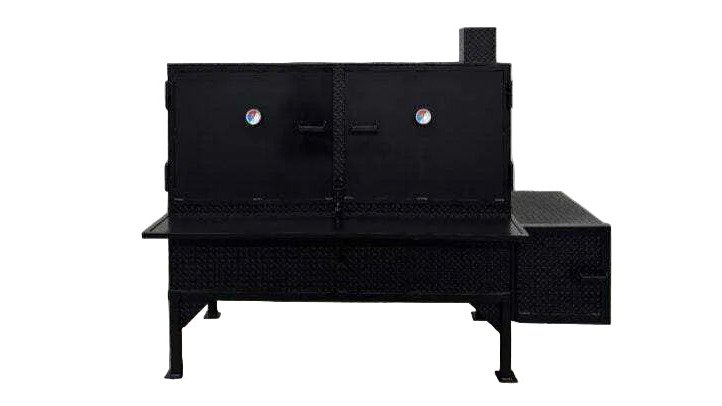
SNS Beast Cabinet Smoker: Built to Feed an Army
The SNS Beast Cabinet Smoker, at $9,299, is the answer when 60 butts is not enough. Its 84 by 36 inch main chamber holds 90 Boston butts, 90 whole chickens, 40 to 50 spare ribs, and more than 40 briskets across six slide-out racks.

For catering operations, the Beast is effectively a mobile smokehouse. The full-length storage version adds a 24 by 36 inch dry storage area with a hinged lid, and an optional mounted spare tire prepares you for trailer flats.
Best Commercial BBQ Smokers for Catering Operations
For full catering trailers, the best commercial BBQ smokers combine smoking capacity with additional cooking stations, since a profitable event menu rarely stops at brisket. The SNS Smoke House, at $8,199, pairs a 30 by 60 inch main chamber with a direct heat grill and a five-tray warming box.
At the top of the range, the SNS Ultimate Smokehouse at $12,799 includes a 36-inch griddle. The Avery Cabinet Smoker, starting at $11,400 for the 150 pork butt capacity version, is built for restaurants and large catering teams.
Model |
Price |
Main Chamber |
Capacity |
Best For |
|---|---|---|---|---|
SNS 40 Vertical |
$5,400 |
30" x 40" |
40 pork butts |
Patios, concession trailers |
SNS 72 Cabinet |
$5,699 |
92" long |
60-75 pork butts |
Weekend catering |
SNS Beast Cabinet |
$9,299 |
84" x 36" |
90 pork butts |
Large events, multi-day cooks |
SNS Smoke House |
$8,199 |
30" x 60" |
60 pork butts |
Smoke + grill combos |
SNS Ultimate Smokehouse |
$12,799 |
60" main chamber |
60 pork butts |
Full mobile kitchen |
The Avery |
$11,400+ |
60" x 72" |
150 pork butts |
Restaurants, large caterers |
The decision comes down to workflow: a restaurant cooking the same menu daily needs capacity and consistency, while a caterer needs versatility, griddle for breakfast, fryer for sides, smoker for the main course.
Total Cost of Ownership: What Your Investment Really Covers
The purchase price is the first payment, not the last. Total cost of ownership includes fuel, maintenance, and labor managing the fire. A well-insulated reverse flow smoker burns less fuel and demands less attention because temperature swings are smaller.
There is also the question of longevity. A smoker built with 1/4-inch steel and a 1,200-degree paint finish will outlast a thinner unit by years, especially if you cook year-round in wet climates. According to guidance from the National Fire Protection Association on outdoor cooking equipment, proper clearance and regular inspection of cooking equipment are essential for safe operation, and this matters more with a large commercial unit that runs for extended periods.
Financing and nationwide delivery options change the math: spreading the cost of a $9,299 Beast over several seasons makes the monthly payment an operating expense rather than a capital outlay.
Commercial Smoker Maintenance Tips to Protect Your Investment
The most common maintenance mistakes are neglecting the firebox and ignoring rust. After each cook, remove ash, which retains moisture and accelerates corrosion. Season the cooking chamber regularly, and inspect door gaskets and hinges for wear.
For trailer-mounted units, the maintenance extends to the chassis. Check axle bearings, tires, and electrical systems before each event season. A breakdown mid-event is not just an inconvenience; it can cost you the contract. The USDA Food Safety and Inspection Service resources on food transport emphasize keeping food at safe temperatures during transport, which requires reliable trailer systems and properly functioning warming boxes.
Regulatory and Safety Compliance: The Maintenance Checklist Most Buyers Skip
In a professional kitchen or catering operation, your maintenance log is a legal document. Health department inspectors will ask to see records of equipment cleaning and temperature calibration. A smoker that cannot hold 225°F consistently is a food safety violation under FDA Food Code guidelines.
The 100-Hour Service Schedule
Professional pitmasters follow a service rhythm tied to hours of operation, not calendar dates. A practical schedule:
- Every 100 hours of cook time: Deep-clean the firebox, removing all ash and creosote buildup. Inspect the chimney and damper for obstruction. Re-grease all slide-out rack tracks.
- Every 500 hours: Replace door gaskets if they show compression marks or fail the dollar-bill test (close the door on a dollar bill; if it pulls out with no resistance, the seal is failing). Inspect and tighten all fasteners on the firebox door and cooking chamber.
- Every 1,000 hours or annually: For trailer units, repack wheel bearings, inspect brake magnets if equipped, and have the propane or gas lines pressure-tested by a licensed technician. For wood-fired units, inspect the firebox interior for warping or cracking in the steel.
Documentation as a Competitive Advantage
Beyond passing inspection, a documented maintenance log is a selling point when bidding on corporate contracts or venue partnerships, which increasingly require proof of equipment maintenance. A simple binder or digital log with dates, tasks, and parts replaced positions you as a professional operation.
The National Fire Protection Association guidelines on commercial cooking equipment maintenance recommend regular inspection of cooking equipment to prevent grease fires, a leading cause of restaurant fires. For a wood-fired smoker running 14-hour cooks, that means checking for creosote accumulation in the chimney stack monthly and cleaning the stack before it restricts airflow. A restricted chimney not only creates a fire hazard but also ruins the airflow dynamics that make reverse flow smokers hold temperature evenly.
A professional grade smoker is a capital asset that should last 15 to 20 years with proper care. Operators who get that lifespan treat maintenance as a scheduled operational cost. Budget 1 to 2 percent of the purchase price annually for replacement parts like gaskets and thermometers.
Choosing the Right Professional Grade Smoker for Your Operation
Start with your busiest cook, not your average. If your largest event requires 80 butts and you buy a 60-butt smoker, you will turn down business or run two shifts, doubling labor cost. Buy for the peak.
Then match the smoker to your fuel preference. A wood-fired smoker delivers the smoke profile competition judges expect. If you prefer set-and-forget convenience, the SNS Pellet Vault at $3,799 combines a 35-pound hopper with a PID digital controller.

The final consideration is support. Buying from an authorized distributor gives you a partner who understands the equipment and can answer questions about operation, maintenance, and trailer setup, a relationship worth as much as the steel in the smoker.
Workflow Integration: Matching the Smoker to Your Kitchen's Rhythm
Most buyer's guides stop at capacity, but each smoker configuration changes your labor model, prep schedule, and space utilization. Here is how the three main configurations behave in a working operation:
Vertical cabinet smokers (like the SNS 40, 72, and Beast) load from the front at waist height, letting one person manage the entire cook without climbing. The trade-off is a smaller footprint per rack, limiting you to rack-sized cuts.
Offset smokers load from the side and require more floor space. They excel at whole-animal cooking but demand more attention due to a temperature gradient; a pitmaster checks the fire every 45 to 60 minutes.
Rotisserie-style pits (like the SNS Competition 60) solve high-volume chicken production. A rotating rack flips 40 pounds of chicken in a single stroke, saving roughly 45 minutes of labor per cook for a caterer doing 300 halves.
Prep-to-Pit Timing: Sizing for Your Actual Service Window
Successful catering operations plan the cook backward from service time. If your event serves at 6 PM and brisket runs a 12-hour cook, you light the fire at 6 AM. For a restaurant opening at 11 AM, you need a smoker that holds finished meat overnight.
For restaurants, the smoker must fit into a workflow of prep, service, and cleaning shifts. A vertical cabinet occupying a 4 by 4 foot floor space is easier to fit than a 12-foot trailer unit.
Space Optimization: The Hidden Cost of Smoker Size
Before you commit to a model, measure your actual workspace with the smoker in place. A trailer-mounted unit needs a parking spot with clearance for the tongue, the propane tanks, and the door swing of the cooking chamber. A stationary cabinet needs 18 inches of clearance on all sides for airflow and maintenance access, plus a non-combustible surface underneath. The National Fire Protection Association clearance requirements for solid-fuel cooking equipment specify minimum distances from combustible walls and ceilings, and local fire marshals enforce these during inspections.
Mark the smoker's footprint with tape and simulate loading a full rack. If you cannot walk around comfortably, you will struggle during service. Most operators need at least 3 feet in front of the loading door and 2 feet on the firebox side.
The right professional grade smoker fits your operation's rhythm, not just your budget. A wood-fired cabinet demands a pitmaster's attention; a pellet unit trades smoke intensity for labor savings. Map your busiest day, count your labor hours, and measure your floor space before comparing price tags.
Frequently Asked Questions
What features define a professional grade BBQ smoker?
A professional grade BBQ smoker is defined by its construction and temperature consistency. Look for 1/4-inch thick steel, which retains heat and resists warping. An insulated firebox keeps the burn stable, while reverse flow technology ensures even heat distribution across the cooking chamber. These features allow a pitmaster to hold a tight temperature range for hours, which is essential for competition results. Cheaper units with thin metal will fluctuate, producing inconsistent flavor and requiring constant attention.
How much should I budget for a commercial-grade smoker?
For 2026, commercial-grade smokers from Blowin' Smoke Cookers start around $3,799 for the SNS Pellet Vault and range up to $15,749 for the Commercial Smoker The Avery. The SNS 40 cabinet is priced at $5,400, while the larger SNS 72 runs $5,699. Your budget should match your output needs. A backyard enthusiast can get by with a smaller cabinet, but a catering business needs the capacity of a Beast or an Avery to make events profitable.
What is the difference between offset and vertical professional smokers?
Offset smokers have a firebox attached to the side of the cooking chamber, creating a horizontal airflow path. Vertical cabinet smokers place the firebox below the cooking racks, which allows heat and smoke to rise evenly through the unit. For catering, vertical cabinets are often preferred because they offer more cooking surface area per square foot of floor space. Many Blowin' Smoke Cookers models, like the SNS 72, combine vertical design with reverse flow baffle systems for superior heat consistency.
What maintenance is required for high-capacity BBQ smokers?
High-capacity smokers need regular upkeep to prevent rust and maintain performance. After each cook, remove ash from the firebox and wipe down the interior surfaces. Season the steel with a light coat of cooking oil to protect against moisture. Check door seals and hinges twice a year for wear. If you use a trailer-mounted unit like the Avery, inspect the axle, tires, and electrical system before each event. Proper care extends the life of your equipment for decades.