
Table of Contents
- Why Precision Smokers Change the Brisket Game
- The Science of Collagen Breakdown and Moisture Retention
- Brisket Internal Temperature Guide for Perfect Results
- Using Butcher Paper vs Foil for Brisket
- Mastering Brisket Resting Techniques
- Common Mistakes That Dry Out Brisket
- Conclusion: Consistent Moisture with the Right Equipment
- Frequently Asked Questions
Last Updated: September 6, 2026
Why Precision Smokers Change the Brisket Game
Dry brisket is the most common failure point for backyard cooks, and avoiding dry brisket with precision smokers comes down to one thing: temperature control. A standard offset smoker swings 30 to 50 degrees during a cook, which forces you to choose between pulling early to avoid overcooking or holding on and risking a dried-out flat (extension.iastate.edu). Precision smokers eliminate that trade-off by holding a tight ambient temperature band, which is why competition teams and caterers rely on them.
This guide from Blowin' Smoke Cookers breaks down the exact thermal management techniques that keep brisket moist from the stall through the resting period. We build heavy-duty steel reverse flow smokers. The answer is rarely the rub or the wood. It is almost always temperature stability and how you manage the final rest.
The Science of Collagen Breakdown and Moisture Retention
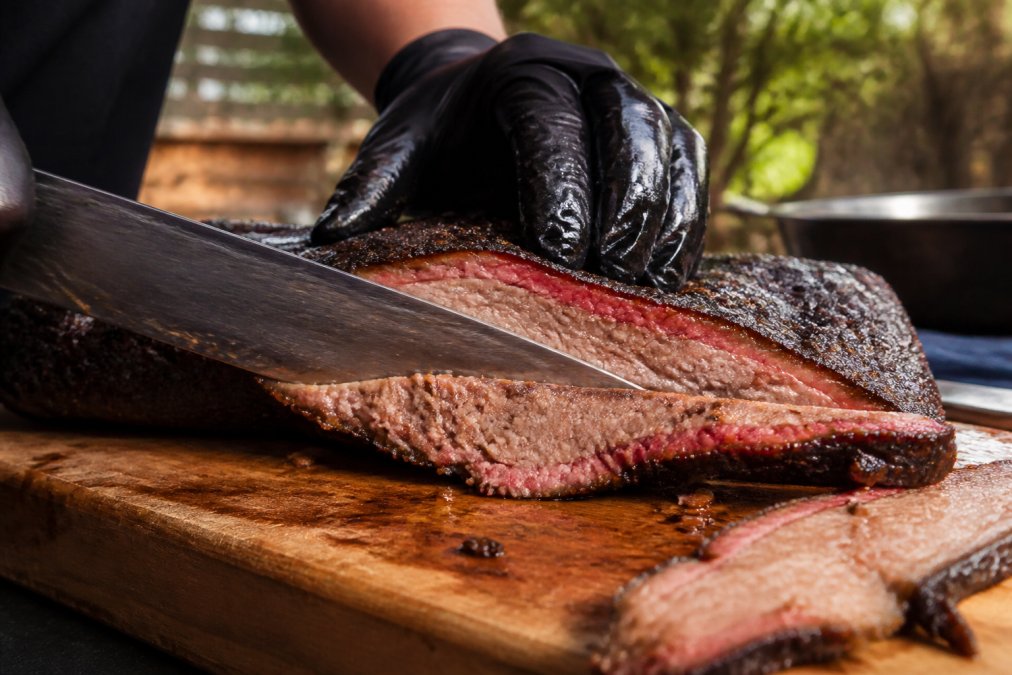
Moist brisket is not about adding water. It is about rendering the connective tissue properly. Brisket contains significant collagen, and that collagen only breaks down into gelatin between 195°F and 205°F internal temperature (peer-reviewed research). Below that range, the meat stays tough and chewy. Above it, the muscle fibers squeeze out the moisture they hold, leaving you with dry, crumbly meat.
The challenge is that the flat and the point cook at different rates. The point has more intramuscular fat and collagen, so it tolerates higher temperatures. The flat is leaner and dries out quickly if it overshoots. A precision smoker with even heat distribution, like the reverse flow design we use, minimizes the temperature gradient between these two muscles. This is the real difference between equipment that produces consistent results and equipment that fights you all day.
Brisket Internal Temperature Guide for Perfect Results
The ideal brisket internal temperature guide starts with targeting 203°F in the flat, but temperature alone is not the full picture. You are aiming for probe tender: when a thermometer probe slides into the meat with the resistance of warm butter. That usually happens between 200°F and 205°F, though every brisket is slightly different.
Track two temperatures during the cook. The ambient probe tells you what the smoker is doing, and the meat probe tells you what the brisket is doing. On a precision smoker, ambient temperature should stay within a 10-degree window, ideally around 250°F to 275°F. The stall, where internal temperature plateaus around 150°F to 170°F, happens as evaporative cooling kicks in (amazingribs.com). Do not fight it. The stall is collagen breaking down and moisture redistributing, and rushing through it with higher heat is a primary cause of dry brisket.
Using Butcher Paper vs Foil for Brisket
The wrap debate usually comes down to bark preservation versus cook speed, but on a precision smoker, the calculation changes because you are not using the wrap to compensate for temperature swings. The real variable is vapor pressure inside the wrap, and that is something you can control more precisely when your ambient temperature is locked in.
How Wrap Choice Interacts with Precision Airflow
On a pellet or PID-controlled smoker, the controller is constantly cycling the fan and auger to hold a set point. That cycling creates micro-fluctuations in humidity inside the cook chamber. Foil traps nearly 100% of the moisture that evaporates off the brisket, which means the surface of the meat is braising in liquid that is mostly water. Butcher paper, by contrast, is permeable. It lets steam escape while still holding the rendered fat and juices close to the meat. In a high-airflow precision smoker, that permeability matters more because the constant fan movement can pull moisture away from the surface faster than in a still-air offset.
A common pattern among competition cooks using precision smokers is to wrap in butcher paper once the bark has set, then finish in foil only if the cook is running long and they need to push through the stall. The paper-first, foil-finish method gives you the bark protection for the first part of the cook and the speed boost only when you actually need it. If you are running a pellet smoker with a super-efficient firebox, you may find you do not need foil at all, the stable heat will carry you through the stall without the extra push.
The 165°F to 170°F Rule Is a Starting Point, Not a Law
The common advice to wrap at 165°F to 170°F internal temperature comes from the era of offset smokers where the stall was a crisis to be managed. On a precision smoker holding 250°F ambient, the stall is a plateau, not a cliff. You can let the brisket run unwrapped through the entire stall and still finish with a moist flat, provided your ambient temperature never spikes above 275°F. The trade-off is time, unwrapped, the stall can last three to four hours. Wrapping early, at 150°F to 155°F, will shorten the stall but will also set the bark earlier, which means less smoke absorption during the final phase.
A more reliable trigger for wrapping is not temperature but bark texture. When the bark has turned a deep mahogany and feels dry to the touch, not tacky, not wet, that is the moment to wrap. On a precision smoker, that bark set typically happens between 160°F and 170°F internal, but it depends on your rub's sugar content and the humidity in your region. In a dry climate like Arizona, bark sets faster. In a humid Gulf Coast environment, it takes longer. Trust the feel, not the number.
Positioning the Wrap Seam for Even Heat Distribution
One detail most guides miss is how the wrap seam orientation affects cooking. On a reverse flow smoker, heat enters from one side and exits the other. If you place the foil or paper seam facing the heat source, the seam can act as a channel, directing hot air along the side of the brisket and accelerating cooking on that edge. Orient the seam perpendicular to the airflow, or tuck it underneath the brisket, to keep heat distribution even across the flat and point.
Mastering Brisket Resting Techniques
Resting is where moisture retention is won or lost, and it is the most underrated step in the process. A brisket that rests properly can gain back tenderness even if it finished slightly hot. One that is sliced immediately will lose juices on the cutting board, no matter how well it cooked.
Rest the wrapped brisket in a cooler or a warm holding cabinet set to 140°F to 150°F for at least one hour, ideally two to three. The internal temperature will continue to rise five to ten degrees during the first part of the rest, a process called carry-over cooking. This is why you pull the brisket at 200°F rather than 205°F if you plan a long rest. The resting period lets the gelatinized collagen redistribute moisture back into the muscle fibers. Slice against the grain and serve with a little of the collected au jus for the best result.
Common Mistakes That Dry Out Brisket
Most dry brisket is not a cooking problem. It is a planning problem. But on a precision smoker, the failure modes are different from an offset. The equipment is not swinging 50 degrees, so the mistakes shift to how you interact with the controller, where you place your probes, and how you interpret the data the smoker gives you.
Mistake 1: Trusting the Built-In Meat Probe Without Verifying
Precision smokers ship with a meat probe that feeds into the PID controller. That probe is convenient, but it is also a single point of failure. The probe tip sits at the end of a metal shaft, and if you insert it too shallow, it reads the ambient temperature inside the smoker, not the meat. If you insert it too deep, it can pass through the flat and into the point, giving you a blended reading that is higher than the flat's actual temperature. A common pattern is pulling the brisket at 203°F on the controller, only to find the flat is actually at 195°F and still tough.
The fix is to use a secondary instant-read thermometer to verify probe tenderness in multiple spots, the flat, the point, and the transition zone between the two. The controller probe is a guide, not a verdict. If your secondary probe meets resistance in the flat but slides cleanly into the point, the flat needs more time, even if the controller says otherwise.
Mistake 2: Setting the Ambient Temperature Too High to 'Speed Up' the Stall
The stall happens because evaporative cooling pulls heat away from the meat surface. On a precision smoker, the PID controller will add more heat to compensate for that evaporative cooling, which is exactly what you do not want. If you set the ambient to 275°F or 300°F to push through the stall faster, the controller will hold that higher temperature, and the surface of the flat will dry out before the collagen in the point has fully rendered.
A better approach is to set the ambient to 250°F and let the stall run its course. The controller will cycle the fan and auger to hold that temperature, and the brisket will sit in a stable environment where the collagen can break down without the muscle fibers squeezing out moisture. If you are on a tight schedule, wrap in foil to push through the stall faster, do not raise the ambient temperature.
Mistake 3: Ignoring the Fat Cap Orientation Relative to the Heat Source
On a reverse flow smoker, the heat source is on one side and the exhaust is on the other. The radiant heat from the firebox side is more intense than the airflow side, even if the ambient temperature reads the same across the chamber. If you place the brisket with the flat pointing toward the heat source, the lean flat will absorb more radiant energy and dry out faster. Position the point toward the heat source and the flat toward the exhaust side. The point's higher fat content can handle the extra radiant load, while the flat stays in the gentler airflow zone.
Fat cap orientation matters too. On a precision smoker with a convection fan, the airflow is more uniform, but the radiant heat from the firebox side is still a factor. Keep the fat cap facing the heat source to shield the meat from direct radiation. If your smoker has a diffuser plate, the radiant load is lower, but the fat cap still provides a buffer against drying.
Mistake 4: Opening the Lid to 'Check' on the Brisket
Every time you open the lid on a precision smoker, you dump the accumulated heat and humidity. The PID controller will respond by firing the auger and fan to recover, which creates a temperature spike that can overshoot your set point by 15 to 20 degrees. Repeated lid openings create a sawtooth temperature pattern that stresses the meat surface. Use a wireless probe system and trust the data. If you need to spritz, do it in one efficient pass, open, spritz, close, within 10 seconds, and do it no more than once per hour after the first two hours.
Conclusion: Consistent Moisture with the Right Equipment
Avoiding dry brisket with precision smokers is about removing variables, and the largest variable is your equipment. A smoker with thick steel and even heat distribution holds temperature through the stall, through wind gusts, and through the long rest. Blowin' Smoke Cookers builds reverse flow smokers with heavy-duty steel construction that hold the tight temperature range competition cooks demand. The SNS Pellet Vault offers set-and-forget temperature control for cooks who want precision without tending a firebox all night. Get started with Blowin' Smoke Cookers and produce brisket that stays moist from the first slice to the last.

Frequently Asked Questions
How do I keep my brisket moist while smoking it?
Maintain a steady ambient temperature between 225-250°F and monitor internal temperature with a reliable probe. Use a water pan to add humidity, spritz the surface, and wrap during the stall. Pull the brisket at probe tender around 200-205°F, not just a set number, and rest it in a warmer for at least 1-2 hours.
What is the difference between butcher paper and foil for wrapping brisket?
Butcher paper allows more airflow and moisture to escape, preserving a firmer bark while still protecting the meat. Foil creates a tighter seal, trapping steam and accelerating cooking time, but it softens the bark. For precision smoker owners, butcher paper is often preferred for better bark, while foil works well when you need to push through the stall quickly.
At what internal temperature is brisket considered overcooked?
Brisket is typically overcooked when it exceeds 210°F, causing the collagen to break down completely and the meat fibers to dry out and become mushy. Remove the brisket when it's probe tender, usually between 200-205°F in the flat. The carry-over cooking will add about 5-10°F during the resting period.