
Last Updated: October 25, 2026
Quick Summary
The best wood types consistent smoker heat are oak for steady, predictable burns and hickory for bold flavor with good heat output. Oak burns slower and more evenly, holding temperature in a narrower band, while hickory requires more attention but delivers stronger smoke flavor. Blend 70% oak with 30% hickory for optimal control and taste.
- Oak has high density and burns predictably for 45 minutes to an hour per split in a properly drafting offset smoker.
- Hickory produces sweet, smoky flavor paired well with pork and ribs, burning hotter than oak but not as intense as mesquite.
- Seasoned wood should have moisture content below 20% for best results; green wood at 50% moisture burns cooler and dirtier.
- Feed splits on a consistent schedule every 30-60 minutes rather than reacting to temperature gauge to prevent overshoot.
- Standardize your fuel size to 4-6 inches across and use one base wood with one accent wood for repeatable temperature control.
Table of Contents
- Why Wood Type Matters for Temperature Stability
- Oak: The Steady Base Wood for Reliable Heat
- Hickory Flavor and Strength in Offset Smokers
- Wood That Burns Longest for Smoking
- Oak vs Hickory for Smoking: Heat Output and Control
- Seasoned Firewood for Smoking: Moisture and Storage
- Building Your Wood Strategy for Competition Results
- Frequently Asked Questions
Why Wood Type Matters for Temperature Stability
Picking the right wood types consistent smoker heat is the difference between a smoker that holds steady and one that swings wildly.
Wood type directly affects three critical factors: how hot the fire burns, how long it stays hot, and how predictable the heat output is. Oak burns steady and long. Mesquite burns hot and fast. Hickory splits the difference.
The wood you choose shapes your entire cook. It determines whether you're babysitting your fire every 20 minutes or checking it once an hour, the difference between eating at 6 PM or 8 PM.
Oak: The Steady Base Wood for Reliable Heat
Oak is the workhorse of smoking.
Why oak works: Oak has high density, so it burns slower and more evenly than lighter woods.
Oak produces clean smoke too. It won't overwhelm your meat with heavy, acrid flavor.
The trade-off: Oak alone can feel mild.
Seasoned oak splits work best. Green or wet oak creates too much steam and not enough heat.
Hickory Flavor and Strength in Offset Smokers
Hickory brings bold flavor and good heat output. It's stronger than oak but not as intense as mesquite.
Hickory's strengths: It produces a sweet, smoky taste that pairs well with pork and ribs, and burns hot enough to hold steady temperatures without losing control.
USDA forest product research shows that hickory wood has high BTU output, which translates to reliable heat generation for smoking applications.
When to use hickory: Use it as your primary wood if you want bold flavor.
Wood That Burns Longest for Smoking
Two woods of the same species can behave completely differently depending on density, moisture, and piece size. For steady heat, control all three.
What actually drives burn time:
- Density. Dense hardwoods pack more mass per cubic inch, so a given volume releases heat over a longer window. Oak, hickory, and other dense hardwoods outlast lighter woods like maple and most fruitwoods at the same size.
- Moisture content. Water in the wood absorbs heat as it turns to steam. Wood at 15-20% moisture sends most of its energy into heat; green wood at 50% sends a large share into boiling off water, which is why wet wood both burns cooler and burns dirtier.
- Piece size. A larger split has more mass and less exposed surface per pound, so it ignites more slowly and releases heat over a longer period. Smaller pieces light fast, burn hot, and fade fast.
Fuel form comparison:
| Form | Typical size | Burn behavior | Best use |
|---|---|---|---|
| Logs | Full rounds, often 12-18 inches | Longest, slowest, hardest to manage in small fireboxes | Large offset fireboxes, long overnight-style holds |
| Splits | Roughly 3-6 inches across | The standard for offset cooking; predictable 30-60 minute windows per load depending on species and draft | Offset and reverse-flow smokers |
| Chunks | Fist-sized to softball-sized | Moderate heat, good for adding flavor on top of a coal bed | Charcoal smokers, kettle-style setups |
| Chips | Small shavings | Fast, hot, short-lived; easy to oversmoke | Pellet grills, gas-assisted smoke boxes, short cooks |
Rough burn windows (qualified, not universal):
A well-seasoned oak split in the 4-6 inch range holds a stable coal bed for roughly 45 minutes to an hour per load in a properly drafting offset. Hickory runs 30-45 minutes per comparable split; fruitwoods like apple and cherry sit in a similar window with lower heat output. These are starting points, your firebox, draft, and outside temperature will move them.
How to stretch a burn without spiking temperature:
- Build a hot coal bed first, then add splits on top of coals rather than against bare metal.
- Pre-warm the next split on the firebox lid or a warming shelf so it ignites faster and doesn't drag the fire down.
- Feed smaller, more frequent splits if your smoker runs hot; feed larger, less frequent splits if it runs cold.
- Keep the exhaust wide open and control temperature with the intake, choking the exhaust traps smoke and creates creosote.
- Stack your woodpile so air moves around each piece; damp, tightly packed wood never fully seasons.
Smoker-specific notes:
- Offset smokers reward 4-6 inch splits fed every 30-60 minutes; the long cook chamber and draft do the heat distribution for you.
- Charcoal smokers (drum, cabinet, kettle) work best with a steady charcoal base plus chunks for flavor; large splits overwhelm the smaller firebox.
- Pellet grills control heat through the controller and auger, so wood choice is about flavor and pellet quality, not burn duration.
The firebox design matters too. A well-designed offset smoker with proper airflow will extract more heat from each piece of wood than a poorly designed box. Reverse flow technology, like you'll find in Sling n Steel custom smoker designs, helps distribute heat evenly and prevents hot spots that waste wood.
Oak vs Hickory for Smoking: Heat Output and Control
Both woods deliver reliable heat but behave differently. Here's how to pick.
Oak characteristics:
- Burns steady and predictable
- Moderate heat output
- Mild smoke flavor
Hickory characteristics:
- Burns hot and strong
- Higher heat output than oak
- Bold, sweet smoke flavor
For temperature control with wood types consistent smoker heat: Oak wins.
For competition: Many pitmasters start with oak to dial in their temperature, then add hickory in the final hours for flavor.
Blending strategy: Mix 70% oak with 30% hickory. This gives you oak's stability with hickory's flavor.
Seasoned Firewood for Smoking: Moisture and Storage
Wet wood kills your heat consistency. Period.
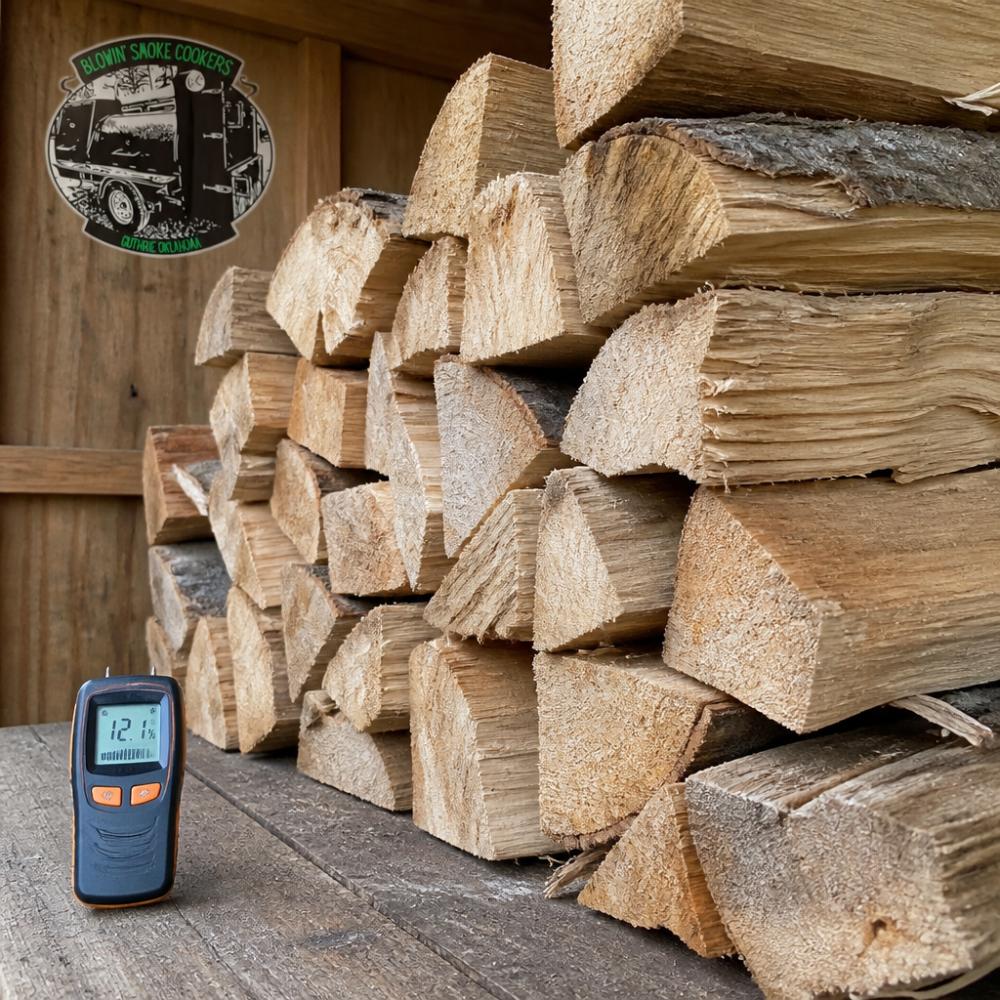
Green wood contains 50% moisture or higher.
Proper seasoning takes time:
- Freshly cut wood needs 6-12 months to season
- Stack it in a dry location with airflow around each piece
- Cover the top to keep rain off but leave sides open for air circulation
Check moisture with a simple wood moisture meter from any hardware store.
Firewood moisture guidelines from the National Association of State Foresters recommend 15-20% moisture content for optimal burning and heat output.
Storage mistakes to avoid:
- Stacking wood directly on wet ground (pulls moisture from soil)
- Covering wood completely (traps moisture inside)
- Storing wood in a damp garage or shed
Properly stored, seasoned hardwood maintains its moisture level for years. Keep it covered on top, open on the sides, and elevated off the ground.
Building Your Wood Strategy for Competition Results
Consistency is a system, not a single wood choice.
The four-part consistency system:
- Pick one base wood and one accent wood. Oak as the base gives you predictable heat; hickory, apple, or cherry as a 10-30% accent gives you flavor without wrecking temperature control.
- Standardize your fuel size. Decide on a split dimension (for example, 4-6 inches across) and cut or buy to that size every time. Variable fuel size is the most common cause of temperature swings.
- Set a feed interval and stick to it. Feed on a schedule, every 30, 45, or 60 minutes, rather than reacting to the gauge. Reactive feeding causes overshoot.
- Log every cook. Record outside temperature, wind, wood species, split size, moisture reading, feed times, and temperature range. Patterns emerge within three or four cooks.
Temperature-control troubleshooting:
| Symptom | Likely cause | Fix |
|---|---|---|
| Temperature spikes 50°F+ after feeding | Too much fuel added at once, or fuel too dry/small | Add smaller splits, close intake halfway, wait 10 minutes before adjusting again |
| Fire fades after 20-30 minutes | Wet wood, oversized splits, or restricted intake | Check moisture with a meter, split smaller, open intake gradually |
| White, billowing smoke | Green wood, smoldering fire, or choked exhaust | Switch to seasoned wood, open exhaust fully, build a hotter coal bed |
| Uneven heat across the grate | Hot spots from firebox design or fuel piled in one area | Use a reverse-flow or tuning plate, spread coals evenly, rotate meat |
| Temperature creeps up over hours | Ash buildup restricting airflow or draft increasing as firebox heats | Clean the firebox between cooks, adjust intake as the smoker warms |
Smoker-specific strategy:
- Offset smokers: Oak base, hickory accent, 4-6 inch splits, feed every 45-60 minutes. Use the intake for temperature and leave the exhaust open.
- Charcoal smokers: Charcoal base with 2-4 chunks of your chosen wood; replenish chunks every 45-60 minutes rather than adding splits.
- Pellet grills: Choose a quality pellet blend and let the controller manage heat; wood choice is a flavor decision, not a temperature one.
Wood sourcing and safety:
Use only clean, untreated hardwood. Avoid lumber scraps, pallet wood, painted or stained wood, and any wood that has been pressure-treated, these can release toxic compounds into your cook.
Practice, then repeat. Identify one or two wood combinations that work in your smoker, test them repeatedly, and don't change anything on game day. Document temperature stability, bark color, and flavor each time, consistency across entries is what judges reward, and your wood strategy is the foundation for all three.
Blowin' Smoke Cookers carries quality offset smokers and reverse flow designs built for this kind of precision. A poorly designed firebox won't hold temperature steady no matter what wood you use.
For competition cooks, learn fire management techniques that complement wood selection for consistent temperature control. Discover how wood choice fits into broader competition BBQ consistency strategies. Understand what smoker features support the wood strategy needed for competition success.
Frequently Asked Questions
What is the best wood for consistent heat in a smoker?
Oak and hickory are the top choices for consistent smoker heat. Oak burns at a steady rate with moderate heat output, making it ideal as a base wood. Hickory delivers slightly hotter, more intense heat. Both are dense hardwoods that resist rapid temperature swings. Mesquite burns hotter and faster, so it requires more active temperature management. For competition-grade results, start with oak or hickory and adjust based on your smoker type and meat selection.
How do I know if my wood is dry enough for smoking?
Seasoned firewood should have a moisture content below 20%, ideally between 12-18%. You can test this with an inexpensive moisture meter. Properly seasoned wood splits cleanly, has visible cracks on the end grain, and produces a hollow sound when two pieces are struck together. Green or wet wood creates excessive white smoke, temperature swings, and creosote buildup. Store split wood in a covered, ventilated area for at least 6-12 months before use to achieve proper seasoning.
Which wood burns the longest in a smoker?
Oak and hickory burn longer than fruitwoods or mesquite due to their density and BTU content. Oak typically provides 1.5 to 2 hours of steady burn per load, depending on wood size and smoker design. Hickory burns at a similar rate but with higher heat output. Mesquite burns faster and hotter, requiring more frequent loading. Wood splits (larger pieces) burn longer than chips or chunks. For extended cooks, use splits or chunks of oak or hickory, and plan your loading schedule based on your target cook time.
Can I mix different wood types to maintain steady smoker temperature?
Yes, blending woods is a proven technique for heat control. Many competition pitmasters use oak as a base wood and add hickory, pecan, or fruitwood for flavor without destabilizing temperature. This approach lets you dial in consistent heat while layering smoke complexity. Start with 70% base wood (oak or hickory) and 30% flavor wood, then adjust to your preference. Avoid mixing fast-burning woods like mesquite with slow-burning hardwoods in the same load, as this creates unpredictable heat swings.
The wood in your smoker determines whether you're fighting temperature swings or riding a steady burn. Oak gives you that stability. Hickory adds the flavor. Proper seasoning ensures both work as designed. When you match the right wood to your smoker's design and your cooking goals, everything else becomes easier. Get started with Blowin' Smoke Cookers and experience how quality equipment combined with the right wood strategy delivers the consistent results you're after.
