
Table of Contents
- Understanding Catering Trailer Power Requirements
- Professional Catering Trailer Electrical Safety: Core Installation Steps
- Food Trailer Electrical Safety Checklist
- Grounding, Bonding, and Ground-Fault Protection
- Food Trailer Generator Safety
- Catering Trailer Electrical Maintenance Schedule
- Handling Wet, Greasy, and Outdoor Conditions
- Permits, Codes, and Professional Certification
- Frequently Asked Questions
Last Updated: October 13, 2026
Understanding Catering Trailer Power Requirements
Professional catering trailer electrical safety starts with knowing how much power your equipment actually needs. Most food trailers run cooking equipment, refrigeration, lighting, and point-of-sale systems simultaneously. Without calculating your electrical load correctly, you risk overloaded circuits, equipment shutdowns during service, and safety hazards.
At Blowin' Smoke Cookers, we work with catering professionals who understand that reliable power keeps events running smoothly. The difference between a well-planned electrical system and an undersized one shows up fast, usually during your biggest event.
Calculating Your Electrical Load
Start by listing every piece of equipment that runs at the same time. A typical catering trailer might include:
- Commercial griddle or grill (3,000-5,000 watts)
- Refrigeration unit (800-1,500 watts)
- Fryer or warming equipment (2,000-4,000 watts)
- Lighting (500-1,000 watts)
- Point-of-sale terminal and chargers (300-500 watts)
Add these numbers together to get your total wattage. If your total is 8,000 watts, you need at least 8,000 watts of available power, but plan for 20% headroom. That means you actually need about 9,600 watts of capacity.
Divide your total wattage by 120 (for standard voltage) to get amperage. An 8,000-watt system needs roughly 67 amps at 120V. This calculation tells you whether a standard 120V shore power connection will work or if you need 240V service.
Choosing Between 120V and 240V Systems
Most home outlets provide 120V, single-phase power. This works for small trailers with light equipment loads.
240V service cuts your amperage requirement in half. That same 8,000-watt system needs only 33 amps at 240V instead of 67 amps at 120V.
For any catering trailer with serious cooking equipment, 240V is the professional standard. Shore power pedestals at event venues typically offer both 120V and 240V connections.
If your trailer will operate at multiple venues, confirm what power sources are available before you design your system. Some smaller events offer only 120V.
Professional Catering Trailer Electrical Safety: Core Installation Steps
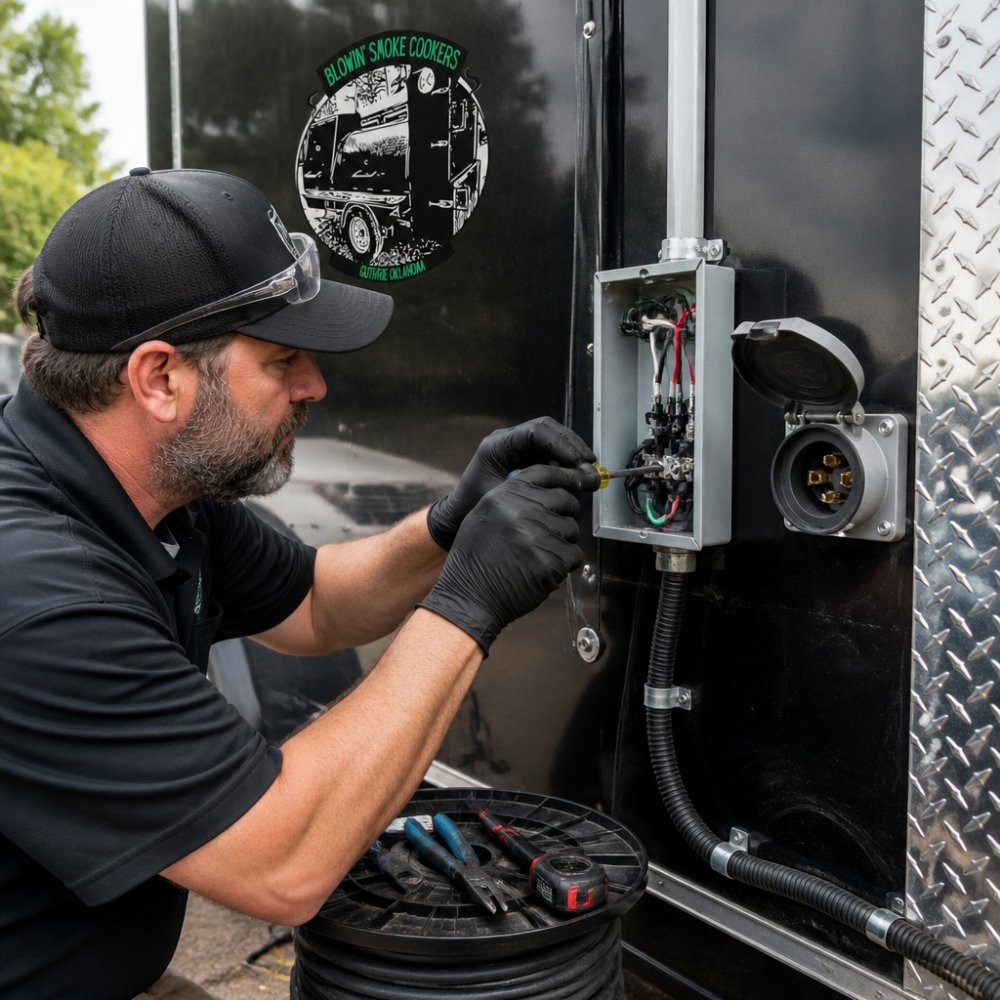
Installing a food trailer electrical system requires precision and code compliance. Every connection, breaker, and wire must meet National Electrical Code standards. Poor installation creates fire risk, shock hazard, and equipment failure.
Selecting Circuits and Circuit Ratings
Each major appliance needs its own dedicated circuit. A commercial griddle pulling 4,000 watts should not share a circuit with lighting or refrigeration. Shared circuits cause voltage drop, nuisance breaker trips, and overheating.
Choose breaker amperage based on the wire gauge and equipment load:
- 20-amp circuit: small appliances, lighting (12 AWG wire)
- 30-amp circuit: medium-draw equipment (10 AWG wire)
- 50-amp circuit: high-demand cooking equipment (6 AWG wire)
The breaker rating must match your wire gauge. Oversizing a breaker for undersized wire creates fire risk. The wire heats up faster than the breaker can trip.
Separate circuits for different equipment types prevent one failure from shutting down your entire operation. If the fryer circuit trips, your griddle and refrigeration keep running.
Installing Receptacles and Connectors
Food trailers operate in wet, greasy environments. Standard household receptacles corrode and fail quickly. Use commercial-grade, weatherproof receptacles rated for outdoor use.
NEMA 5-15R receptacles handle standard 120V circuits. NEMA 5-20R receptacles provide 20-amp 120V service.
All outdoor receptacles must have ground-fault circuit interrupter (GFCI) protection. GFCI outlets detect ground faults instantly and shut off power in milliseconds. This protection is non-negotiable for wet environments.
Install receptacles in protected locations away from direct water spray. Mount them above counter height to keep them out of standing water and spill zones.
Wiring and Rough-In Installation
Run all wiring through metal conduit or armored cable (MC cable). Conduit protects wires from physical damage, rodents, and corrosion.
Keep wiring away from cooking surfaces and grease accumulation zones. Heat damage to insulation creates short circuits and fire risk.
Use appropriately sized wire for each circuit. Undersized wire heats up under load and fails. Oversized wire wastes money but does not harm safety.
Secure all wiring every 18 inches with approved clamps or clips. Loose wiring vibrates during towing and develops cracks in the insulation. Secure runs also make future troubleshooting easier.
Food Trailer Electrical Safety Checklist
A food trailer electrical safety checklist catches problems before they become emergencies. Run through these steps before your first catering event and repeat them seasonally.
Pre-Service Inspection Protocol
Visual inspection finds obvious hazards quickly:
- Look for cracked or damaged insulation on all visible wiring
- Check that all receptacles are secure and not loose in their boxes
- Confirm breaker switches move freely and reset properly
- Inspect conduit for dents, rust, or separation at joints
- Verify all connections are tight (use a wrench to check terminal bolts)
- Ensure no wires run across hot surfaces or sharp edges
- Check that GFCI outlets have test and reset buttons (they should protrude slightly)
Open electrical panels and look inside. Corrosion, water damage, or loose connections inside the panel indicate deeper problems. If you see white powder, green oxidation, or water stains, the system needs professional service before operation.
Testing and Verification Steps
Use a multimeter to verify voltage at key points:
- Check shore power voltage at the main inlet (should read 240V or 120V as expected)
- Measure voltage at each circuit breaker (should match the breaker rating)
- Test GFCI outlets using their built-in test button (outlet should cut power instantly)
- Verify ground continuity with a continuity tester (all metal frames should read as electrically connected)
Load testing reveals problems that idle testing misses. Run your heaviest equipment while monitoring voltage. Voltage should not drop more than 3% under full load. Larger drops mean undersized wiring or a weak power source.
Test your generator under full load before relying on it. Many generators perform fine at half load but struggle when all equipment runs simultaneously. Discover this during testing, not during an event.
Document all test results. Keep records of voltage readings, breaker trips, and any repairs. This documentation proves your system was safe and helps troubleshoot future issues.
Grounding, Bonding, and Ground-Fault Protection
Grounding and bonding protect people from electrical shock. These systems work silently until a fault occurs, then they save lives.
Grounding provides a safe path for fault current to reach earth.
Bonding connects all metal parts electrically. The trailer frame, metal appliance cases, and metal conduit must all be bonded together.
Test bonding with a continuity tester.
GFCI protection detects ground faults and cuts power in 25 milliseconds. This speed prevents serious injury.
Older trailers sometimes lack proper grounding or bonding.
Food Trailer Generator Safety
Generators provide independence from shore power. They also introduce new hazards if not operated correctly.
Shore Power vs. Generator Operation
Shore power from an event venue is the safest option when available. The power source is isolated, properly grounded, and typically has professional maintenance. Your trailer connects via a weatherproof inlet and runs normally.
Generators give you flexibility. You can operate anywhere, parking lots, remote venues, backup power during outages. But generators require active management.
Never run a generator indoors or in an enclosed space. Generator exhaust contains carbon monoxide, a colorless, odorless poison. Outdoor operation only, with the exhaust directed away from people.
Safe Generator Setup and Connection
Use a heavy-duty generator rated for your electrical load. A 7,500-watt generator handles most food trailers.
Connect your generator to the trailer using a properly rated power cord.
Never backfeed power into shore power lines.
Place the generator at least 20 feet from windows, doors, and air intakes. Exhaust fumes should not enter the trailer or nearby structures.
Check the generator's oil level before each use. Low oil causes engine damage and potential failure during service. Keep fuel fresh, stale fuel clogs carburetors.
Catering Trailer Electrical Maintenance Schedule
Regular maintenance prevents failures during events. A simple schedule keeps your system reliable.
Monthly and Seasonal Checks
Monthly inspection takes 15 minutes:
- Test GFCI outlets using the test button
- Visually inspect visible wiring for damage
- Check all breaker switches move freely
- Look for corrosion or water damage in the electrical panel
Before each catering season, perform a full inspection:
- Run load testing with all equipment operating
- Test voltage at multiple points in the system
- Inspect all receptacles for corrosion or looseness
- Check bonding continuity on metal frames and appliances
- Clean dust and debris from the electrical panel
- Verify the generator runs under full load
After heavy use or exposure to water, inspect immediately. Salt spray, rain, or standing water can accelerate corrosion.
Documentation and Record-Keeping
Keep a maintenance log. Record:
- Date of inspection
- Voltage readings at key points
- Any repairs or adjustments made
- GFCI test results
- Generator runtime and fuel consumption
- Any anomalies or concerns noted
This documentation proves your system was maintained professionally. It also helps identify patterns. If a specific breaker trips repeatedly, the log shows when it started and helps pinpoint the cause.
Share maintenance records with any electrician who services your trailer. They can see what was done previously and avoid repeating unnecessary work.
Handling Wet, Greasy, and Outdoor Conditions
Food trailers operate in harsh environments.
Grease accumulation on equipment and wiring accelerates insulation breakdown. The oily film traps moisture and promotes corrosion.
Moisture is the biggest enemy of electrical systems. Condensation forms inside electrical panels when temperature changes rapidly.
Outdoor receptacles need weatherproof covers. Even when not in use, water can seep into outlet boxes.
Salt spray corrodes copper and aluminum rapidly. If your trailer operates near coastal areas, inspect more frequently.
Temperature swings cause expansion and contraction. Loose connections become looser as metal heats and cools.
Permits, Codes, and Professional Certification
Electrical work in food trailers must meet the National Electrical Code (NEC). Local jurisdictions may have additional requirements.
Most jurisdictions require a licensed electrician to perform electrical installation.
After installation, request a final inspection. The inspector verifies that wiring, breakers, grounding, and bonding all meet code.
If you purchase a used catering trailer, have the electrical system inspected by a qualified electrician.
Professional certification matters. A qualified electrician holds a license, carries liability insurance, and understands local codes.
Professional catering trailer electrical safety is not optional, it's the foundation of reliable operation.
Frequently Asked Questions
What are the key power requirements I need to check before connecting a catering trailer?
Before connecting your catering trailer, verify the total electrical load by adding up the wattage of all appliances and equipment you plan to run simultaneously. Check whether your site offers 120V, 240V, or three-phase shore power. Confirm the amperage rating available, most catering trailers require either 30-amp or 50-amp service. Inspect all receptacles, connectors, and wiring for damage, and verify that the power source has proper grounding and ground-fault protection. Always consult the trailer's electrical documentation and confirm compliance with local electrical codes.
How can I prevent electrical shock and ground-fault hazards in a food trailer?
Install ground-fault circuit interrupter (GFCI) protection on all receptacles in wet or damp areas, including kitchen prep zones and outdoor connections. Ensure proper bonding between all metal components, including the trailer frame, to create a continuous ground path. Use only three-conductor or four-wire connections with a dedicated ground wire. Never operate electrical equipment with wet hands or in standing water. Label all circuits and outlets clearly. Have a qualified electrician inspect the grounding and bonding system annually, and replace any damaged cords or connectors immediately.
Is it safe to use a generator with a catering trailer, and what precautions should I take?
Yes, generators can power a catering trailer safely if properly installed and maintained. Use a generator with sufficient capacity to handle your total electrical load plus 25% headroom. Install a transfer switch to prevent backfeeding power into the main shore power line, this protects utility workers and prevents equipment damage. Operate the generator outdoors, at least 20 feet away from the trailer and occupied spaces, to prevent carbon monoxide exposure. Use heavy-duty, grounded extension cords rated for the generator's output. Never refuel a running generator, and allow it to cool before refueling. Inspect the generator monthly and have a qualified electrician verify the connection safety.
How often should I inspect and maintain the electrical system on my catering trailer?
Conduct a visual inspection before each service event, checking for damaged cords, loose connections, and corrosion on receptacles and connectors. Perform a detailed monthly inspection that includes testing GFCI outlets, checking breaker operation, and verifying proper grounding with a multimeter. Have a qualified electrician conduct a comprehensive inspection and safety test annually or after any accident, weather event, or equipment failure. Keep detailed records of all inspections, tests, and repairs. Replace any corroded, damaged, or deteriorating components immediately. If your trailer operates year-round in wet or coastal conditions, increase inspection frequency to every six months.