
7 Best Oils for Seasoning Steel Smokers
Editorial Team
Nov 05
Table of Contents
- Why Seasoning Your Steel Smoker Matters
- Understanding Smoke Point and Thermal Stability
- How to Season a New Steel Smoker
- The 7 Best Oils for Seasoning Steel Smokers
- Oils to Avoid When Seasoning
- Preventing Rust on Steel Smokers
- How to Clean Smoker Grates After Cooking
- Maintenance and Re-Seasoning Cycle
- Frequently Asked Questions
Last Updated: September 30, 2026
Why Seasoning Your Steel Smoker Matters
Seasoning a steel smoker creates a protective layer that prevents rust and improves heat retention. Without proper seasoning, bare steel oxidizes quickly, especially when exposed to moisture and high temperatures. The protective patina you build through seasoning also enhances the non-stick properties of your cooking surfaces, making cleanup easier and preventing food from sticking to grates.
For serious pitmasters and backyard enthusiasts, a well-seasoned smoker is the foundation of consistent results. At Blowin' Smoke Cookers, we understand that equipment durability directly impacts your ability to produce competition-ready barbecue. The seasoning process isn't complicated, but choosing the right oils for seasoning steel smokers makes all the difference between a smoker that lasts decades and one that deteriorates within a few years.
Pro Tip
The best time to season a new steel smoker is before your first cook. Don't wait until rust appears, prevention is far easier than restoration. Apply thin coats rather than one thick layer, which can become sticky and collect debris.
Understanding Smoke Point and Thermal Stability
The smoke point is the temperature at which an oil begins to break down and emit smoke. For seasoning steel smokers, you need oils with high smoke points because your smoker operates at temperatures between 225°F and 350°F during normal cooking, and can spike higher during startup or cleaning.
When an oil's smoke point is too low, the fatty acids degrade before polymerizing on the steel surface, creating sticky residue instead of a protective layer. Oils with better oxidative stability maintain their integrity at high temperatures.
Thermal stability matters for re-seasoning maintenance too. Oils with higher smoke points rebuild the protective patina more effectively over multiple heating cycles.
Look for oils with smoke points above 400°F for reliable seasoning performance. This safety margin ensures the oil polymerizes correctly even during the intense heat of startup or when your smoker runs hot during a long cook.
How to Season a New Steel Smoker
Proper surface preparation is the first step. Start by degreasing the entire interior and exterior with a clean cloth and mild degreaser to remove any manufacturing residue, dust, or protective coatings. This ensures the oil bonds directly to the steel rather than sitting on top of contaminants.
Once clean and dry, apply a thin coat of high-smoke-point oil with a lint-free cloth. Most people apply too much oil, creating sticky residue instead of protection. You should barely see the oil on the surface.
Wipe away excess oil with a clean cloth. Heat your smoker to 350°F for 30-45 minutes, allowing the oil to polymerize and bond with the metal surface.
Allow the smoker to cool completely before handling. Repeat this process 3-5 times for new smokers. Each application builds on the previous layer, creating a more durable patina. After the initial seasoning cycles, you'll only need to maintain the layer with occasional re-seasoning during regular use.
The 7 Best Oils for Seasoning Steel Smokers
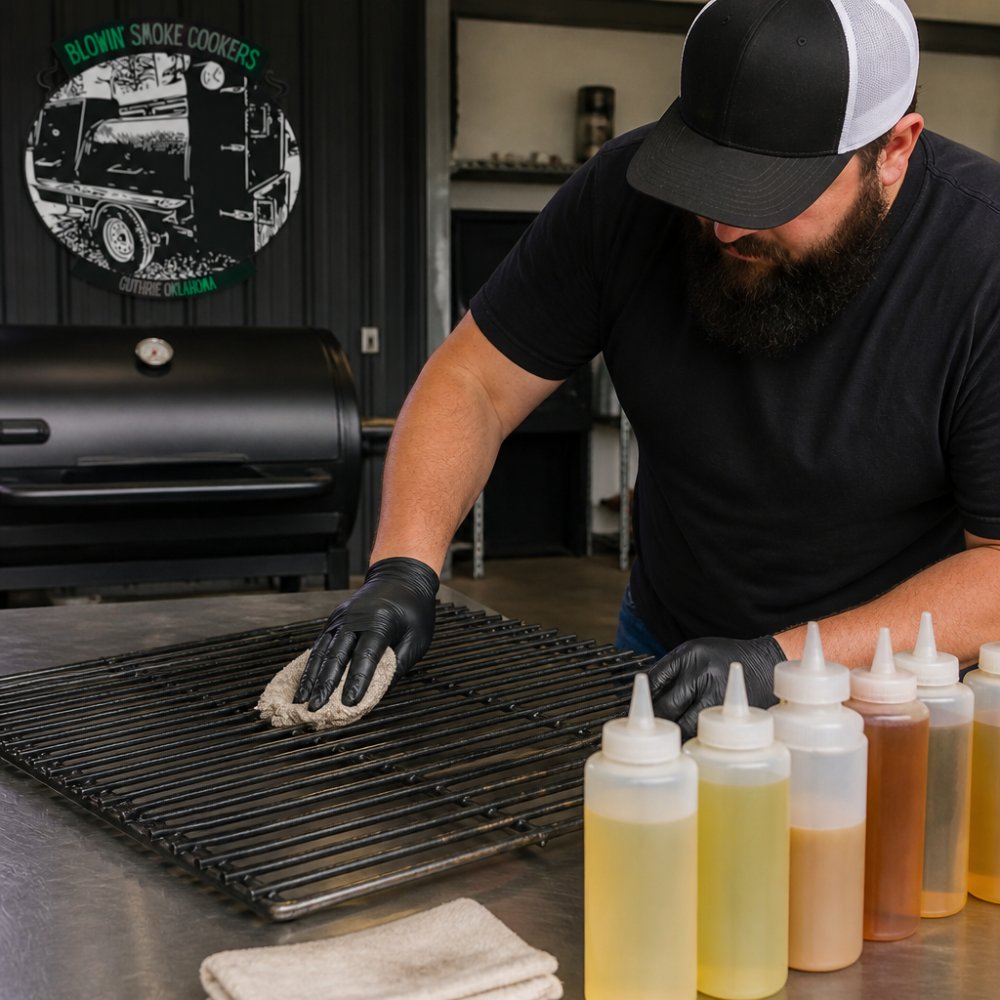
Selecting the right oils for seasoning steel smokers is critical for building a durable, long-lasting protective layer. The oils listed below all have smoke points above 400°F and excellent oxidative stability, making them ideal for the thermal demands of steel smoker seasoning.
Avocado Oil
Avocado oil has a smoke point around 520°F, making it one of the highest options available. It contains monounsaturated fats that polymerize effectively at high temperatures, creating a durable seasoning layer. The oil is also relatively neutral in flavor, so it won't impart unwanted tastes to your food.
The main drawback is cost. For competition pitmasters prioritizing durability, the superior rust prevention and heat resistance justify the expense.
Best for: Competition pitmasters and catering professionals who prioritize durability and don't mind premium pricing.
Grapeseed Oil
Grapeseed oil offers a 420°F smoke point with excellent oxidative stability. It polymerizes smoothly and creates a consistent, non-sticky seasoning layer.
It's moderately priced, widely available, and works well for re-seasoning maintenance without leaving residue.
Best for: Home enthusiasts and small catering operations seeking a balanced combination of performance and value.
Canola Oil
Canola oil has a 400°F smoke point and is one of the most affordable options. It's readily available and works effectively for initial seasoning and maintenance.
Canola oil has slightly lower oxidative stability, requiring more frequent re-seasoning, but this reinforces the protective patina for regular home cooks.
Best for: Home backyard cooks on a budget who don't mind periodic re-seasoning maintenance.
Peanut Oil
Peanut oil has a 450°F smoke point and excellent thermal stability. It polymerizes effectively and creates a durable seasoning layer.
It's moderately priced and available at most grocery stores, but avoid it if you or your guests have peanut allergies.
Best for: Home cooks and small caterers without peanut allergies who want solid performance at reasonable cost.
Sunflower Oil
Sunflower oil offers a 440°F smoke point with good oxidative stability. It's affordable and works effectively for initial seasoning and maintenance.
It's widely available and budget-friendly. Re-season every 10-15 cooks due to slightly lower oxidative stability.
Best for: Budget-conscious home enthusiasts who prioritize affordability and accessibility.
Soybean Oil
Soybean oil has a 450°F smoke point and is one of the most affordable options available at virtually every grocery store.
It has moderate oxidative stability, requiring regular re-seasoning, but the low cost makes this economically reasonable.
Best for: Budget-focused home cooks who accept periodic re-seasoning as part of regular maintenance.
Vegetable Oil
Vegetable oil is a blend with a 400-425°F smoke point. It's the most affordable option and works adequately for basic seasoning.
The trade-off is variability, vegetable oil blends differ by brand and region, so oxidative stability and polymerization performance can fluctuate. This makes vegetable oil less predictable for serious competition cooks who need consistent results. However, for casual home use, vegetable oil is perfectly functional.
Best for: Casual home cooks prioritizing cost above all other factors.
| Oil | Smoke Point | Cost Level | Oxidative Stability | Best For |
|---|---|---|---|---|
| Avocado | 520°F | Premium | Excellent | Competition & catering |
| Grapeseed | 420°F | Moderate | Excellent | Home & small catering |
| Canola | 400°F | Budget | Good | Home cooks |
| Peanut | 450°F | Moderate | Excellent | Home (no allergies) |
| Sunflower | 440°F | Budget | Good | Budget-conscious home |
| Soybean | 450°F | Budget | Good | Very budget-focused |
| Vegetable | 400-425°F | Budget | Fair | Casual home use |
Oils to Avoid When Seasoning
Never use olive oil for seasoning steel smokers. Its smoke point is around 375°F, which is too low for reliable polymerization at typical smoker temperatures. Olive oil will break down and create sticky residue instead of a protective patina.
Butter and coconut oil also have smoke points too low for smoker seasoning. Butter burns around 350°F and coconut oil around 350-375°F depending on processing. Both will degrade rapidly at smoker temperatures, leaving behind burnt residue that attracts debris and promotes rust.
Avoid synthetic oils and blends marketed for non-stick cookware. These products are formulated for stovetop use, not the sustained high heat of a smoker.
Watch Out
Using low-smoke-point oils creates sticky residue that collects debris and accelerates rust formation. This defeats the entire purpose of seasoning and can damage your smoker's interior surfaces.
Preventing Rust on Steel Smokers
Consistent seasoning is the primary defense against rust formation. The polymerized oil layer acts as a barrier between the steel and moisture. Even with perfect seasoning, exposure to humidity and moisture will eventually challenge that barrier.
How to Clean Smoker Grates After Cooking
Allow your grates to cool completely before cleaning. Hot grates are difficult to handle safely and the rapid temperature change from cleaning can damage the seasoning layer. Once cooled, use a grill brush or wire brush to remove food debris and ash buildup.
Maintenance and Re-Seasoning Cycle
Establish a re-seasoning routine based on your cooking frequency. For competition pitmasters or caterers cooking multiple times per week, re-season after every 5-10 cooks. For home enthusiasts cooking weekly, re-season every 10-15 cooks. For casual cooks using the smoker monthly, re-season every 3-4 months.
Key Takeaway
The best oils for seasoning steel smokers are those with smoke points above 400°F and strong oxidative stability. Premium options like avocado and grapeseed oil deliver superior durability, while budget options like canola and vegetable oil work fine for regular home cooks who maintain a consistent re-seasoning schedule.
Frequently Asked Questions
What oil is best for seasoning a steel smoker?
Avocado oil ranks at the top for steel smokers because it has a smoke point around 520°F, allowing proper polymerization of the seasoning layer. Grapeseed oil and canola oil are close alternatives with smoke points of 420°F and 400°F respectively. The best choice depends on your budget and local availability. What matters most is consistent application in thin coats and maintaining proper curing temperatures to build a durable, non-stick patina.
How many coats of oil are needed to season a new steel smoker?
Most experts recommend 3-5 thin coats for initial seasoning. Each coat should be applied lightly, buffed to remove excess, and cured at high heat (around 400-500°F depending on your oil's smoke point) for 30-60 minutes. Multiple thin coats build a stronger seasoning layer than one thick coat, which can become sticky or flake. After initial seasoning, maintain the surface with light re-seasoning every 2-3 months of regular use.
Does the smoke point of an oil matter when seasoning a smoker?
Yes, smoke point is critical. Oils with higher smoke points (above 400°F) undergo better oxidative stability and thermal bonding to the steel surface. When an oil reaches its smoke point, it breaks down, releasing smoke and potentially leaving residue rather than a clean patina. For steel smokers, use oils with smoke points of 400°F or higher to ensure the seasoning layer polymerizes properly and creates a rust-resistant, non-stick surface.
Can you use vegetable oil to season a steel smoker?
Yes, vegetable oil works for seasoning steel smokers because it has a smoke point around 400-450°F, which is acceptable for the curing process. However, it's not the top choice, avocado, grapeseed, and canola oils deliver more consistent results because of their superior oxidative stability and higher smoke points. If vegetable oil is what you have on hand, it will still build a protective seasoning layer, but you may need slightly more coats to achieve the same durability.