
Table of Contents
- What Makes a Heavy Duty BBQ Smoker Worth Buying
- Best Heavy Duty BBQ Smoker Brands Compared: Specs and Prices
- SNS Beast Cabinet Smoker With Full Length Storage
- SNS 40 Vertical Smoker Cabinet
- SNS Cabinet 60 Wagon Competition Smoker and Competition 60 Barbeque Smoker
- SNS 72 Smoker Cabinet and The Avery Cabinet Smoker
- SNS Pellet Vault
- Meadow Creek Offset Smokers: TS70P and TS120P
- How to Maintain a Heavy Duty Smoker
- Best Smoker for Competition BBQ
- Reverse Flow Smoker Benefits
- Frequently Asked Questions
Last Updated: September 20, 2026
What Makes a Heavy Duty BBQ Smoker Worth Buying
A heavy duty BBQ smoker is built from thick steel and insulated components so it holds steady temperatures through long cooks, bad weather, and years of repeated use.
The gap between a budget unit and a heavy duty BBQ smoker comes down to four things:
- Steel gauge thickness. Quarter-inch plate and 3/16-inch tanks resist warping and hold heat far longer than thin sheet metal.
- Insulation. A double-walled, insulated firebox keeps temperatures stable when the ambient temperature drops.
- Airflow management. Dampers and vents that seal tight give you control over the fire instead of fighting it.
- Repairability. Welded steel can be re-welded, re-gasketed, and re-seasoned. Stamped metal cannot.
That last point is the one most buyers ignore. What separates a smoker you keep from one you replace is whether it can be maintained.
Best Heavy Duty BBQ Smoker Brands Compared: Specs and Prices
The table below lines up the heavy duty smoker brands we carry, from compact patio units to full competition rigs. Every price reflects the current listing from Blowin' Smoke Cookers.
Model |
Price |
Main Chamber |
Capacity |
Best For |
|---|---|---|---|---|
SNS Pellet Vault |
$3,799 |
36" x 22" cabinet |
4 racks, 20" x 32" |
Set-and-forget cooking |
SNS Barrel 40 Patio Smoker |
$3,199 |
30" x 40" barrel |
2 racks |
Backyard hosting |
Meadow Creek TS70P |
$4,255 |
3/16" steel tank |
2 stainless grates |
Competition stick burning |
SNS 40 Vertical Smoker Cabinet |
$5,499 |
30" x 40" cabinet |
40 pork butts |
Catering in tight spaces |
SNS 72 Smoker Cabinet |
$5,699 |
92" x 30" box |
60-75 pork butts |
High-volume cabinet cooking |
SNS Cabinet 60 Wagon |
$5,799 |
60" x 30" cabinet |
60 pork butts |
Competition wagon rigs |
Competition 60 Barbeque Smoker |
$5,799 |
60" x 30" tank |
60 pork butts |
Tank-style stick burning |
Meadow Creek TS120P |
$5,830 |
3/16" steel tank |
11+ sq ft grate area |
Patio stick burners |
$9,599 |
84" x 36" cabinet |
90 pork butts |
Feeding a crowd |
|
The Avery Cabinet Smoker |
$11,999 |
60" x 72" chamber |
150 pork butts |
Large catering operations |
SNS Beast Cabinet Smoker With Full Length Storage
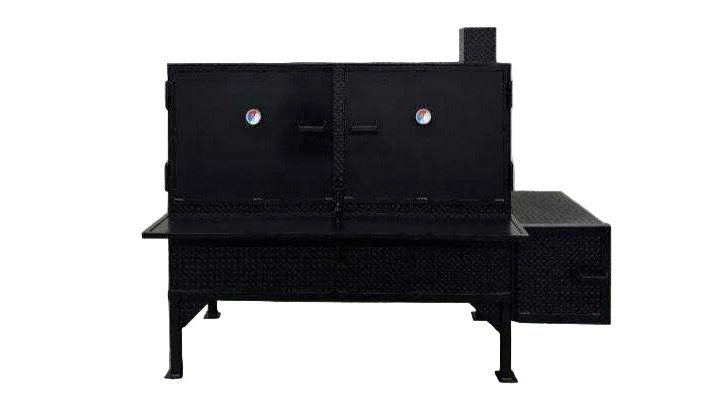
The Beast answers the problem of running out of room. The main smoker is built from 1/4-inch diamond tread steel and measures 84 inches by 36 inches, with six slide-out cooking racks sized at 38 by 34 inches.

Wood Smoker SNS Beast Cabinet Smoker →
The numbers tell the story of what it can handle:
- 90 Boston butts
- 90 whole chickens
- 40-50 spare ribs
- 40+ briskets
That is a cabinet smoker for a catering operation or a very serious backyard setup. The insulated firebox measures 36" x 20" x 20", and a warming box at 36" x 20" x 38" gives you a second zone for resting meat. A fish fryer mounts on the backside, and a 36" x 24" storage basket sits on the front.
SNS 40 Vertical Smoker Cabinet
A vertical cabinet design puts serious capacity on a small footprint. The SNS 40 packs a 30" by 40" main chamber into a unit that fits a patio, a small yard, or a concession trailer.

Three full racks hold up to 40 pork butts. The firebox is double-walled and fully insulated at 20" x 20" x 30", built to retain heat and push reverse-flow smoke evenly through the chamber. At around 1,000 pounds shipping weight, it is not a unit you wheel out for a quick cook.
Where it fits: catering side hustles, event cooking, or feeding a large crew without giving up your whole yard. The insulation and steel construction mean tight temperature control even when the weather shifts.
SNS Cabinet 60 Wagon Competition Smoker and Competition 60 Barbeque Smoker
Two models at the same price point, built for two different competition styles.
The SNS Cabinet 60 Wagon Competition Smoker uses a cabinet layout. The main cabinet is 60" x 30" with three slide-out racks measuring 57" x 28", an insulated firebox at 30" x 20" x 20", and a rib box at 30" x 20" x 32" with five racks sized 18" x 27". Capacity runs 60 Boston butts, 60 whole chickens, 30 spare ribs, and 20-30 briskets.

The Competition 60 Barbeque Smoker takes the tank approach.
SNS 72 Smoker Cabinet and The Avery Cabinet Smoker
These two sit at opposite ends of the cabinet range: volume versus scale.
SNS Pellet Vault
Not every heavy duty cook wants to babysit a fire. The Pellet Vault is a commercial-grade pellet smoker that runs on a PID controller set in 5-degree increments, with a temperature range of 160°F to 350°F and 36,000 BTUs.
- Cabinet measures 36" wide, 65" tall, and 22" deep, with four slide-out racks at 20" x 32"
- 35-pound hopper with a viewing window and a pellet dump for easy removal
- Removable burn pot for straightforward ash removal
- 301 stainless steel hopper lid and burn pot
- USA-made PID algorithm, with the controller mountable on either side
- 1-year warranty
Meadow Creek Offset Smokers: TS70P and TS120P
Meadow Creek builds tank smokers, and these two offset models cover backyard and competition use at different scales.
How to Maintain a Heavy Duty Smoker
- Season the chamber after every cook. A thin coat of cooking oil on interior steel blocks rust between sessions.
- Empty the ash pan before it fills. Ash traps moisture against the metal, and moisture is what starts corrosion.
- Check door gaskets and latches each season. An airtight seal is what holds your temperature; a worn gasket quietly costs you fuel.
- Touch up chips and scratches promptly. Powder coating and paint protect the steel, and small repairs stop small problems from spreading.
- Store under cover when possible. Weatherproofing extends the life of any outdoor cooker, especially in humid or coastal climates.
Best Smoker for Competition BBQ
The best smoker for competition BBQ holds a narrow temperature band for hours without intervention and gives you enough rack space to cook all four categories at once.
Three features decide it:
- Insulated firebox. Holds heat through overnight cooks and shifting ambient temperatures.
- Reverse-flow draft. Spreads heat evenly so one rack does not run hotter than another.
- Slide-out racks. Let you check and pull meat without losing chamber temperature.
Reverse Flow Smoker Benefits
A reverse flow smoker routes heat and smoke under a plate, along the length of the chamber, and back across the cooking grates before it exits, producing even heat across the whole cooking surface and steadier temperatures over a long cook.
The practical benefits:
- Even cooking across racks. No hot spot at the firebox end.
- Steadier temperatures. The plate acts as a heat sink, smoothing swings.
- Better smoke distribution. Smoke travels the full chamber before leaving.
- Less fuel wasted. Retained heat means you burn less to hold the same temperature.
Frequently Asked Questions
What features define a heavy duty BBQ smoker?
Heavy duty smokers are built around three specs: steel thickness, insulation, and airflow control. Look for 1/4-inch steel in the firebox and cooking chamber, a double-walled insulated firebox that holds heat in cold or windy weather, and adjustable dampers for managing airflow. A reverse flow design pushes smoke under a baffle plate and back across the cooking surface, which evens out temperatures from end to end. Slide-out racks, an ash cleanout system, and positive-lock latches are other signs of commercial-grade construction.
Why do professional pitmasters prefer thick-gauge steel smokers?
Thick steel absorbs and holds heat, so the smoker recovers faster when you open the door and stays steady through overnight cooks. A 1/4-inch firebox resists warping over years of high-heat burns, and the extra mass means fewer fuel adjustments during a long brisket cook. Insulated fireboxes add another layer of temperature stability in rain, wind, or winter. That consistency is what separates competition-ready results from backyard guesswork, and it reduces how often you have to check the fire.
What are the benefits of reverse flow technology in heavy duty smokers?
Reverse flow smoker benefits come down to even heat and cleaner smoke. Instead of letting hot air travel straight across from the firebox, a reverse flow design routes smoke underneath a baffle plate, then back over the food toward the chimney. The longer path gives heat more time to distribute, which cuts the hot spot near the firebox and keeps temperatures within a narrow range across the whole cooking surface. That consistency matters most for low and slow cooks like brisket, pork butt, and ribs.
Are heavy duty smokers better for beginners or professionals?
Heavy duty smokers suit both, but for different reasons. Beginners benefit because thick steel and insulated fireboxes forgive small mistakes in fire management, and the temperature stays put while you learn. Professionals and competition teams need the tight temperature control, large cooking surface area, and repairable construction that heavy duty units deliver. If you host big backyard gatherings, a heavy duty cabinet smoker with slide-out racks makes cooking for a crowd easier than juggling multiple smaller cookers.
How does steel thickness affect heat retention in a smoker?
Steel thickness acts like a heat battery. A 1/4-inch firebox and cooking chamber absorb heat during the burn and release it slowly, so the internal temperature stays stable when outside conditions change or when you open the door. Thinner steel swings with every gust of wind and loses heat fast, forcing constant vent adjustments. That is why heavy duty brands spec 1/4-inch plate on fireboxes and at least 3/16-inch on cooking tanks, and why those smokers hold temperature within a tight range for hours.