
Table of Contents
- Why Calibration Is Necessary for Accurate Readings
- Tools and Equipment Needed for Calibration
- The Ice Bath Calibration Method
- The Boiling Water Calibration Method
- How Often to Calibrate Your BBQ Thermometer
- Troubleshooting Meat Thermometer Readings
- Maintenance and Storage for Long-Term Accuracy
- Frequently Asked Questions
Last Updated: September 28, 2026
Why Calibration Is Necessary for Accurate Readings
An inaccurate meat thermometer ruins your cook, you might undercook meat or pull it off too early, and your guests notice. Learning how to calibrate a professional meat thermometer ensures you never guess on temperature again.
Calibration ensures your thermometer matches reality. Over time, probes drift and sensors degrade, a thermometer accurate last season may be off by 5-10 degrees now. For competition pitmasters, that margin decides wins and losses. For anyone serving food, it's a food safety issue.
Understanding how to calibrate a professional meat thermometer keeps your readings honest. It takes 10 minutes, costs nothing, and is the difference between guessing and knowing.
Tools and Equipment Needed for Calibration
For ice bath calibration:
- A glass or cup
- Ice cubes (crushed ice works better than whole cubes)
- Water
- Your meat thermometer
- Optional: a small wrench or pliers to turn the calibration nut
For boiling water calibration:
- A pot
- Water
- Your meat thermometer
- Optional: a wrench or pliers for adjustment
For digital thermometers:
- The same ice and boiling water setup
- A small screwdriver or hex key (check your thermometer's manual for the adjustment tool)
The Ice Bath Calibration Method
The ice bath method calibrates your thermometer at 32 degrees Fahrenheit, the freezing point of water at sea level. The process differs between dial and digital thermometers.
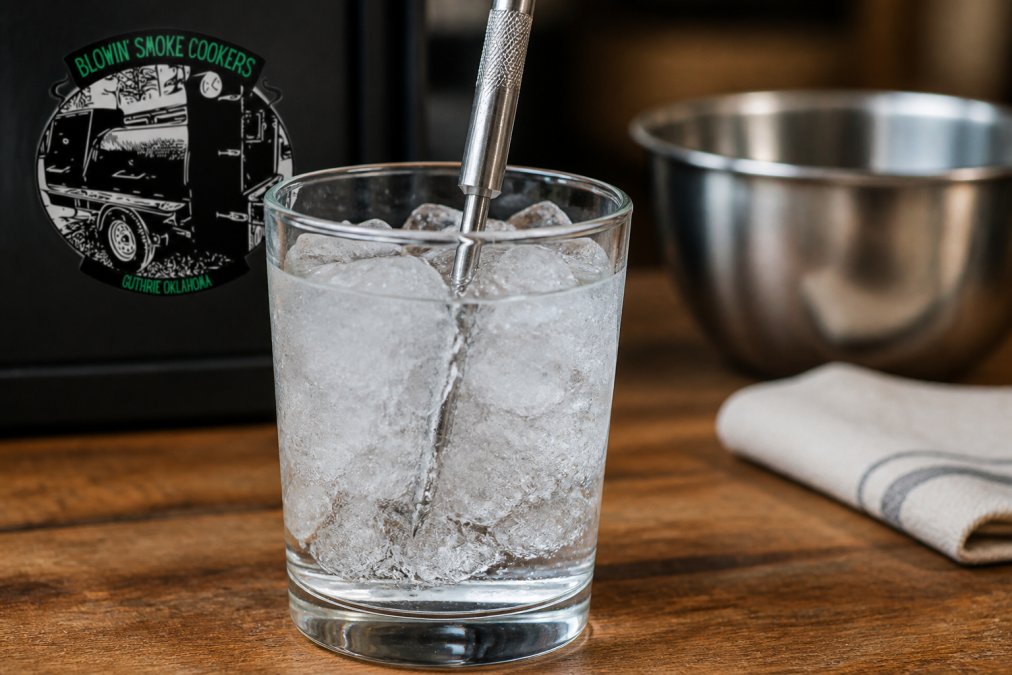
Dial Thermometer Ice Bath Calibration
Step 1: Prepare your ice bath Fill a glass with crushed ice and add cold water to create a slurry. The water fills gaps around ice crystals and creates uniform thermal contact with your probe.
Step 2: Insert the probe Submerge your probe to the immersion depth mark (usually 2-3 inches). Wait 30-60 seconds for the needle to stabilize; dial thermometers respond more slowly than digital units because the needle must physically move through the mechanical linkage.
Step 3: Read the thermometer Your thermometer should read 32 degrees Fahrenheit. If it doesn't, the dial has drifted and requires adjustment.
Step 4: Adjust the dial (if needed) Dial thermometers have a small calibration nut on the back of the head. Use a wrench or hex key to turn it: clockwise raises the reading, counterclockwise lowers it. Make quarter-turn adjustments and retest after each one.
Digital Thermometer Ice Bath Calibration
Step 1: Prepare your ice bath
Step 2: Insert the probe Submerge your probe to the immersion depth mark. Wait 10-15 seconds for the readout to stabilize; digital sensors respond faster than dial thermometers.
Step 3: Read the display Your thermometer should read 32 degrees Fahrenheit. If it reads off, the sensor has drifted and requires recalibration.
Step 4: Recalibrate (if needed) Most digital thermometers have a calibration button labeled "CAL" or "ZERO." While the probe is submerged, press and hold it for 3-5 seconds until the display confirms recalibration. The thermometer now stores 32 degrees as its reference point.
Some models require removing the probe before pressing calibration, check your manual. Unlike dial adjustment, you are resetting the electronic sensor's reference point, not moving a physical needle.
The Boiling Water Calibration Method
The boiling water method calibrates your thermometer at 212 degrees Fahrenheit (at sea level). This is the opposite end of the temperature range and confirms accuracy at higher heat.
How Often to Calibrate Your BBQ Thermometer
Most pitmasters calibrate once per season before spring's first cook, or before each competition. Some check before every major cook.
Calibration schedule:
- Once per season: Casual home cooks and backyard enthusiasts
- Before each competition: Competitive pitmasters
- Monthly during heavy use: Professional caterers and restaurants
- Anytime readings seem off: Any user, any time
Troubleshooting Meat Thermometer Readings
When your thermometer reads off, start with these checks. Not every drift can be fixed by recalibration, some indicate the thermometer needs replacement.
Recalibration-Fixable Problems
Problem: Thermometer reads 5-10 degrees too high
- Recalibrate using the ice bath method. If it reads 32 degrees after recalibration, test in boiling water to confirm accuracy across the range.
- If it drifts again within weeks, the sensor is degrading and replacement is better than repeated recalibration.
Problem: Thermometer reads 5-10 degrees too low
- Recalibrate using the boiling water method. After recalibration, verify readings in both ice water and boiling water.
- If it reads correctly at one temperature but drifts at the other, the sensor is non-linear and replacement is the better choice.
Problem: Readings vary wildly from one moment to the next
- Confirm you're waiting long enough: digital thermometers need 10-15 seconds, dial thermometers 30-60 seconds.
- Move the probe to a different spot in the meat; temperature varies throughout, especially surface versus center.
- Check that your probe is clean; grease or residue blocks heat transfer.
Replacement-Necessary Problems
Consistent drift of more than 3-5 degrees after calibration If your thermometer drifts again within a week of recalibration, the sensor or mechanical component is failing. Replacement is more reliable than repeated recalibration.
The Replace vs. Repair Decision Matrix
Use this quick reference to decide whether to recalibrate or replace:
Symptom |
Recalibrate |
Replace |
|---|---|---|
Reads 3-5 degrees off in ice bath |
✓ Try first |
If drift repeats within weeks |
Reads correctly after recalibration, stays accurate for months |
✓ Yes |
Not needed |
Reads off by more than 5 degrees even after recalibration |
✗ |
✓ Yes |
Drifts again within days or weeks of recalibration |
✗ |
✓ Yes |
Dial needle stuck or sluggish |
✗ |
✓ Yes |
Digital display blank or won't power on |
✗ |
✓ Yes (after battery check) |
Probe visibly bent, corroded, or cracked |
✗ |
✓ Yes |
Reads differently at 32°F vs. 212°F after recalibration |
✗ |
✓ Yes |
Maintenance and Storage for Long-Term Accuracy
How you store and handle your thermometer between cooks affects how long it stays accurate.
Storage best practices:
- Keep your thermometer in a cool, dry place. Extreme temperature swings degrade sensors and mechanical components.
- Store the probe in a protective sheath or case. A loose probe bouncing around in a toolbox gets damaged.
- For dial thermometers, avoid storing them where the dial face faces direct sunlight. UV exposure fades the numbers and can warp the housing.
- Keep digital thermometers away from moisture. Store them with the battery compartment closed and sealed.
Cleaning your thermometer:
- Wipe the probe clean after every use. Grease and meat residue harden and interfere with temperature sensing.
- Use warm water and mild soap. Dry completely before storing.
- Never soak a dial thermometer in water. The internal mechanism can rust.
- For digital thermometers, avoid submerging the battery compartment or display. Wipe the probe only.
Handling:
- Don't drop your thermometer. A hard fall can damage the sensor or knock a dial needle out of calibration.
- Don't use your thermometer as a scraper or tool. The probe is delicate.
- Avoid rapid temperature changes. Don't pull a hot probe out of a smoker and plunge it into ice water to cool it down. Let it cool naturally first.
When to replace:
- If your thermometer consistently reads more than 3-5 degrees off after calibration attempts, the sensor is degraded. Replacement is cheaper than the guesswork.
- If the dial face is cracked or the numbers are illegible, replace it.
- If a digital thermometer won't hold a charge or the display is dim or unreadable, battery replacement may help. If not, it's time for a new thermometer.
Frequently Asked Questions
How do I tell if my meat thermometer is accurate?
Test your thermometer using the ice bath method: fill a glass with crushed ice and water, wait for thermal equilibrium (about 2 minutes), and insert the probe to the dimple. It should read 32°F. Repeat with boiling water, which should read 212°F at sea level. If readings are off by more than 2°F, your thermometer needs adjustment or replacement. Regular validation ensures food safety and consistent cooking results.
How often should a professional meat thermometer be calibrated?
Calibrate your BBQ thermometer before each competition or catering event, and at minimum once per month during regular use. Digital thermometers can drift over time due to sensor degradation, especially with frequent temperature changes. Professional pitmasters often check calibration weekly to ensure precision for competition-grade results. If you notice temperature variance or suspect accuracy issues, recalibrate immediately regardless of schedule.
Why is my meat thermometer not reading correctly?
Incorrect readings usually stem from improper probe placement, sensor drift, or calibration drift. Ensure the probe reaches the center of the meat at the correct immersion depth. Clean the probe tip regularly to remove residue. Check that your thermometer hasn't drifted by running an ice bath test. If readings are consistently off by more than 2-3°F, the sensor may be degraded and the thermometer should be replaced. Altitude can also affect boiling point calibration.
Can all digital meat thermometers be calibrated?
Most digital thermometers have an adjustment calibration nut or digital offset setting, but not all models are user-adjustable. Check your thermometer's manual for calibration instructions. Some budget models lack this feature and cannot be recalibrated—only replaced. Professional-grade digital thermometers designed for pitmasters typically include calibration capability. If your model doesn't offer adjustment, use the ice bath and boiling water methods to validate accuracy before use.
Accurate temperature control is the foundation of consistent, competition-ready results. Calibration keeps your thermometer honest and your cooks predictable. A professional meat thermometer paired with a reverse flow smoker built for precision, like the equipment we carry from Sling n Steel and Meadow Creek, gives you the tools to deliver the same results, every time. Check your thermometer before your next cook. It takes minutes and pays dividends in confidence and consistency.