
Table of Contents
- How to Manage Fire for 12-Hour Brisket Cook: Core Principles
- Temperature Management and Control Systems
- Charcoal Management for Long Cooks
- Maintaining Smoker Temperature Overnight
- The Stall, Wrapping, and Fire Adjustments
- Best Competition Grade BBQ Smokers 2026
- Common Fire Management Mistakes and Recovery
- Frequently Asked Questions
Last Updated: September 26, 2026
How to Manage Fire for 12-Hour Brisket Cook: Core Principles
Learning how to manage fire for 12 hour brisket cook requires precision, patience, and understanding how your smoker responds to fuel and airflow. Fire management during long, unattended hours separates competition-grade brisket from mediocre results.
A brisket held steady at 225-250°F for 12 hours produces crispy bark, deep smoke penetration, and locked-in moisture. Temperature swings between 180°F and 280°F create uneven cooking and dry meat.
Temperature Management and Control Systems
Hold 225-250°F in the smoker chamber to render fat, develop bark, and avoid drying the meat.
Thermal mass and insulation reduce fuel adjustments and stabilize temperature. Reverse flow design directs heat evenly across the cooking chamber, eliminating hot spots.
Here's what temperature stability actually means in practice:
- Ambient temperature: The air temperature inside your smoker chamber
- Internal meat temperature: What your probe thermometer reads when inserted into the thickest part of the brisket
- Firebox temperature: The heat being generated by your fuel
Keep ambient temperature within a 25-degree band (e.g., 210-260°F if targeting 235°F). Wider swings waste time and create uneven cooking.
Automated systems use servo motors to adjust dampers; manual smokers require damper adjustments. Start with dampers 25% open and adjust based on thermometer readings.
Charcoal Management for Long Cooks
Charcoal management determines fire stability. You need enough fuel to sustain combustion without overloading your firebox.
Calculating Your Fuel Needs
A typical offset firebox burns roughly 15-20 pounds of charcoal per hour at 225-250°F, requiring 180-240 pounds total for a 12-hour cook, staged and ready.
Consumption varies by outside temperature (cold nights +20-30%, warm days -10-15%), wind exposure (10+ mph winds +15-25%), smoker insulation (well-insulated smokers use 30-40% less fuel), and charcoal quality (premium briquettes burn consistently; lump charcoal burns unpredictably).
Practical Fuel Staging for 12 Hours
Fill your firebox three-quarters full (40-50 pounds) at ignition for 2-3 hours of burn time. Stage 5-pound batches within reach. Add fuel every 1.5-2 hours during day, every 2-3 hours overnight. Never add more than 5-10 pounds at once; large additions spike temperature 30-50°F and take 20-30 minutes to stabilize.
Managing Ash and Combustion Efficiency
Rake ash every 2-3 hours to prevent 30-50°F temperature drops. Watch for overnight buildup. Use a charcoal grate if available to improve airflow and extend burn time by 10-15%.
Wood Chunks: Smoke Without Chaos
Use small wood chunks (oak or hickory) on top of charcoal. Add one chunk every 1-2 hours for the first 6 hours, then every 3-4 hours. Soak chunks 30 minutes before use for cleaner smoke. Never use treated wood or softwoods.
Emergency Fuel Protocols
If running low on charcoal mid-cook, use 2-3 pound batches every 1-1.5 hours, or finish the last 2-3 hours in a 325°F oven. If charcoal burns too fast, close dampers to 20-30% (firebox) and 50% (chimney). If temperature doesn't drop, switch charcoal brands.
The Stall and Fuel Adjustment
The stall (150-160°F plateau) occurs when pitmasters panic and add too much fuel, causing temperature spikes that slow moisture absorption. Reduce fuel additions by 25-30% during the stall; wrapped brisket cooks faster.
Maintaining Smoker Temperature Overnight
Overnight hours test most home cooks. Set up your smoker for stability before stepping away; you can't rely on visual cues.
Pre-Sleep Setup Protocol
Start your cook early enough to sleep only 4-6 hours. You need to be present for the stall, wrapping, and final push to doneness.
Fill your firebox with 50-60 pounds of charcoal for 4-6 hours of fuel, minimizing overnight refueling.
Set dampers conservatively: firebox 20-25% open, chimney vent 40-50% open. Slower burn means more stable temperature.
Wood Smoker SNS Beast Cabinet Smoker →
- Check your thermometer one final time before bed. Your smoker should be holding steady at 225-250°F with no drift over the last 30 minutes. If it's creeping up or down, adjust your dampers now, not after you've slept for 2 hours and woken to a 280°F chamber.
Remote Thermometer Selection and Placement
Use a quality remote thermometer with dual probes, 100+ feet wireless range, alarm thresholds (low 200°F, high 275°F), and 48+ hour battery life.
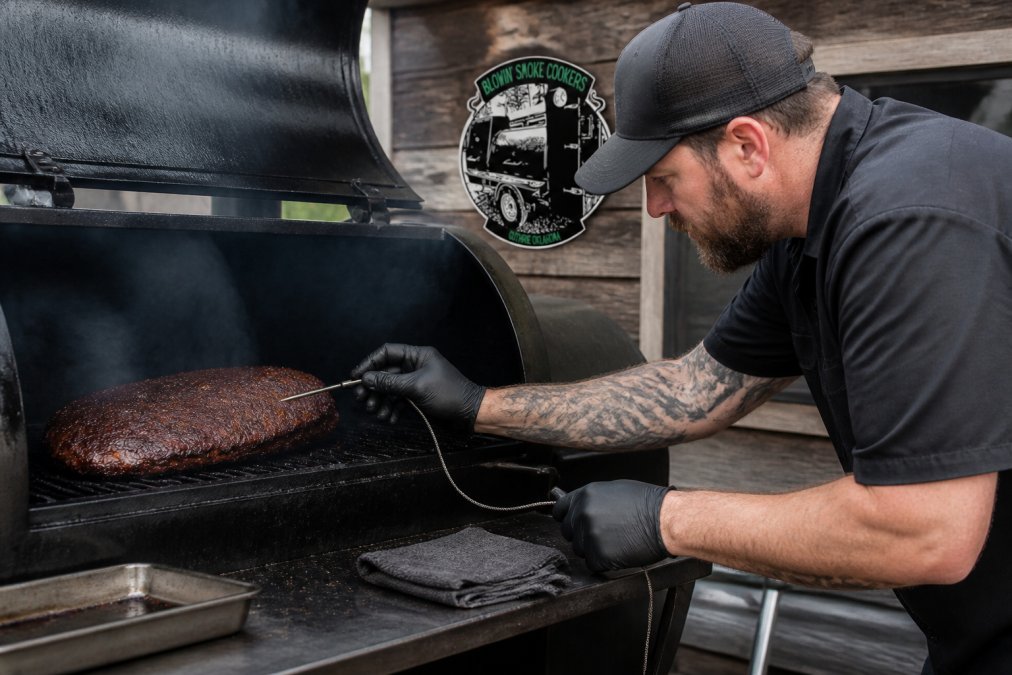
Insert meat probe into the thickest part of brisket away from bone. Place chamber probe at grate level away from direct firebox heat to avoid 20-30°F reading errors.
Environmental Adjustments for Overnight Cooks
Cold nights (below 50°F): open dampers 5-10% more, check every 2 hours, add 10-15 extra pounds charcoal. Warm nights (above 70°F): close dampers 5-10% more, check every 3-4 hours, reduce charcoal by 10-15 pounds. Windy conditions (10+ mph): increase firebox damper 10-15%, close chimney vent to 35-40%, check every 1.5-2 hours.
The Overnight Check Routine
Set alarm 2-3 hours after bed. Check remote thermometer: if 225-250°F, on track; if 260°F+, close firebox damper to 15% and chimney vent to 35%; if 210°F or below, open dampers and add 3-5 pounds charcoal. Inspect firebox for active coals; rake ash if needed. At hour 8-9, brisket should be 150-160°F. Set next alarm 2-3 hours later.
Troubleshooting Overnight Temperature Drift
Temperature creeping up: close firebox damper to 15-20% and chimney vent to 40%; if no drop in 15 minutes, remove charcoal. Temperature dropping: rake ash, add 5-10 pounds charcoal, open firebox damper to 30% and chimney vent to 55%. Temperature swinging: make smaller damper adjustments (5% increments), close chimney vent to 45%, or reposition smoker away from wind.
The thermal mass of a heavy-duty smoker works in your favor here. A well-built smoker with proper insulation, like the SNS 40 Cabinet Smoker or SNS 72 Cabinet Smoker from Blowin' Smoke Cookers, resists temperature swings better than lightweight equipment. That means fewer adjustments needed overnight and more consistent results.

The Stall, Wrapping, and Fire Adjustments
The stall is real, and it's not a failure, it's physics. Around 150-160°F internal temperature, the brisket stops rising. This happens because evaporative cooling on the meat's surface offsets the heat you're applying. It can last 1-3 hours, and it's where most pitmasters panic and ramp up their fire.
Don't do that.
Instead, here's what happens at the stall and how to manage your fire:
During the stall (150-160°F internal temp):
- Keep your smoker at 225-250°F. Do not increase heat.
- This is the time to wrap your brisket in butcher paper (the "Texas crutch"). Wrapping traps moisture and helps push through the stall.
- Reduce your airflow slightly. Less oxygen means a slower, gentler cook that won't dry out the meat.
- Add a small amount of liquid (beef broth or apple juice) inside your wrap. This adds moisture and flavor.
After wrapping (160-190°F internal temp):
- Your fire can relax. Wrapped meat cooks faster because it's insulated.
- You might actually need to reduce your fuel slightly to prevent temperature creep.
- This is where emergency fire recovery becomes relevant: if your temperature has drifted high during the stall, now's the time to dial it back by closing your dampers or removing some charcoal.
The final push (190°F to target, typically 203°F):
- Open your dampers slightly. You want airflow to accelerate the final cook.
- Your fire should be stable and consistent. No big adjustments now.
- Monitor your internal temperature closely. The difference between perfectly tender (203°F) and overdone (210°F+) is 30 minutes of cooking.
Emergency fire recovery: if your temperature spikes above 280°F, open your chimney vent fully and close your firebox damper to 10-15%. This cools your smoker quickly without killing your fire. If it stays high, remove a handful of charcoal from your firebox. Recovery takes 10-15 minutes.
Best Competition Grade BBQ Smokers 2026
To master how to manage fire for 12 hour brisket cook, your equipment matters. A lightweight smoker with poor insulation will fight you every hour. A competition-grade smoker with heavy-duty steel construction, proper reverse flow design, and thermal mass will make your job dramatically easier.
Blowin' Smoke Cookers specializes in equipment built for exactly this: long, unattended cooks that demand precision. Our partnership with Sling n Steel Custom Smokers and Meadow Creek products brings you American-made smokers engineered for consistency.
The SNS Beast Cabinet Smoker is built for volume and stability.
Common Fire Management Mistakes and Recovery
Most pitmasters make the same mistakes on their first long cook. Knowing them in advance saves you hours of frustration.
Recovery: Switch to briquettes. Your temperature will stabilize immediately.
Frequently Asked Questions
How do you maintain a steady temperature in a charcoal smoker for 12 hours?
Steady temperature depends on three factors: airflow control through the firebox damper and chimney vent, consistent charcoal fuel placement, and thermal mass. Start with a full firebox of quality briquettes, adjust your damper to hold your target temperature (typically 225-250°F), and add small amounts of charcoal every 1-2 hours rather than large dumps. A reverse flow smoker like the SNS 40 Cabinet Smoker maintains heat retention and temperature stability better than offset designs, reducing the frequency of fuel adjustments needed during long cooks.
What is the best fuel source for long brisket cooks?
High-quality briquettes are ideal for 12-hour cooks because they burn consistently and produce less ash than lump charcoal. Briquettes maintain steady heat output and temperature stability, which is critical for unattended cooking. Wood chunks should be added sparingly, too much smoke penetration can overpower the meat. Most competition pitmasters use briquettes as the base fuel and add small amounts of oak or hickory wood chunks only during the first 4-6 hours when the meat accepts smoke best.
Is my brisket ruined if the fire goes out during a 12-hour cook?
A brief fire loss (under 30 minutes) typically won't ruin your brisket if the internal temperature hasn't dropped significantly. Meat retains heat due to thermal mass. However, extended fire loss can result in food safety issues and uneven cooking. The best approach is prevention: use a smoker with excellent heat retention, monitor your fuel supply hourly during the first half of the cook, and consider an automated temperature control system for overnight periods. If fire does go out, quickly rekindle it and continue, the brisket will recover if the internal temperature remains above 140°F.
What is the 4-2-10 rule for brisket?
The 4-2-10 rule is a timing framework: smoke unwrapped for 4 hours (bark formation and smoke penetration), wrap in foil or butcher paper for 2 hours (the stall acceleration phase), then unwrap for the final 10 hours until the internal temperature reaches 203°F. This method balances bark development with tender, moist meat. However, actual times vary based on brisket size, ambient temperature, and your smoker's airflow characteristics. Monitor internal temperature with a probe thermometer rather than relying strictly on the clock, a 12-pound brisket may finish in 10-11 hours total, while larger cuts take 13-14 hours.