
Which Brisket Dry Rub Keeps Your Meat Moist?
Editorial Team
Nov 16
Last Updated: November 14, 2026
Quick Summary
The best brisket dry rub for moisture is a simple equal-parts coarse salt and coarse black pepper blend with a little garlic powder, applied as a dry brine 12 to 24 hours ahead. Coarse salt dissolves slowly, seasons deeper and helps the surface hold water, while heat control and resting do the real moisture work.
- A rub cannot add moisture; it only helps the surface retain what is already there.
- Apply salt 12 to 24 hours ahead, then add the remaining spices 1 to 2 hours before cooking.
- Keep sugar-heavy rubs off long cooks because brown sugar burns above 275°F.
- Use roughly 1 tablespoon of rub per pound and pat it on from about 12 inches up.
- Wrap when the bark is set and the internal temp stalls, usually around 165°F.
Ready for a smoker that holds temp?Heavy-duty reverse flow smokers built for consistent, moist brisket every cook.
Shop Brisket Smokers
Table of Contents
- What a Brisket Dry Rub Can and Cannot Do for Moisture
- The Simple Brisket Rub Recipe That Works Every Time
- Four Brisket Dry Rub Recipes Built for Moisture
- The Best Brisket Rub Recipe for Bark
- Beef Brisket Rub Overnight: Salt Timing and Dry Brining
- How to Keep Brisket Moist From Rub to Rest
- How Much Rub per Pound of Brisket
- Pick the Right Smoker for Moist Brisket
- Frequently Asked Questions
What a Brisket Dry Rub Can and Cannot Do for Moisture
A brisket dry rub cannot add moisture to meat.
A rub helps by drawing surface moisture out and dissolving salt into the meat, which seasons it and slightly improves water-holding capacity near the surface.
Watch out: loading a brisket with a wet, sugar-heavy slather and calling it "moisture protection" can backfire. Sugar may burn before the bark sets, leaving a bitter crust.
The Simple Brisket Rub Recipe That Works Every Time
If you want one recipe to memorize, this is it.
Use this ratio:
- 4 tablespoons coarse salt
- 4 tablespoons coarse-ground black pepper
- 1 tablespoon garlic powder
Mix in a bowl and apply. That's a classic Texas-style base and the foundation most competition rubs are built on. It adheres well, forms a clean bark, and doesn't fight the beef flavor.
What most guides miss is that coarse salt matters more than which spices you add. Fine salt dissolves too fast and pulls moisture to the surface before the bark can set.
Four Brisket Dry Rub Recipes Built for Moisture
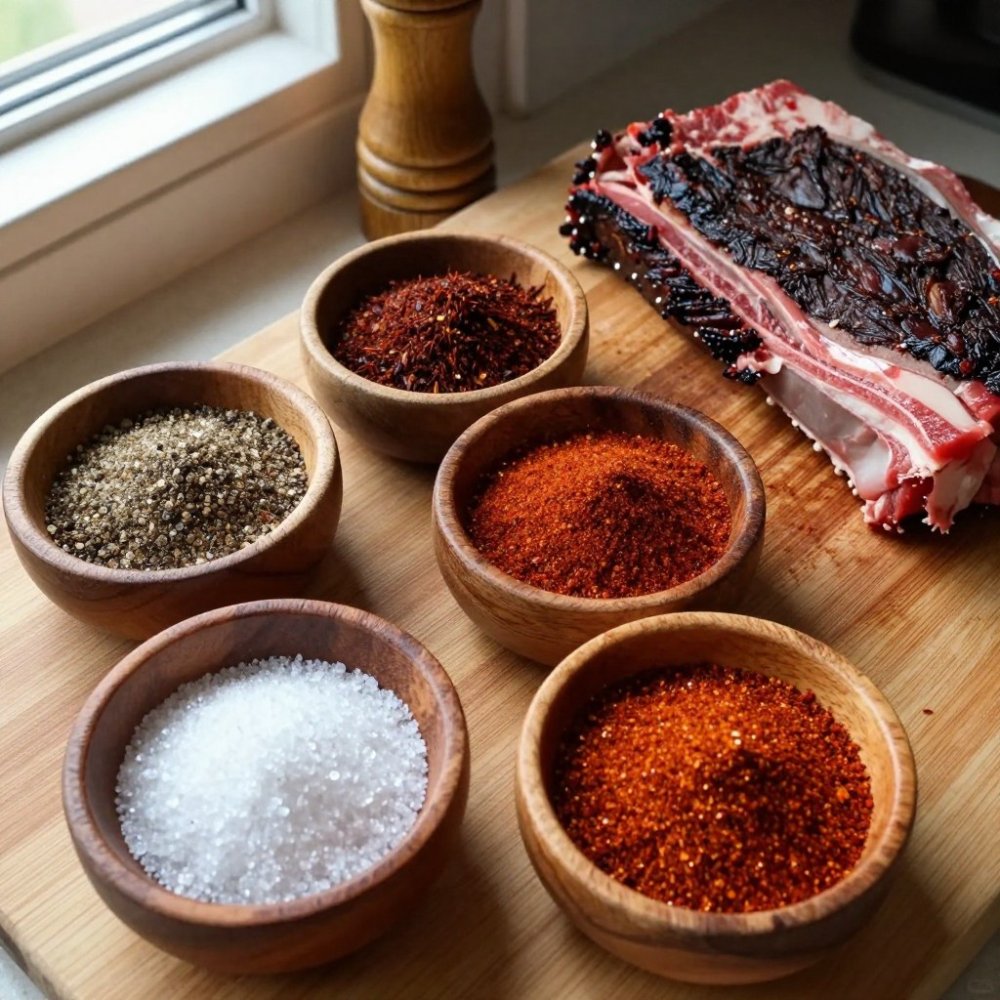
Each recipe follows the same principle: control the salt, control the sugar, and let the spice blend support the beef instead of masking it. Pick the one that matches your cook length and your crowd.
Texas Salt and Pepper (SPG) Rub
The standard: 4 parts coarse salt, 4 parts coarse black pepper, 1 part garlic powder. This is the SPG blend, and it's the safest choice for long cooks because there's no sugar to burn. It produces a dark, peppery bark and lets the smoke do the talking.
Savory Garlic and Onion Rub
For cooks who want depth without sweetness, combine 3 tablespoons coarse salt, 3 tablespoons coarse black pepper, 2 tablespoons garlic powder, 2 tablespoons onion powder, and 1 teaspoon ground mustard. The mustard powder helps the rub adhere and adds a subtle tang. No sugar means no scorching risk.
Sweet and Smoky Brown Sugar Rub
Use this one only on shorter cooks or at lower heat. Mix 3 tablespoons coarse salt, 2 tablespoons brown sugar, 2 tablespoons paprika, 1 tablespoon smoked paprika, 1 tablespoon black pepper, and 1 teaspoon garlic powder. The brown sugar aids bark formation and browning, but it will burn above 275°F. Keep it for the last few hours or a hot-and-fast cook.
Competition-Style Layered Rub
Competition cooks often apply a base layer of salt and pepper, then a second layer of a sweeter, paprika-forward blend. Try 3 tablespoons coarse salt, 3 tablespoons coarse pepper as the base, then a top layer of 2 tablespoons paprika, 1 tablespoon brown sugar, 1 teaspoon onion powder, and 1 teaspoon oregano. The layering gives you a mahogany bark and a more complex bite.
The Best Brisket Rub Recipe for Bark
The best brisket rub recipe for bark is one with enough coarse salt and pepper to draw surface moisture and enough time on the smoker to set it. Bark is dehydrated meat surface, not a coating. It forms when the rub dissolves, the surface dries, and smoke particles bond to it.
Three things build bark:
- Coarse salt and pepper applied evenly, with no bare patches
- Steady low heat, ideally 225°F to 250°F, so the surface dries before it burns
- Patience through the stall, when most cooks panic and wrap too early
If you want a deeper bark, skip the wrap or wrap in butcher paper rather than foil. Foil traps steam and softens the crust. Butcher paper breathes and lets the bark keep developing.
Beef Brisket Rub Overnight: Salt Timing and Dry Brining
Applying the beef brisket rub overnight is the single best moisture move you can make with seasoning.
Here's the timing we recommend:
- Apply salt first, 12 to 24 hours before the cook
- Add the rest of the rub 1 to 2 hours before it hits the smoker
- Keep the brisket covered and refrigerated between steps
Why split it? Salt needs time to penetrate. Paprika, garlic powder, and sugar don't; they sit on the surface and can get gummy if left overnight. Salt now, spices later.
Watch out: don't leave a sugar-heavy rub on overnight in the fridge. It pulls moisture, clumps, and can leave bald spots where the bark won't form.
How to Keep Brisket Moist From Rub to Rest
Knowing how to keep brisket moist comes down to controlling evaporation and giving the meat time to reabsorb its own juices.
- Temperature: Hold a steady temperature at the grate. Heat drives evaporation, and spikes can dry the surface and stall the cook.
- Wrap timing: Wrap when the bark is set and the internal temp stalls, usually around 165°F. The stall happens because evaporating surface moisture is cooling the meat as fast as the fire heats it. Wrapping cuts off that evaporation, which is why the temperature climbs again. Wrap too early and you steam the bark soft; wrap too late and you've already lost more moisture than you needed to.
- Spritzing: A light spritz every 60 to 90 minutes after the first few hours adds surface moisture and slows bark over-darkening. Don't overdo it or you'll wash off the rub. Spritz the edges and thin parts first, since they dry fastest.
- The rest: This is the step people skip. Rest the brisket at least one hour, wrapped and insulated, before slicing. During the rest, muscle fibers relax and reabsorb juices that were pushed to the surface during the cook. Slice too soon and those juices run onto the cutting board instead of staying in the meat.
Doneness matters as much as any of these. Cook to probe tenderness, not just temperature: a brisket is ready when a probe slides into the flat with little resistance.
Brisket grade and fat cover influence moisture before you light the fire. Keeping a fat cap intact helps shield the lean meat during the cook.
When something goes wrong, match the fix to the symptom:
- Dry and crumbly: usually overcooked or cooked too hot. Next time pull earlier on probe tenderness and hold 225°F to 250°F.
- Dry and tough: usually undercooked. The collagen hasn't rendered. Keep cooking and re-probe every 20 minutes.
- Salty: the dry brine ran too long or the salt share was too high. Shorten the salt window or cut the salt in the blend, and don't add salt at the table.
- Unevenly seasoned: rub was patched in clumps or wiped off during wrapping. Apply from 12 inches up, pat rather than rub, and patch thin spots after the stall.
For a deeper look at fire management across a long cook, our guide on how to manage fire for a 12-hour brisket cook walks through the vent and fuel adjustments that keep temperatures stable. If you're cooking on an offset, mastering 225 F on an offset smoker covers the fire management specifics that protect moisture.
How Much Rub per Pound of Brisket
Use roughly 1 tablespoon of rub per pound of brisket as a starting point, then adjust for surface area rather than weight alone.
The weight rule breaks down on two cuts. A flat has more exposed surface per pound than a whole packer, so a 6-pound flat can need nearly as much rub as a 10-pound packer. A point is thick and compact, so it takes less per pound.
Here's a quick reference:
| Brisket Size | Total Rub | Salt Portion | Apply When |
|---|---|---|---|
| 8 lb flat | 1/2 cup | 3 tbsp | Salt 12-24 hrs ahead |
| 12 lb packer | 3/4 cup | 4 tbsp | Salt 12-24 hrs ahead |
| 16 lb packer | 1 cup | 5 tbsp | Salt 12-24 hrs ahead |
Scale any recipe by multiplying each ingredient by the same factor.
Salt is the ingredient to cap, not the spices.
Apply the rub from about 12 inches up so it falls evenly. Pat it in, don't rub it. Rubbing pushes the rub into your hand and leaves bare spots on the meat.
Pick the Right Smoker for Moist Brisket
A rub can only do so much. The smoker decides whether your brisket cooks evenly or dries out on one side, and temperature stability matters most for moisture.
For patio cooks who want steady heat and real capacity, the SNS 24 Patio Smoker is a option for smaller briskets and tabletop setups.
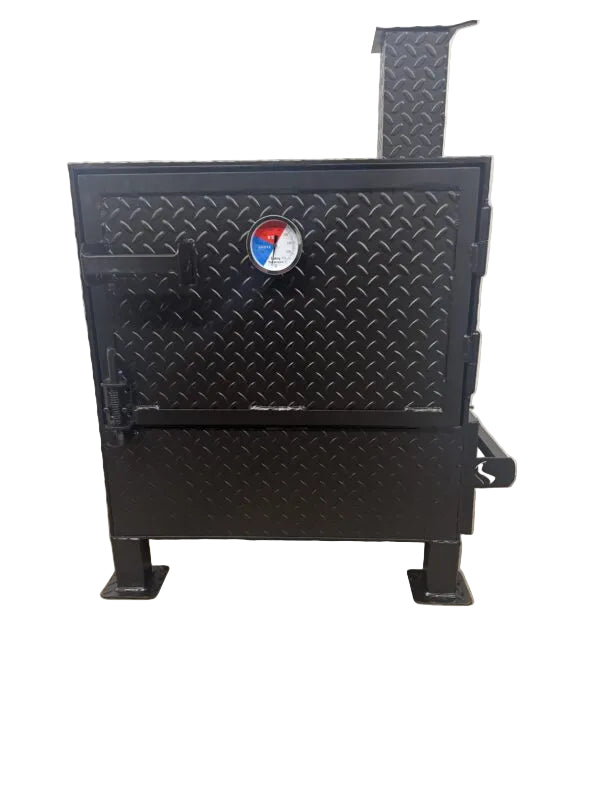
If you're feeding a crowd or cooking packers regularly, the SNS Barrel 40 Patio Smoker gives you a 30"x40" main chamber and two large cooking racks measuring 24"x32" and 28"x32". Available in traditional or reverse flow, it's built from heavy solid steel and holds temperature through long cooks without constant babysitting.
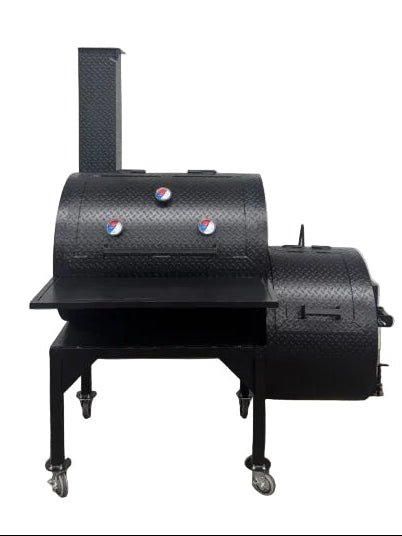
Both are built with heavy-duty steel construction and reverse flow design. For a fuller explanation of why rub alone can't guarantee moisture, read our guide on avoiding dry brisket with a precision smoker.
A dry brisket is almost never a rub problem. It's a heat problem, a timing problem, or a resting problem, and the fix starts with equipment that holds temperature where you set it.
Frequently Asked Questions
Does a dry rub actually help keep brisket moist?
A brisket dry rub helps moisture indirectly. The salt in the rub draws moisture to the surface and dissolves into the meat, which seasons it and slightly improves water retention during the cook. The bark it builds also slows surface drying. The rub itself does not add water, so pair it with a stable smoker temperature, a water pan if your pit has one, and a proper rest. Wrapping at the stall is what protects the bulk of the moisture.
How long should you leave a dry rub on brisket before cooking?
For a simple brisket rub recipe, apply it at least 40 minutes before the meat goes on. For deeper seasoning, apply the beef brisket rub overnight, 8 to 12 hours ahead, and leave the brisket uncovered in the refrigerator. That dry-brine window lets salt penetrate and season the meat throughout. Skip heavy sugar rubs overnight, since sugar can draw too much surface moisture and burn during a long cook.
What is the best brisket rub for bark?
A coarse rub with plenty of black pepper builds the strongest bark. Coarse-ground pepper and coarse salt create a textured surface that dries and sets into a dark, crunchy layer. Adding a small amount of brown sugar helps browning, but too much sugar burns before the brisket finishes. Apply the rub evenly, let it sit until it looks wet, then cook at a steady 225 to 275°F and wrap only after the bark is set.
How do you keep brisket moist during a long smoke?
Cook at a steady temperature, keep the fat cap between the heat source and the meat, and wrap at the stall, typically around 160 to 170°F, in butcher paper or foil. A water pan adds humidity in offset and cabinet smokers. Pull the brisket when it probes tender, usually between 200 and 205°F, then rest it wrapped in a cooler for at least an hour. Resting lets juices redistribute instead of running out on the cutting board.
Can you use the same brisket rub in an oven and a smoker?
Yes. A brisket dry rub works in either, but adjust the sugar. In an oven, sugar browns slowly and rarely burns, so sweet rubs are safe. In a smoker, high heat and long cook times can scorch sugar, so keep brown sugar to a small share of the blend or skip it. In both cases, apply the rub the same way, keep the meat uncovered until the surface looks wet, and cook low and slow.
