
Table of Contents
- How Professional BBQ Smoker Price Ranges Break Down in 2026
- Entry-Level vs. Prosumer vs. Professional: What Each Tier Actually Means
- Commercial Offset Smoker Prices: What Drives the Cost
- Professional Catering Smoker Features Worth Paying For
- Total Cost of Ownership: Beyond the Sticker Price
- Pellet Grills, Charcoal, and Offset Smokers: Price-to-Performance by Fuel Type
- How to Choose the Right Professional BBQ Smoker for Your Budget
- Conclusion
Last Updated: August 30, 2026
How Professional BBQ Smoker Price Ranges Break Down in 2026
Buying a professional BBQ smoker is one of the most consequential equipment decisions a pitmaster, caterer, or serious backyard cook will make. At Blowin' Smoke Cookers, we work with buyers across all three tiers of the market daily, and the single biggest mistake we see is treating price as a proxy for quality without understanding what actually separates the tiers. The professional bbq smoker price ranges 2026 landscape spans entry-level backyard units to full-scale commercial catering trailers built for daily production cooking. Understanding where your money goes is the real purpose of this guide.
Entry-Level: Backyard Enthusiasts and First-Time Buyers
Entry-level smokers serve the backyard cook who wants genuine smoke flavor without complexity. These units feature thinner-gauge steel, smaller cooking chambers, and limited airflow management. Temperature stability is harder to maintain, and cooking surface area suits family gatherings but not catering events. The limitation shows up fast once you push frequency or volume: thin steel loses heat retention quickly, fuel efficiency drops, and you're fighting the fire instead of cooking.
Prosumer: Serious Competitors and Part-Time Caterers
Prosumer equipment occupies the most interesting position in the market. Built for people who take BBQ seriously enough to compete or cater part-time, these units feature heavier-gauge steel, more precise airflow management, larger charcoal capacity, and meaningful improvements in heat retention. Reverse flow technology, which forces heat and smoke in a controlled path for a more consistent smoke ring and fewer hot spots, starts appearing as a standard feature rather than an upgrade.
Professional-Grade: Full-Time Catering and Competition Circuits
Professional-grade smokers are built for consistent output under demanding conditions. Heavy-gauge steel construction, serious BTU output, large cooking surface area, and commercial-quality grill grates define this tier. These units are designed to run daily, handle large loads of brisket and ribs, and survive transport on competition circuits or catering routes without structural degradation. Warranty coverage and customer support reflect the investment level. This is where Sling n Steel Custom Smokers and Meadow Creek BBQ Products operate, and it's the tier Blowin' Smoke Cookers specializes in as an authorized distributor of both brands.
Entry-Level vs. Prosumer vs. Professional: What Each Tier Actually Means
The terminology gets blurry fast. Here's a cleaner framework.
| Tier | Typical User | Steel Gauge | Cooking Surface | Key Limitation |
|---|---|---|---|---|
| Entry-Level | Backyard, occasional use | Light (under 3/16") | Small to medium | Poor heat retention, durability |
| Prosumer | Competitors, part-time caterers | Medium (3/16" to 1/4") | Medium to large | Not built for daily commercial use |
| Professional | Full-time caterers, circuits | Heavy (1/4" and above) | Large to very large | Higher upfront investment |
Entry-level lacks insulation quality, airflow management precision, and structural integrity for sustained high-heat cooking. It's a design choice optimized for price, not a failure.
Prosumer is where most serious buyers land. The cooking chamber handles real production, steel holds heat through weather changes, and the unit survives competition-level demands with proper technique. It won't survive daily commercial abuse indefinitely.
Professional-grade is an infrastructure decision. These smokers are built to commercial kitchen equipment standards, heavier, more expensive to ship, requiring more maintenance knowledge. The trade-off is longevity, consistency, and resale value that entry-level units cannot match.
Commercial Offset Smoker Prices: What Drives the Cost
Commercial offset smoker prices are driven by variables that compound on each other. Steel gauge, cooking chamber volume, firebox design, and fabrication quality all interact to determine final cost.
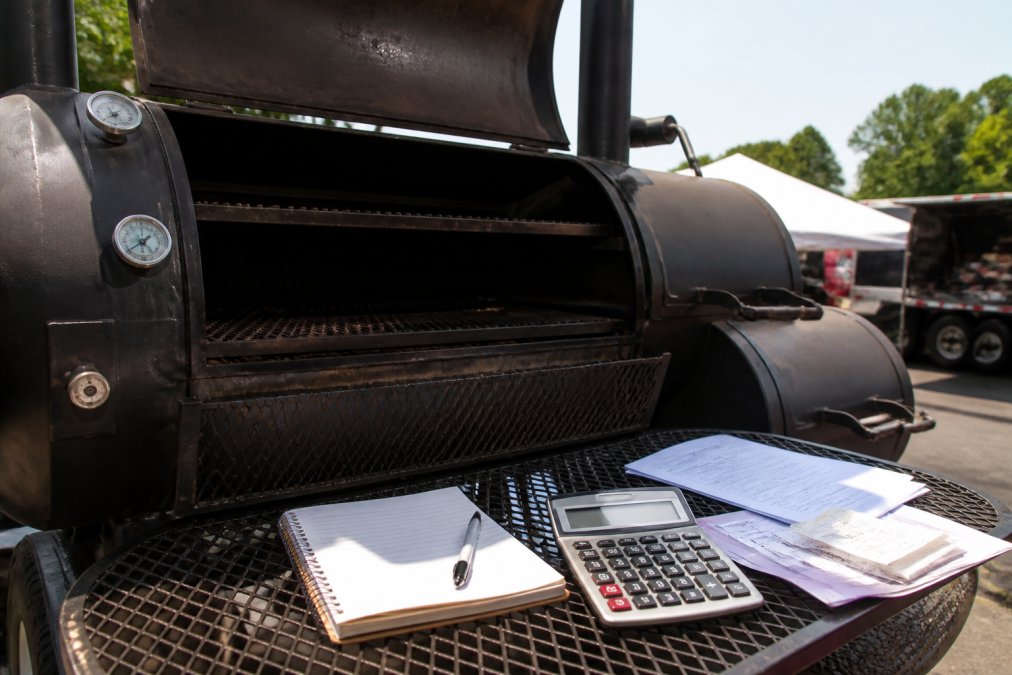
According to the American Welding Society's resources on steel fabrication standards, heavier-gauge steel requires more material, more skilled labor, and more welding time. That cost flows directly into the final price of any heavy-duty smoker.
Steel Gauge, Cooking Chamber Size, and Build Quality
Steel gauge is the single biggest cost driver. Moving from 3/16-inch to 1/4-inch plate steel increases material costs significantly, but the performance difference is substantial. Thicker steel holds heat longer, resists warping under thermal cycling, and provides the structural rigidity needed to support heavy grill grates loaded with meat.
Cooking chamber size amplifies this. A larger chamber requires more steel, more welding, and more precise fabrication to maintain airtight seals. Gaps destroy temperature stability, defeating the purpose of buying a professional unit.
Build quality encompasses welds, hinges, drip tray design, and ash management. These details separate a smoker that works for three years from one that works for thirty.
Reverse Flow vs. Standard Offset: Does It Affect Price?
Reverse flow design does add cost, and it's worth it for most serious buyers. A standard offset draws heat and smoke from the firebox through the cooking chamber and out the exhaust stack. A reverse flow offset uses a baffle plate beneath the grates to redirect heat under the entire chamber before it rises through the food and exits. The result is more even temperature distribution and a more consistent smoke ring.
The baffle plate adds material and fabrication complexity, which is why reverse flow units typically cost more than standard offset smokers of equivalent size. For competition pitmasters and caterers needing consistent results across large loads, that premium is justified.
Professional Catering Smoker Features Worth Paying For
Not every feature on a professional catering smoker justifies its price. Some do.
Temperature Stability and Airflow Management
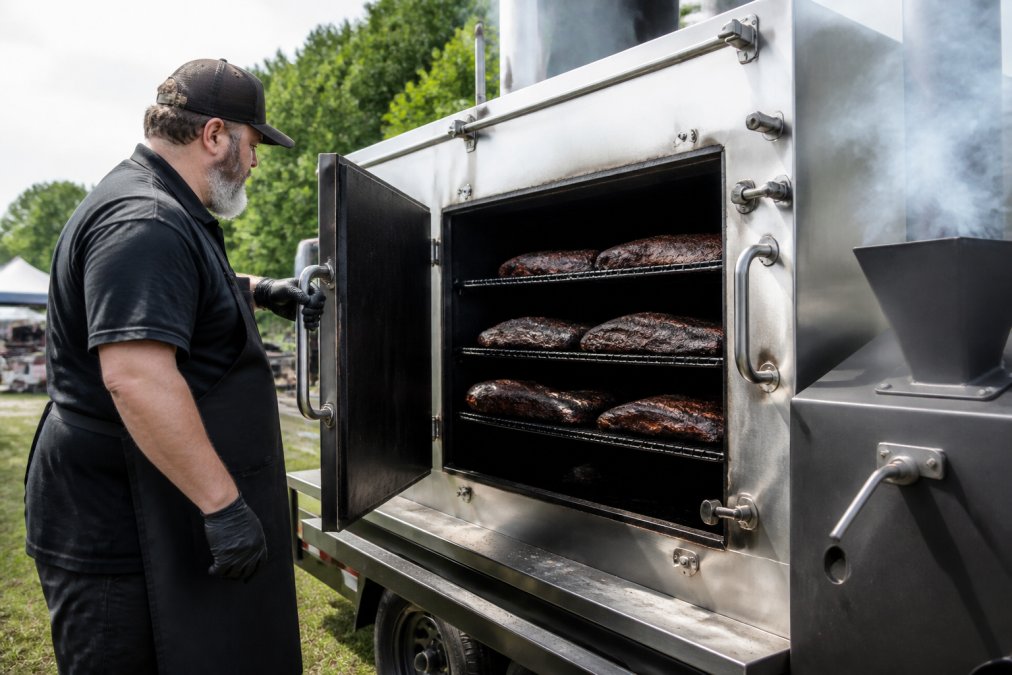
Temperature stability is the most important performance characteristic in any professional catering smoker. Inconsistent heat produces inconsistent results, which is fatal for a catering business or competition entry. Airflow management, through precisely fitted dampers, intake vents, and exhaust stacks, delivers temperature stability.
A common mistake is assuming a digital controller or built-in thermometer solves this problem. They help with monitoring, but don't compensate for a poorly designed firebox or leaky cooking chamber. The engineering has to be right first.
Cooking Surface Area and Charcoal Capacity
Cooking surface area determines production capacity. For catering operations, this is a direct revenue variable. Charcoal capacity matters equally: a firebox requiring constant reloading disrupts temperature stability and adds labor.
Professional catering smokers worth their price allow extended burns without constant attention. This depends partly on firebox size and partly on insulation quality, which determines how efficiently the unit converts fuel into sustained heat.
Durability: Heavy-Gauge Steel, Powder Coating, and Rust Resistance
Year-round outdoor use is the real test of a professional smoker. Rust resistance starts with steel gauge and extends through surface treatment. Powder coating, when applied correctly over properly prepared steel, provides meaningful protection against moisture and oxidation. Thin powder coating over inadequately prepped steel fails within a few seasons.
Heavy-gauge steel is also more rust-resistant simply because oxidation takes longer to penetrate to a structurally significant depth.
Total Cost of Ownership: Beyond the Sticker Price
The sticker price of a professional bbq smoker is the beginning of the financial conversation, not the end. Total cost of ownership includes fuel costs, maintenance, replacement parts, and downtime when equipment fails.
Fuel Efficiency and Ongoing Running Costs
Fuel efficiency varies dramatically between smoker types and build quality levels. A well-insulated, heavy-gauge offset smoker burns less wood or charcoal to maintain target temperature than a thin-walled unit because it loses less heat to the environment. Over a full season of catering or competition, that difference in fuel consumption adds up to meaningful cost savings.
According to the USDA's guidance on food service equipment efficiency, operating costs are a core consideration in any commercial food service equipment decision. A unit that burns 30% less fuel per cook session pays back part of its premium price every time it runs.
Maintenance, Cleaning, and Long-Term Durability
Professional-grade smokers require less reactive maintenance than entry-level units because components are built to tighter tolerances and heavier specifications. They do require consistent preventive maintenance: cleaning the cooking chamber, managing ash buildup, inspecting welds, and treating exterior surfaces.
A well-maintained professional smoker should outlast multiple entry-level or prosumer units. The math on long-term durability almost always favors the higher upfront investment when the unit is used regularly.
Resale Value and Longevity
Entry-level smokers have minimal resale value after two to three seasons. Professional-grade units from reputable American manufacturers hold value significantly better because the secondary market for quality equipment is active among caterers and competitors who know what they're looking at.
A professional bbq smoker built from heavy-gauge steel with documented provenance and proper maintenance history can be resold for a substantial fraction of its original price years after purchase. According to the National BBQ Association's industry resources, equipment longevity and resale value are increasingly cited by catering professionals as primary factors in equipment selection.
Pellet Grills, Charcoal, and Offset Smokers: Price-to-Performance by Fuel Type
Fuel type shapes both the cooking experience and the price-to-performance equation.
Pellet grills use a digital controller and auger system to feed wood pellets into a burn pot, maintaining temperature automatically. PID technology produces impressive temperature stability with minimal user intervention. Wi-fi connectivity is common at prosumer and professional tiers. The trade-off is a more mechanically complex system with more failure points, ongoing pellet costs, and a smoke profile some pitmasters find less intense than traditional wood or charcoal.
Charcoal smokers produce the smoke ring and bark profile that competition judges reward. Charcoal capacity and airflow management are critical variables. The learning curve is steeper, but the ceiling for flavor development is higher.
Offset smokers burning wood chunks or splits represent the traditional approach and remain the standard on the competition circuit. Reverse flow offset smokers, like those in the Sling n Steel and Meadow Creek lineups carried by Blowin' Smoke Cookers, represent the current standard for professional-grade indirect heat cooking.
| Fuel Type | Temperature Control | Smoke Intensity | Maintenance Load | Best For |
|---|---|---|---|---|
| Pellet | Easiest (digital/PID) | Moderate | Mechanical upkeep | Consistency, convenience |
| Charcoal | Moderate skill required | High | Ash management | Backyard, competition |
| Offset (wood/charcoal) | Highest skill required | Highest | Cleaning, seasoning | Competition, catering |
How to Choose the Right Professional BBQ Smoker for Your Budget
The right smoker matches your actual use case, not the most impressive unit you can afford. Overspending on unused capacity is wasteful. Underspending on needed durability is worse.
Backyard Hosts and Large Gathering Cooks
If you're hosting large backyard events but not catering commercially or competing, a prosumer-tier offset smoker with solid cooking surface area and decent heat retention will serve you well. You don't need commercial-grade durability, but you do need enough cooking chamber size to handle a full brisket or multiple racks of ribs simultaneously. Look for heavy-gauge steel construction, a reliable drip tray system, and rust-resistant powder coating if the unit will live outdoors year-round.
A professional-grade catering trailer is overkill for this buyer. A well-built prosumer offset smoker delivers competition-quality results without the commercial price tag.
Competition Pitmasters
Competition demands consistency above everything else. The smoke ring, bark development, and internal temperature curve need to be repeatable across different environments and weather conditions. This requires a smoker with precise airflow management, excellent insulation quality, and a cooking chamber design that minimizes temperature variance.
Reverse flow offset smokers have become the dominant choice on the competition circuit for exactly this reason. The baffle plate design produces more even heat distribution, translating directly to more consistent results.
Catering Business Owners
For catering professionals, a professional bbq smoker is a revenue-generating asset. The calculation is straightforward: how many events can this unit support, at what production volume, before it requires significant maintenance or replacement? A commercial-grade catering trailer smoker with large cooking surface area, strong charcoal capacity, and heavy-gauge steel construction can handle daily use for many years with proper maintenance.
The Small Business Administration's guidance on equipment financing notes that equipment purchases for small businesses should be evaluated against their revenue-generating capacity, not just upfront cost. For a catering business, a professional-grade smoker that enables larger events and more consistent food quality is a business investment with a calculable return.
Blowin' Smoke Cookers carries both Sling n Steel Custom Smokers and Meadow Creek BBQ Products specifically because these brands meet the durability and performance standards that catering professionals require. Both are American-made, built to commercial specifications, and supported by manufacturers who understand the demands of production cooking.
Frequently Asked Questions
What smokers do professional pitmasters use for competitions?
Competition pitmasters typically rely on heavy-duty offset smokers built from thick-gauge steel, often with reverse flow technology to maintain consistent temperature across the entire cooking chamber. These smokers prioritize heat retention, precise airflow management, and large cooking surface area. American-made units from manufacturers known for tight construction tolerances are favored on the circuit because temperature stability directly affects smoke ring development and bark formation, both judged in competition.
Are expensive BBQ smokers worth the investment for catering?
For catering businesses, a higher upfront cost often pays off through lower total cost of ownership. Heavy-gauge steel construction resists warping and rust, reducing repair costs over years of heavy use. Better insulation quality means lower fuel consumption per cook. Catering smokers also tend to hold larger charcoal capacity and offer more cooking surface area, which directly affects how many covers you can serve per event. A unit that breaks down mid-event costs far more than the price difference between tiers.
How much does a professional BBQ smoker typically cost?
Professional BBQ smoker price ranges in 2026 vary widely by tier. Entry-level offset smokers suited to serious backyard cooks start in the hundreds of dollars, while prosumer-grade units built for competition or part-time catering run into the low thousands. Full commercial catering trailers and custom-built professional smokers can reach tens of thousands of dollars depending on cooking surface area, steel gauge, and trailer configuration. Contact a distributor directly for current pricing on specific models.
What is the difference between a prosumer and a professional-grade smoker?
A prosumer smoker bridges the gap between consumer and commercial equipment. It typically uses heavier steel than entry-level models, offers better temperature stability, and is built to handle more frequent use, but it lacks the cooking surface area and structural reinforcement of a full commercial unit. Professional-grade smokers are engineered for daily operation, high-volume catering, or competition circuits where consistent results under pressure are non-negotiable. The price difference reflects steel gauge, weld quality, cooking chamber size, and warranty coverage.
The decision to invest in a professional bbq smoker comes down to matching equipment capability to your actual demands. Blowin' Smoke Cookers carries Sling n Steel and Meadow Creek equipment because both brands deliver the heavy-gauge steel construction, reverse flow precision, and long-term durability that serious cooks and catering professionals need. Browse the full lineup and add the right unit to your cart today.
This article was written using GrandRanker