
Is a Dual Fuel Smoker Worth It for Catering?
Editorial Team
Nov 09
Last Updated: November 7, 2026
Quick Summary
A dual fuel smoker is worth it for catering when your menu is varied and your events are mobile or unpredictable. It lets you pick wood for flavor, charcoal for steady heat, or both, and gives you backup fuel if one supply runs short. If you cook one menu at one fixed location with reliable fuel, a simpler single-fuel unit may serve you better.
- Wood gives deeper smoke flavor for brisket and pork butts, while charcoal holds heat steadily for long cooks.
- A second fuel source keeps the cook going if wood runs short at a remote venue.
- Dual fuel units cost more upfront and add two sets of handling, storage, and cleanup routines.
- Size capacity from your largest typical event, converting guests to cooked pounds, then raw pounds.
- Confirm venue rules on open flame and power in writing before the event.
Which smoker fits your catering volume?Blowin' Smoke Cookers builds heavy-duty dual fuel and commercial smokers for catering operations.
Compare Catering Smokers
Table of Contents
- What a Dual Fuel Smoker Does for a Catering Operation
- Dual-Fuel Smoker Pros and Cons for Catering
- Dual-Fuel Smoker vs. Single-Fuel Smoker: Where Each Fits
- Smoker Capacity for Catering: Matching Output to Your Event Volume
- Best Smoker for a Catering Business: Blowin' Smoke Cookers Options Compared
- Fuel, Transport and Event-Day Logistics
- Calculating Whether the Investment Pays Off
- Choosing Your Smoker and Booking a Consultation
- Frequently Asked Questions
What a Dual Fuel Smoker Does for a Catering Operation
A dual fuel smoker runs on more than one energy source, giving a catering operation flexibility single-fuel units do not offer. The answer depends on how you cook, where you cook, and how many people you feed.
In practice, a dual fuel smoker lets you pick the fuel that fits the job. Wood gives the deepest smoke flavor for brisket and pork butts; charcoal holds heat steadily for long cooks. Some operators use wood early for color and flavor, then switch to a controlled heat source to finish. The SNS 42 Cabinet Combo Smoker, for example, uses wood, charcoal, or both, suiting a caterer who wants one unit to cover several menu items.
Fuel flexibility also protects you when conditions change. If wood runs short at a remote venue, a second fuel source keeps the cook going. Dual fuel is not a replacement for good planning, but it reduces the scenarios that can stop service.
Dual-Fuel Smoker Pros and Cons for Catering
Pros:
- Fuel options for different menu items. Wood for flavor, charcoal for steady heat, or a mix for both.
- Backup fuel at events. You are less dependent on a single supply chain.
- Consistent output across batches. Solid steel construction and a heat separator between the firebox and main chamber are features of the SNS 42.
- Scalable to commercial volume. Larger models handle high-volume service without rebuilding your process.
Cons:

- Higher upfront cost. Dual fuel units sit at a higher price point than basic single-fuel smokers.
- More variables to manage. Two fuel types mean two sets of handling habits, storage needs, and cleanup routines.
- Learning curve. Staff need training to switch fuels mid-cook without temperature swings.
- Weight and transport. Heavy-duty construction is durable, but it adds moving and setup effort.
For a caterer who serves the same menu every weekend with one fuel type, the extra flexibility may not justify the cost. For a business with varied menus across different venues, it often does.
Dual-Fuel Smoker vs. Single-Fuel Smoker: Where Each Fits
A single-fuel smoker is simpler to operate and cheaper to buy. If your business is small, your menu is narrow, and your venues have reliable fuel access, a single-fuel unit can do the job well. Many new caterers start there to test demand before committing to larger equipment.
A dual fuel smoker fits better once your operation outgrows that setup. If you cook at outdoor events where wood may not be practical, or you want both deep-smoke and steady-heat items, the second fuel source adds real capability. It also helps when one piece of equipment must serve as both smoker and grill, as the SNS Pellet Vault and Charcoal Grill Combo does with its charcoal grill option.

The decision comes down to menu breadth and event variety: narrow menu and fixed location point toward single-fuel, broad menu and mobile events toward dual fuel.
Smoker Capacity for Catering: Matching Output to Your Event Volume
Capacity determines whether a smoker keeps up with your bookings. Mismatched capacity causes wasted fuel and floor space or missed orders and slow service.
Start with the raw figures from our product listings. The SNS 42 is listed at 15 to 20 pork butts, 12 to 16 spare ribs, 8 to 12 briskets, or 15 to 20 whole chickens, depending on trimmed meat sizes. The SNS 4060 is listed at 75 Boston butts, 75 whole chickens, 40 spare ribs, or 30 to 40 briskets.
Convert capacity to servings. Multiply your load count by the cooked yield per load to get servings per cook, and estimate portions against your menu and guest count.
Plan batch timing, not just batch size. Pork butts and briskets run 12 to 16 hours at typical smoking temperatures, so a second load started after the first finishes will not be ready for lunch service.
Build in a buffer. A smoker that runs one large load per cycle is often more practical for a growing caterer than a very large unit that sits underused between bookings. But the buffer matters: if your largest event fills the smoker to 90 percent, one dropped pan or one underperforming cut puts you short.
Test your actual menu on your smoker before quoting a large event off the catalog number.
To size your smoker, start with your largest typical event, convert guests to cooked pounds, convert cooked pounds to raw pounds, divide by what one load produces, and add a buffer for a second cook and a holding plan. That sequence gives you a capacity decision you can defend to a client, not just a spec sheet.
Best Smoker for a Catering Business: Blowin' Smoke Cookers Options Compared
Our current catering lineup gives you several paths depending on budget and menu. Here is how the options compare based on our product listings.
| Model | Starting Price | Fuel / Format | Best For |
|---|---|---|---|
| SNS 42 Cabinet Combo Smoker | $2,999.00 | Wood, charcoal, or both | Food trucks and smaller catering operations |
| SNS Pellet Vault Wood Smoker Combo | $4,699.00 | Pellet with wood smoke start | Set-and-forget cooking for catering and restaurants |
| SNS Smoker and Grill Combo Concession Cabinet | $6,399.00 | Charcoal grill with reverse flow smoker | Concession trailers needing smoke and grill together |
| SNS Pellet Vault and Charcoal Grill Combo | $8,799.00 | Pellet smoker with charcoal grill option | Catering trailers with versatile menus |
| SNS 4060 Smoker and Grill With Cabinet Main Chamber | $9,199.00 | Smoker with charcoal grill and fryer stands | High-volume catering and large events |
Starting Price
SNS 42 Cabinet Combo Smoker $2,999.00
SNS Pellet Vault Wood Smoker Combo $4,699.00
SNS Smoker and Grill Combo Concession Cabinet $6,399.00
SNS Pellet Vault and Charcoal Grill Combo $8,799.00
SNS 4060 Smoker and Grill With Cabinet Main Chamber $9,199.00
Pros of the SNS 42: Lowest entry price in the line and flexible fuel options.
Cons of the SNS 42: Less capacity than the larger units, so it may need more frequent loads at big events.
Pros of the SNS Pellet Vault Wood Smoker Combo: Starts with wood flavor and finishes on pellet convenience, with a digital controller and a listed 1-year warranty.
Cons of the SNS Pellet Vault Wood Smoker Combo: Requires a 110V outlet and depends on pellet supply.
Pros of the SNS 4060: Large capacity with a smoker, charcoal grill, rib box, and storage basket.
Cons of the SNS 4060: The highest price in this comparison and a larger footprint to transport and park.
Pricing for each model is listed above from our current catalog. Shipping rates vary, and the concession cabinet listing asks you to call for shipping quotes.
Fuel, Transport and Event-Day Logistics
Fuel planning matters as much as the smoker itself, and it is where most catering events go wrong. The goal is not to guess how much fuel you need, but to estimate it, carry a margin, and have a plan for the venue that does not cooperate.
Estimate fuel needs from burn rate, not rules of thumb. Charcoal and wood consumption scale with cook time, outside temperature, wind, and how often you open the door.
Carry backups in the right form. For a wood-and-charcoal unit, that means a sealed backup of charcoal or a second wood source that lights reliably, plus a starter method that does not depend on the venue's power.
Plan for venue restrictions. Many venues restrict open flame, wood smoke, or propane on decks and near structures, and some require a fire extinguisher and a permit for outdoor cooking.
Transport is the next constraint. The SNS 42 has a shipping weight of 1000 pounds, so plan for the equipment needed to move it. Shipping options include lift gate service ($349) or forklift delivery to businesses ($249).
Hold food safely through the service window. Whole pork butts and briskets hold better than sliced or pulled product, so hold whole and pull on site when you can.
Event-day discipline keeps the cook on track. Use a meat probe to track internal temperature, log fuel levels, and keep a spare ignition source ready. Build a simple checklist: fuel weighed and loaded, backup fuel staged, power confirmed, holding equipment tested, probe calibrated, and venue rules in hand.
Confirm the venue's power supply before service starts, since pellet units require a 110V outlet.
Calculating Whether the Investment Pays Off
To decide whether a dual fuel smoker is worth it, run the numbers for your own business. Start with the purchase price, add delivery and setup costs, and divide by the number of events you expect in the first year. That gives you an equipment cost per event.
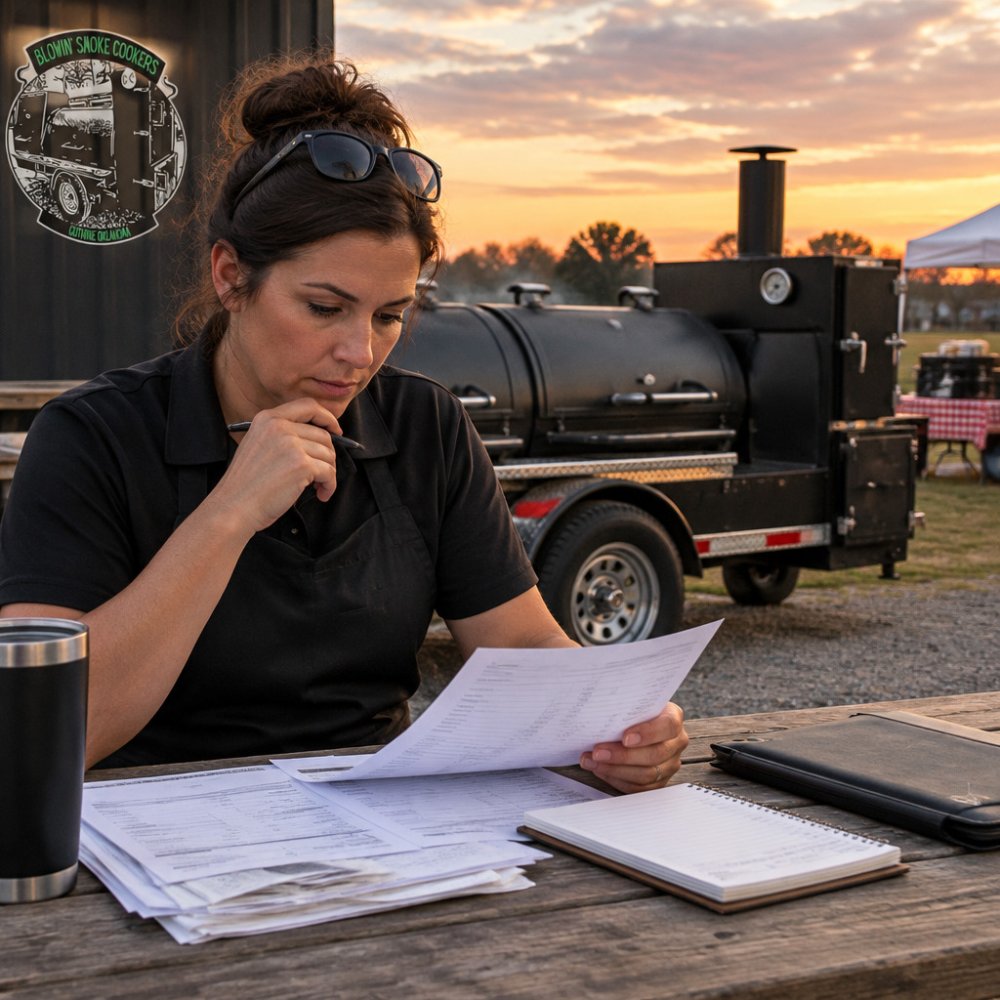
Next, estimate the margin you earn per event from smoked menu items and compare it against the equipment cost per event. If the smoker lets you take bookings you would otherwise decline, or add menu items that raise your average order, the investment shortens its payback period.
Consider a simple example. If a unit costs $2,999.00 and you expect 40 events in the first year, the equipment cost is about $75 per event before fuel and labor. Add your own fuel, labor, and maintenance costs to finish the calculation, and treat the result as a planning estimate.
Watch out: buying more capacity than your bookings justify ties up cash and makes each cook less efficient. Start with the size your current events require and step up when demand is proven.
!A caterer reviewing event invoices and a notepad beside a parked catering trailer with a smoker at dusk
Choosing Your Smoker and Booking a Consultation
A dual fuel smoker can suit catering when your menu is varied, your events are mobile or unpredictable, and your bookings justify the added capacity and flexibility. If you cook one menu at one location with a steady fuel supply, a simpler unit may serve you better.
Start by matching your menu, your largest typical event, and your transport setup to one of the models above. Review the SNS 42 Cabinet Combo Smoker for a compact dual fuel option, or look at the SNS 4060 if your business runs large events every week. Review the models above to see which configuration fits your operation, or contact Blowin' Smoke Cookers for help choosing.
Frequently Asked Questions
Is a dual-fuel smoker easier to manage during a catering event?
A dual-fuel smoker can run on pellets or wood for steady, hands-off temperature control, then switch to charcoal for searing or a higher heat finish. The SNS Pellet Vault Wood Smoker Combo has a listed temperature range of 160°F to 300°F. Crews still need to plan fuel refills, ash removal and temperature checks on each batch.
Can a dual-fuel smoker handle large catering cooks?
Yes, but capacity depends on the model. The 42 Cabinet Combo Smoker is listed at roughly 15 to 20 pork butts, 12 to 16 slabs of spare ribs, 8 to 12 briskets or 15 to 20 whole chickens per load, depending on trimmed meat size. The SNS 4060 Smoker Grill lists 75 boston butts, 75 whole chickens, 40 spare ribs or 30 to 40 briskets. Match the listed capacity to your largest typical order before buying.
How does a dual-fuel smoker compare with a single-fuel smoker for a catering business?
A single-fuel smoker is simpler and often cheaper, but it offers fewer fuel options. A dual-fuel setup lets you cook with wood for smoke flavor and use pellets or charcoal when you need consistent heat or want to shorten a cook. The trade-off is a higher purchase price and more components to maintain. The 42 Cabinet Combo Smoker lists a starting price of $2,999.00, while the SNS Pellet Vault and Charcoal Grill Combo starts at $8,799.00.
What should caterers consider before choosing a dual-fuel smoker?
Start with your largest event volume, the menu you serve, and where you will cook. Check the rated capacity, the fuel types you can source locally, and whether the unit is built for trailer or fixed use. Confirm power requirements for pellet models, which list a 110V outlet. Budget for fuel, delivery and maintenance as well as the purchase price, and ask about the warranty before committing.
