
Table of Contents
- When Smoker Firebox Damage Happens: Signs and Severity
- Is It Safe to Use a Smoker with Firebox Damage?
- Smoker Firebox Inspection: What to Check Before Deciding
- Cracked Smoker Firebox Repair: DIY vs. Professional Options
- Smoker Repair or Replace: The Economics Decision
- Smoker Firebox Replacement: What to Expect
- Making the Final Call: Repair Worth It for Your Situation
- Frequently Asked Questions
Last Updated: October 18, 2026
When Smoker Firebox Damage Happens: Signs and Severity
Visible damage falls into predictable categories: cracks in the steel, rust holes eating through the bottom half, and warped panels. These aren't cosmetic, they affect performance and safety.
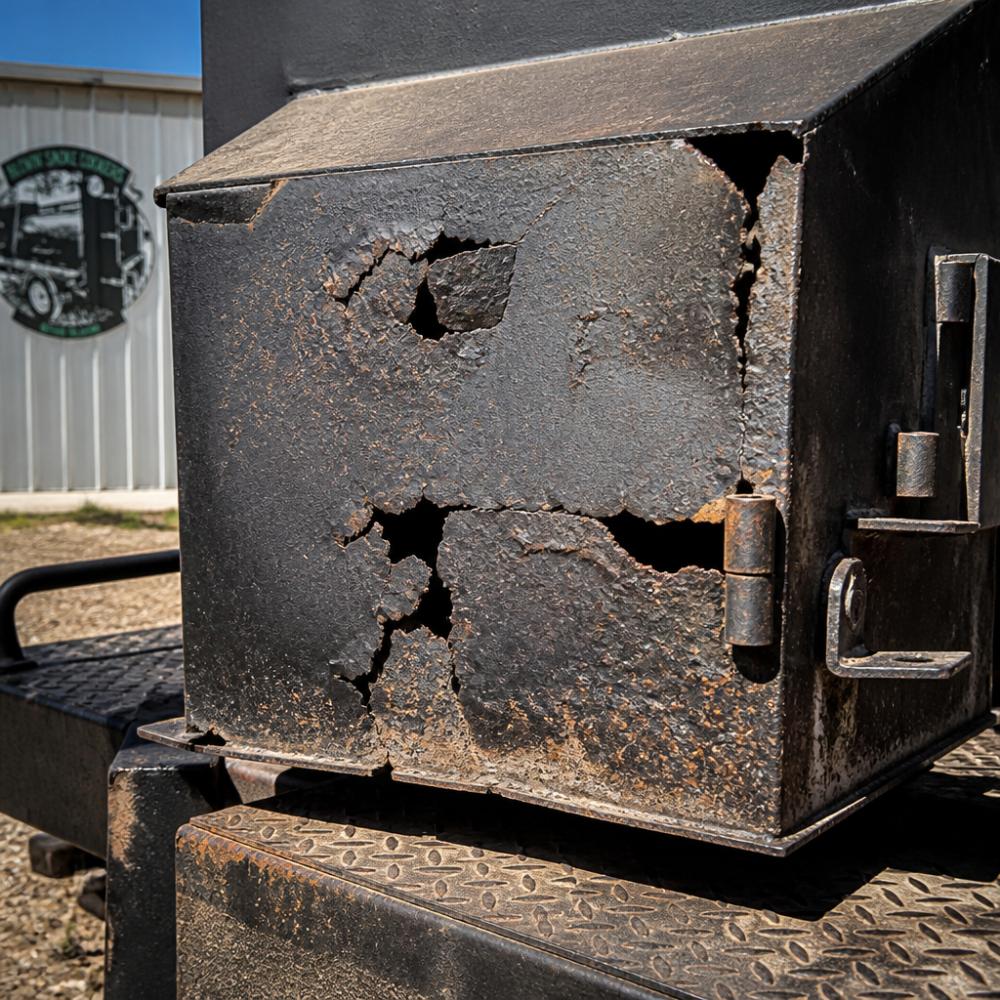
Visible damage: cracks, rust holes, and warping
Cracks typically start small, a hairline fracture near a weld expands as the firebox contracts with temperature cycles. Rust holes result from prolonged moisture exposure combined with heat cycles that break down the steel's protective coating.
Warping happens when one section heats faster than another or structural support fails. A box that's lost its shape won't hold temperature evenly, hurting cooking results.
Performance red flags: temperature swings and smoke leaks
Before visible damage appears, your smoker signals trouble through its behavior. Temperature swings of 20-30 degrees often mean airflow problems from cracks or gaps, and smoke leaking from seams means heat is escaping.
These issues make consistent cooking nearly impossible, and for competition or catering work, an unreliable firebox costs money every use.
Is It Safe to Use a Smoker with Firebox Damage?
A cracked or rusted firebox raises legitimate safety concerns, but risk depends on the type and extent of damage.
Small surface rust is cosmetic, and a hairline crack that hasn't grown is manageable short-term.
A deteriorating firebox allows uncontrolled airflow, so you lose temperature control.
The safest approach: if you're unsure, don't use it until you've had someone qualified assess the damage.
Smoker Firebox Inspection: What to Check Before Deciding
Before calling a professional or committing to a repair, inspect it yourself. It takes 30 minutes and gives you concrete information to work with.
DIY inspection checklist
- Check the interior for rust spots, pitting, or holes. Use a flashlight and look at the bottom half especially, that's where moisture settles.
- Run your hand along interior seams and welds. Feel for gaps or separation where metal should be joined tight.
- Look for discoloration or heat stress marks that suggest uneven heating or structural shifting.
When to call a professional for assessment
If your inspection reveals penetrating rust holes, active cracks longer than 2 inches, or structural warping, get a professional assessment before using the smoker again. A technician can evaluate whether repair or replacement is safer.
Professional assessment costs less than a failed repair attempt and gives you confidence in your next decision.
Cracked Smoker Firebox Repair: DIY vs. Professional Options
You have three paths: temporary patches, professional welding repairs, or replacement. Each has trade-offs, and the biggest is what you get for the money.
Temporary patches and high-temperature sealants
High-temperature silicone sealants can buy time on small cracks. They're inexpensive and easy to apply, but temporary, most hold up a season or two before reapplication, and they won't fix rust holes or structural issues.
Automotive silicone rated to 500°F and above works better than generic caulk but is still not permanent. Use it while waiting for a repair appointment or when damage is minor.
Welding and metal fabrication repairs
Professional welding addresses the root problem. A qualified metal fabricator can cut out rusted metal, patch holes, reinforce cracks, and restore structural integrity. Done right, the repair is permanent.
The trade-off is cost and turnaround time: repairs usually require removing the firebox or bringing the equipment to a shop, which means downtime. Welding also requires expertise, a welder who mostly works on trailers or gates may not understand how heat cycling affects a firebox seam.
What professional firebox repair actually includes
This is the part that tells you whether a quote is fair. A legitimate repair follows a sequence:
- Inspection. The technician assesses the full extent of damage, not just the visible crack, but the metal around it. Rust often travels under paint and along seams, so the visible damage is usually smaller than the real damage.
- Metal preparation. Rusted or cracked metal is cut back to sound steel. Skipping this step is the most common cause of a repair that fails within a season, because welding over rust or paint produces a weak bond.
- Welding or fabrication. The technician welds a patch or reinforcement, or fabricates a replacement panel if the damage is large. Proper heat control during welding matters, too much heat warps thin panels and can distort the box.
- Sealing and gasket work. Seams and the door opening are sealed so the firebox holds temperature and airflow stays controlled. This is where smoke leaks get fixed.
- Testing. The repaired box is run through temperature cycles to confirm the repair holds and the smoker drafts correctly.
- Warranty. A reputable shop stands behind the work for a defined period. Ask for the warranty terms in writing before authorizing work.
Ask any repair service for references and process details. Cheap repairs often skip metal preparation or post-weld testing, failing faster than the original damage. A shop that walks you through all six steps is worth trusting with a firebox.
Smoker Repair or Replace: The Economics Decision
Whether professional firebox repair is worth it comes down to a simple comparison: repair cost, replacement cost, and how much useful life the smoker has left. Here's a framework to apply to a real quote.
The three numbers you need before deciding
- The repair quote, itemized. Ask the shop to break the estimate into inspection, metal preparation, welding or fabrication, sealing, testing, and labor. A single lump-sum number hides whether you are paying for a proper repair or a quick patch.
- The replacement cost for equivalent equipment. Not the original purchase price, what it would cost today to buy a smoker of similar size, material thickness, and build quality. Include freight and any assembly.
- Remaining service life. A well-maintained offset smoker with thick-gauge steel commonly lasts 15-20 years. A thin-gauge box used heavily may be near the end of its life at 8-10 years. If the smoker is already past two-thirds of its expected life, a major repair is usually money spent on a unit that will fail again soon.
A practical repair-versus-replace decision tree
Work through these in order. Stop at the first one that applies.
- Is the damage structural? Cracks that run across a seam, a firebox that has lost its square, or rust-through across a large panel means the box is failing, not just worn. Replacement is usually the safer call.
- Is the damage isolated? One cracked weld or one rust hole in a thick panel is a repairable defect. Multiple cracks plus rust-through in several spots means the metal is at end of life.
- Is the repair quote more than roughly half the replacement cost? At that threshold the economics rarely favor repair, because you are paying most of a new unit's price for a used one with a patched box.
Repair economics over time, not just today
Factor in likely repeat repairs. A patch on a thin panel rusting from the inside often needs attention again within a season or two, while a properly welded repair on thick steel can last the smoker's remaining life.
Also weigh downtime. A repair that takes the smoker offline for two to four weeks has a real cost if you cook for events or clients, replacement with a unit you can use immediately may be worth more than the repair savings.
What a fair repair quote looks like
A quote that only lists a total is a red flag. A fair estimate separates inspection findings from the work: what will be cut out, welded or fabricated, what sealant or gasket will be used, how it will be tested, and what warranty covers it. Itemization also lets you compare quotes, a lower total that skips metal preparation or post-weld testing isn't actually cheaper.
Smoker Firebox Replacement: What to Expect
If replacement is your path, understand what's involved. Firebox replacement isn't a simple swap, it's a project that requires planning.
Replacement parts and compatibility
Fireboxes aren't universal, an offset smoker's differs from a pellet smoker's, a kamado's, or a gas grill's. Compatibility matters, and sourcing the right replacement can take time.
Some manufacturers sell replacement fireboxes directly. Others require you to source parts from specialty metal fabricators. Verify compatibility before ordering anything.
Installation and labor considerations
Replacing a firebox means disconnecting the old one, removing it, installing the new one, and testing all connections and seals. Some handle it themselves with welding or fabrication skills; most hire it out.
Labor for installation typically runs 4-8 hours depending on how the original was installed and how accessible it is. Add that to parts cost when comparing to repair pricing.
Making the Final Call: Repair Worth It for Your Situation
The decision isn't universal. What makes sense for a competition pitmaster's primary cooker differs from a backyard enthusiast's occasional-use equipment.
Decision framework: smoker type, age, and usage
Offset smokers and traditional fireboxes: These handle repair well because the firebox is the core component.
Pellet smokers: The firebox is part of a more complex system.
Kamado and ceramic cookers: These rarely need firebox repair because ceramic doesn't rust or weld like steel.
Gas grills: Firebox damage is less common, but when it happens, the grill's age usually determines the decision.
Questions to ask a professional before committing
- What's the full extent of damage, and how did it happen?
- Is the repair permanent, or is this a temporary fix?
- What warranty or guarantee comes with the repair?
A professional who answers these clearly and honestly is worth trusting with your equipment.
Deciding whether professional smoker firebox repair is worth it comes down to specifics: your equipment's age, damage severity, repair versus replacement costs, and how much you cook. Small cracks on newer equipment often justify repair; multiple damage points on aging smokers usually point toward replacement.
Frequently Asked Questions
Can a smoker firebox be repaired?
Yes, many smoker firebox issues can be repaired. Small cracks and rust holes can often be patched with high-temperature sealants or welded by a professional. However, the repairability depends on the damage extent, firebox material, and location of the damage. Structural damage affecting the firebox's ability to hold heat or maintain airflow may require replacement instead. A professional inspection will determine whether repair is feasible for your specific situation.
How do you know when a smoker firebox needs to be replaced?
Replace your firebox if you see extensive corrosion covering large areas, multiple cracks that compromise structural integrity, severe warping that prevents proper door sealing, or damage affecting the reverse flow system. If repair costs approach 50-70% of a replacement firebox cost, replacement often makes better economic sense. Also consider the smoker's age and remaining service life. A professional can assess whether repair will extend the smoker's usable life sufficiently to justify the expense.
Is it safe to use a smoker with a cracked firebox?
Small surface cracks may not pose immediate safety risks, but larger cracks or holes compromise the firebox's ability to maintain consistent temperature and airflow control. Structural damage can lead to uneven heat distribution, difficulty maintaining target temperatures, and potential fire safety concerns if cracks allow uncontrolled fuel or sparks to escape. Do not continue using a smoker with significant firebox damage. Have it professionally inspected to determine if it's safe to operate until repairs can be made.
What should you ask a professional before approving smoker firebox repair?
Ask the repair professional: What's the damage extent and repair method they recommend? How long will the repair last before similar issues recur? Will they provide a warranty on the repair work? What's the total labor and parts cost? How long will the smoker be out of service? Can they provide references from similar repairs? Understanding these details helps you make an informed decision about whether repair is worth the investment compared to replacement.