
Energy Efficiency in Commercial BBQ Smokers: Where Fuel Goes
Editorial Team
Nov 07
Last Updated: November 6, 2026
Quick Summary
Commercial BBQ smokers lose energy mainly through their walls, door seals and exhaust, so fuel is wasted every hour they run. The most reliable way to compare fuel costs is to measure fuel used per finished pound of product across identical batches. Heat retention, door seals and a full-load cooking routine all reduce the bill.
- Compare fuels by measured cost per finished pound, not by price per bag or tank.
- Log cumulative kWh with a plug-in monitor to get accurate electric smoker running costs.
- Test heat retention by timing how long the chamber takes to drop 50°F with the door closed.
- Check door gaskets with a paper strip; if it pulls out easily, that section is not sealing.
- Cook full loads and log standby hours separately, since idle time burns fuel without producing product.
Table of Contents
- How Commercial BBQ Smokers Use Energy Differently
- Commercial BBQ Smoker Fuel Consumption by Fuel Type
- Commercial Smoker Heat Retention and Insulation
- How to Measure Energy Use Per Cook and Per Pound
- Operating Practices That Cut Fuel Use
- Ventilation, Exhaust and Heat Loss in Commercial Installations
- Choosing a Commercial Smoker Built for Lower Operating Costs
- Frequently Asked Questions
How Commercial BBQ Smokers Use Energy Differently
Commercial BBQ smokers run for hours at a time, often through a full service. That long run time means small inefficiencies add up fast. A unit that loses heat through its walls or lid burns more fuel every hour it runs.
Most of the energy in a commercial smoker goes into three jobs: heating the cooking chamber, replacing the heat and smoke that escape each time the door opens, and keeping the temperature steady against the outside air. Each job draws on the same fuel, so a smoker that handles all three well will cost less to run over a year.
Pitmasters often focus on the flavor a fuel adds. Energy use matters just as much for the monthly bill. Knowing where the heat goes is the first step to spending less on it.
Commercial BBQ Smoker Fuel Consumption by Fuel Type
Fuel choice shapes both the cost per cook and how much attention the smoker needs. Wood, charcoal, pellets, gas, and electric heat each behave differently, and the only fair way to compare them is on a per-pound-of-finished-product basis with the same batch size, cook duration, and ambient conditions.
- Wood gives strong flavor but burns unevenly, so it needs regular tending and produces variable heat output per split.
- Charcoal holds steady heat well once lit, which helps with consistent cook times, but lump and briquette densities vary enough that weight-based tracking matters.
- Pellets feed fuel automatically through an auger on a set schedule, which makes fuel use more predictable and easier to meter.
- Gas (propane or natural gas) delivers instant, controllable heat with high turndown, but standby losses and burner cycling dominate consumption on long holds.
- Electric units convert power directly into heat with near-100% conversion at the element, and their cost is fully captured by a plug-in energy monitor reading kilowatt-hours.
The right choice depends on your menu, your staffing, and what your kitchen can support, but the decision should be driven by measured cost per pound, not by the price per bag or per tank.
Wood, Charcoal and Pellet Fuel Use Compared
Wood and charcoal both need an operator to keep the fire going, and both lose efficiency to opening the firebox door. Pellet smokers use an auger to feed fuel on a set schedule, which can make fuel use more predictable and easier to log.
Watch out: comparing a full-chamber pellet cook against a half-loaded wood cook will make pellets look far more efficient than they are, because the wood cook's energy is spread over fewer pounds.
Electric Commercial Smoker Energy Use
Electric smokers convert power directly into heat. Their running cost depends on your local electricity rate and how long the heating elements stay on. Insulation and a tight door seal reduce how often those elements have to cycle back on, which lowers the total kilowatt-hours used per cook.
To model electric cost accurately, use a plug-in energy monitor that records cumulative kilowatt-hours, not just instantaneous wattage. Log the reading at start and end of cook, multiply the difference by your utility's per-kilowatt-hour rate (including demand charges if your rate structure has them), and divide by finished pounds.
Gas and Propane Consumption
Gas smokers and propane-fired cabinets are often judged by tank life, but tank life is a poor efficiency metric because it ignores batch size and cook duration. Weigh the tank before and after each cook on a scale rated for the tank's full weight; the difference in pounds of propane consumed, multiplied by your refill cost per pound, gives the fuel cost for that cook.
Standby time is the hidden cost in gas units. A smoker held at temperature for two hours before loading and two hours after pulling product can consume a meaningful share of its total fuel without producing any finished pounds. Log standby hours separately from cook hours so you can see and reduce them.
Commercial Smoker Heat Retention and Insulation
Insulation is one of the most overlooked parts of energy efficiency, and it is also one of the easiest to verify before you buy. A smoker with thick, double-walled steel and a well-insulated firebox holds heat longer after it reaches temperature. That means less fuel burned to recover from a door opening or a cold morning start.
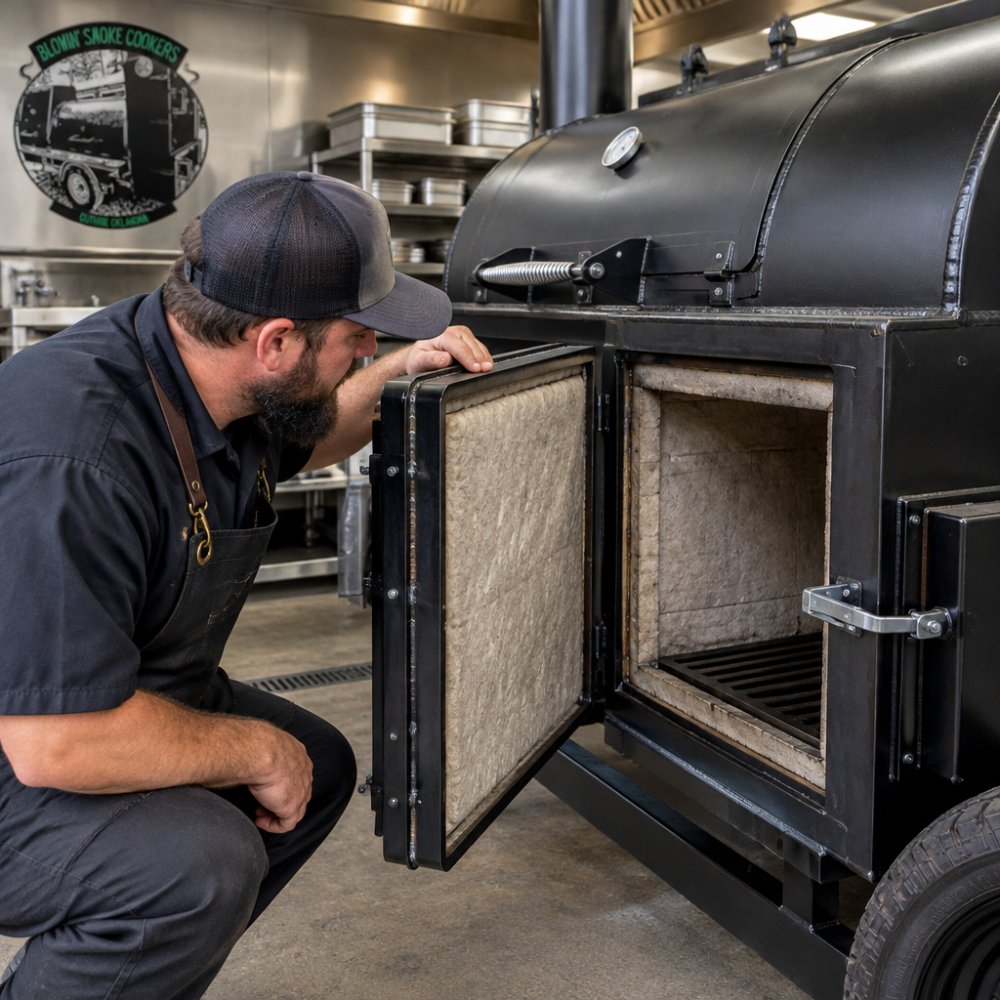
The mechanism is straightforward: heat leaves a smoker through the walls, the door, the seams, and the exhaust. Insulation slows conduction through the walls; gaskets and tight seams slow leakage at the door and joints; a properly sized exhaust slows convective loss. Each path you tighten reduces the fuel the burner must supply to hold setpoint.
How to Verify Heat Retention Before You Buy
Ask for a heat-retention test rather than a claim. A practical method: bring the empty smoker to a set temperature (for example, 250°F), shut off or idle the fuel supply, and record how long the chamber takes to drop a fixed amount (for example, 50°F) with the door closed and ambient temperature noted. Repeat with the door opened for a fixed interval (for example, 30 seconds) to simulate a load, and record recovery time back to setpoint.
Watch out: a hold-time test run on a warm day will flatter a poorly insulated unit, so record ambient temperature alongside the result and compare only tests run under similar conditions.
SNS Pellet Vault Wood Smoker Combo →
Seals, Gaskets and Door Fit
Check the door gaskets and seals on any smoker you use. A worn seal lets hot air escape constantly, and the burner works harder to make up the difference. Replacing a seal costs far less than the extra fuel a leaking door wastes. Test door fit with a simple dollar-bill or paper-strip check around the perimeter: if the strip pulls out easily with the door latched, that section of gasket is not sealing. Gaskets that are user-replaceable without disassembling the door are worth prioritizing, because seal wear is the most common heat-loss failure on units in daily service.
Wall Construction and Firebox Insulation
Ask about wall construction before you buy, since insulation affects the bill every day you run the unit. Double-walled cabinets with insulation between the skins hold temperature with less fuel than single-wall cabinets, and an insulated firebox reduces radiant loss into the kitchen. On outdoor installations, wind exposure across the cabinet accelerates heat loss and forces the burner to compensate, so a sheltered position or a wind break can matter as much as wall thickness.
Pair that construction with the measurement method above, log hold time, recovery time, and fuel used per cook, and you will have a defensible efficiency comparison rather than a manufacturer claim.
How to Measure Energy Use Per Cook and Per Pound
You cannot manage what you do not measure. A simple tracking method shows you which cooks cost the most to run.
- Record the fuel or power used before each cook. For gas or propane, note the tank weight. For pellets, weigh the bag. For electric, read the meter or use a plug-in energy monitor.
- Record the fuel or power used after the cook ends.
- Subtract to get the total used for that cook.
- Divide by the pounds of finished product to get energy use per pound.
Track this for two weeks across different menu items. You will likely find that a few cooks account for most of the cost. Those are the ones to optimize first.
Operating Practices That Cut Fuel Use
Small habits change the fuel bill more than most buyers expect.
- Preheat only as long as needed. Running the smoker an extra hour before loading meat burns fuel without adding quality.
- Keep the door closed. Every opening lets heat and smoke escape, and the smoker has to rebuild its temperature.
- Load a full chamber. Cooking a full load uses about the same energy as a half load, so the cost per pound drops.
- Clean the firebox and drip pan. Ash and grease buildup block airflow and make the fire work harder.
- Set the temperature accurately. Running 25 degrees hotter than the recipe calls for uses more fuel for no gain.
Build these steps into a written opening and closing checklist so every shift follows them.
Ventilation, Exhaust and Heat Loss in Commercial Installations
Where a smoker sits affects how much heat it loses. A unit in an open-air area on a windy day loses heat faster than one sheltered by a wall or enclosure. Drafts across the cooking chamber also change the temperature and force the burner to compensate.
Exhaust systems matter too. Good ventilation removes smoke and heat from the kitchen, but an exhaust hood pulling too hard can draw warm air away from the smoker and strain the fuel supply. Work with your installer to balance the airflow so the smoker keeps its heat while the space stays safe and comfortable.
Choosing a Commercial Smoker Built for Lower Operating Costs
When you compare smokers, look beyond the purchase price. Ask these questions:
- How thick is the cabinet wall, and is it double-walled?
- Is the firebox insulated?
- Does the door seal tightly, and can the gasket be replaced easily?
- Does the fuel system feed consistently, so you avoid temperature swings?
- How much capacity do you get per cook, and how much fuel does a full load take?
A smoker that holds heat well and cooks a full load efficiently often costs less per pound over its life, even if the upfront price is higher.
Our commercial smokers, including the SNS Pellet Vault Wood Smoker Combo, are built for commercial use. For a fuel-by-fuel side-by-side, see our guide to pellet vs charcoal smokers for commercial BBQ operations. If heat loss outdoors is a problem, our guide on why professional smokers hold heat better explains the construction details. You can also read about low-maintenance smokers that run efficiently, or learn how to fix heat loss on windy days. For a full feature checklist, see essential features for high-volume BBQ smokers.

The checklist below lists the features that most affect how much a commercial smoker costs to run over its life.
| Feature | What to look for | Why it matters |
|---|---|---|
| Cabinet wall | Double-walled, thick steel | Slows heat loss through the walls |
| Firebox | Insulated | Reduces radiant loss into the kitchen |
| Door seal | Tight fit, replaceable gasket | Stops hot air escaping at the door |
| Fuel feed | Consistent feeding | Avoids temperature swings |
| Capacity | Full load per cook | Lowers fuel cost per pound |
Frequently Asked Questions
Does a commercial BBQ smoker use a lot of electricity?
It depends on the design. Electric commercial smokers draw power from a 110-volt outlet to run heating elements, a convection fan and controls, so their electricity use is measured in kilowatt-hours. Pellet smokers, such as the SNS Pellet Vault, run on a 110-volt supply for the auger, combustion fan and controller, and burn fuel for heat. Compare the rated voltage and draw on the spec sheet, then multiply by your hours of use and your local electricity rate to estimate monthly cost.
Should smoker vents be open or closed for efficient cooking?
Keep vents set to the position the controller and cook plan call for, and avoid leaving them wide open for long periods. Open vents let heat and smoke escape, so the smoker burns more fuel to hold temperature. Partial opening provides the airflow that a clean, steady burn needs without dumping heat. Adjust in small steps and watch chamber temperature for stability before changing the setting again.
What makes a commercial BBQ smoker energy efficient?
Double-walled steel construction, an insulated firebox and tight door seals slow heat loss. A convection fan that circulates heat evenly reduces hot spots that force the heat source to overwork. A digital controller with precise setpoints, such as the PID controller on the SNS Pellet Vault that adjusts in 5-degree increments, holds temperature without large swings.
