
Table of Contents
- Step 1: Legal Requirements and Licensing for Your BBQ Catering Business
- Step 2: Secure a Commissary Kitchen and Meet Health Department Rules
- Step 3: Food Safety Certification for Caterers and HACCP Planning
- Step 4: Commercial BBQ Smoker Requirements and Equipment Essentials
- Step 5: BBQ Catering Menu Planning, Pricing, and Profit Margins
- Step 6: Catering Liability Insurance, Contracts, and Startup Capital
- Step 7: Marketing, Event Logistics, and Scaling Your BBQ Catering Operations
- Frequently Asked Questions
Last Updated: September 23, 2026
Step 1: Legal Requirements and Licensing for Your BBQ Catering Business
Learning how to start a bbq catering business begins with paperwork, not pork. Before you smoke your first brisket for paying guests, you need the right legal foundation in place, and the order matters because each step feeds the next.
Choose your entity first. Most caterers form a limited liability company to separate personal assets from business liabilities. A single-member LLC is the common starting point; a corporation or an S-corp election becomes worth exploring once you have employees or investors. File your formation documents with your state's secretary of state office, then apply for an Employer Identification Number through the IRS. The EIN is free and you can apply online; you will need it to open a business bank account and to file taxes.
Then layer on the food-specific licenses. Your catering license typically comes from your state or county health department, and the category you fall under depends on how you operate:
- Mobile food unit / mobile food establishment, if you cook and serve from a trailer or truck.
- Catering operation, if you prepare food at a commissary and deliver it to events.
- Temporary food establishment permit, for a single event or festival, often issued per event.
Most jurisdictions require you to hold a commissary agreement before they will issue a mobile food permit, so line up your kitchen before you file. Inspectors will want the written agreement, a menu, a HACCP plan, and proof of a certified food protection manager on staff.
Register for sales tax. In most states, prepared food is taxable, and you collect and remit sales tax on catering invoices. Register with your state department of revenue, and note that some states treat separately stated service charges differently from the food itself. Get this wrong and you can owe back tax plus penalties.
Add event vendor permits. Festivals, farmers markets, and city parks usually require a separate vendor permit on top of your health license. These are issued by the event organizer or the local municipality, and they often carry their own insurance and fire-safety requirements.
- Form your LLC or corporation with the state
- Obtain your EIN from the IRS
- Secure a written commissary agreement
- Apply for your state/local health department license or mobile food permit
- Register for sales tax collection with the state department of revenue
- Obtain event vendor permits as needed
- Confirm workers' compensation coverage if you hire staff
A note on sequencing. Do not sign a venue contract or take a deposit before your health license is in hand. A common pattern among new caterers is to book a wedding, then discover the permit process takes several weeks longer than expected. Build the licensing timeline into your launch date, not the other way around.
Step 2: Secure a Commissary Kitchen and Meet Health Department Rules
A commissary kitchen is a licensed commercial facility where you store, prep, and clean between events. Most health departments require mobile caterers to operate from one rather than a home kitchen.
Your commissary agreement must be in writing, and inspectors will ask to see it. The facility needs proper refrigeration, three-compartment sinks, and handwashing stations. Schedule your health department inspection before your first paid gig, not after.
FDA Food Code retail food guidance outlines the baseline sanitation standards most state and county health departments adopt.
Step 3: Food Safety Certification for Caterers and HACCP Planning
Food safety certification for caterers usually means earning a ServSafe Food Protection Manager credential or an equivalent state-approved course. At least one certified manager must be on site during service in most jurisdictions.
A HACCP plan is a written system that identifies biological, chemical, and physical hazards at each step of your process, then sets critical control points to prevent them. For BBQ, your critical limits center on temperature control: holding cooked meats above 135°F and cooling leftovers rapidly.
Step 4: Commercial BBQ Smoker Requirements and Equipment Essentials
Commercial bbq smoker requirements come down to capacity, temperature control, and transport. A backyard offset pit will not keep up with a 300-guest wedding, and unstable temps put you at risk of a foodborne illness claim.
SNS Cabinet 60 Grill Smoker Combo With →
A reverse flow cabinet smoker built from heavy-gauge steel holds temperature far more consistently than thin-walled budget units, which matters when you are cooking 60 pork butts overnight.
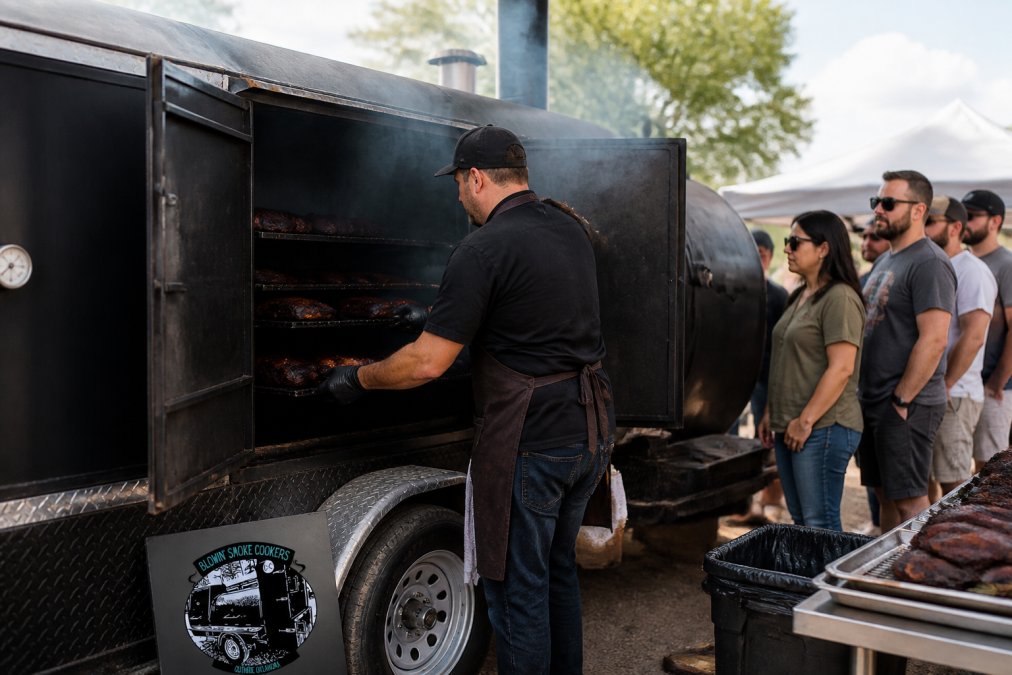
Blowin' Smoke Cookers builds catering trailers with 1/4-inch diamond tread steel cabinets and reverse flow design, including the SNS Cabinet 60 with a three-bay sink package and the SNS Deluxe 72 for higher-volume operations.

Equipment Need |
Why It Matters |
What to Look For |
|---|---|---|
Reverse flow smoker |
Even heat, fewer flare-ups |
1/4-inch steel cabinet |
Three-bay sink |
Health code compliance |
Hot water, handwash station |
Insulated firebox |
Fuel efficiency overnight |
|
Rib/warming box |
Holding capacity at events |
Multiple slide-out racks |
Step 5: BBQ Catering Menu Planning, Pricing, and Profit Margins
BBQ catering menu planning starts with a narrow core menu. Pick four to six proteins, two to three sides, and one or two desserts. A tight menu keeps your food cost percentage predictable and your bulk cooking workflow efficient.
Build your menu around yield, not raw weight. This is the single biggest pricing mistake new BBQ caterers make. A raw brisket loses a large share of its weight during a long cook through trim, evaporation, and rendering. Pork butts and ribs lose weight too. If you price off the raw weight you bought rather than the cooked weight you serve, you will underprice every plate.
Price by service style.
- Buffet / on-site catering, priced per head, because you are providing staff, chafing dishes, setup, and service time.
- Drop-off catering, priced per pan or per platter, because the client handles service. Drop-off carries a lower labor cost, so the per-person effective price can be lower while your margin holds.
- Add-ons, charge separately for premium proteins, extra sides, dessert, and beverage service. Add-ons are where margin lives, because the base package is often priced competitively to win the booking.
Set minimums and deposit terms that protect your margin. A per-event minimum guest count or minimum dollar amount keeps small jobs from eating your day. Pair that with a deposit that covers your food purchasing, and a final guest-count deadline that locks the number you cook to. These terms belong in your catering contract, not in a text message.
Step 6: Catering Liability Insurance, Contracts, and Startup Capital
Catering liability insurance protects you against foodborne illness claims, property damage, and liquor liability if you serve alcohol. General liability plus a commercial auto policy for your trailer covers most startup needs.
Step 7: Marketing, Event Logistics, and Scaling Your BBQ Catering Operations
Customer acquisition for a new BBQ caterer comes from three places: local events, referrals, and a simple website with your menu and booking form. Niche marketing beats generic advertising, so target wedding venues, corporate parks, and breweries in your area.
Frequently Asked Questions
What permits are required to start a BBQ catering business?
You will typically need a business license, a food service or catering license, a food handler or manager certification, and a permit for your commissary kitchen. Many states also require a mobile food unit permit for your catering trailer and a vendor permit for each event. Requirements vary by state and county health department, so confirm the exact list with your local health department before you buy equipment or sign event contracts.
How much money do I need to start a catering business?
Startup capital covers your commercial smoker or catering trailer, commissary kitchen access, licensing fees, liability insurance, and initial food inventory. A catering trailer from Blowin' Smoke Cookers ranges from $6,499 for the SNS Tailgater to $13,100 for the SNS Deluxe 72, so your equipment choice drives most of the budget. Plan for several months of operating expenses on top of equipment so you can cover slow periods while you build clients.
How much is BBQ catering for 100 people?
Most BBQ caterers price per person, with brisket, pulled pork, ribs, and sides bundled into a per-head rate. Your food cost percentage should stay near 28 to 33 percent of the event price, so a 100-person job needs a quote that covers meat, sides, labor, transport, and overhead while protecting your profit margin. Build a written catering invoice template that lists every line item so clients see exactly what the price includes.
Is starting a catering business profitable?
BBQ catering can be profitable because bulk cooking and slow smoking keep food cost percentage predictable and labor needs low compared to plated service. Profit margins depend on your menu engineering, portion control, and how well you control overhead costs like fuel, commissary rent, and trailer maintenance. Caterers who track inventory management and event-by-event costs usually find the highest margins in chicken and pulled pork plates sold at volume.
What is the biggest challenge in scaling a BBQ catering business?
Scaling operations usually breaks on labor and logistics, not cooking. Staffing and labor laws, food transport, temperature control, and event scheduling all get harder once you book multiple jobs per weekend. The caterers who scale successfully standardize their menu, buy high-capacity equipment like a 72-inch catering trailer smoker, and build a repeatable event checklist before they add staff or new service areas.