
Table of Contents
- What Heat Resistant Gloves Do Pitmasters Actually Need
- Best BBQ Gloves: Core Selection Criteria
- Heat-Resistant Grilling Gloves: What Separates Competition Grade from Budget Options
- BBQ Glove Heat Rating: Understanding Temperature Limits
- How to Clean BBQ Gloves and Extend Their Life
- Common Mistakes Pitmasters Make When Choosing Gloves
- Frequently Asked Questions
Last Updated: October 7, 2026
What Heat Resistant Gloves Do Pitmasters Actually Need
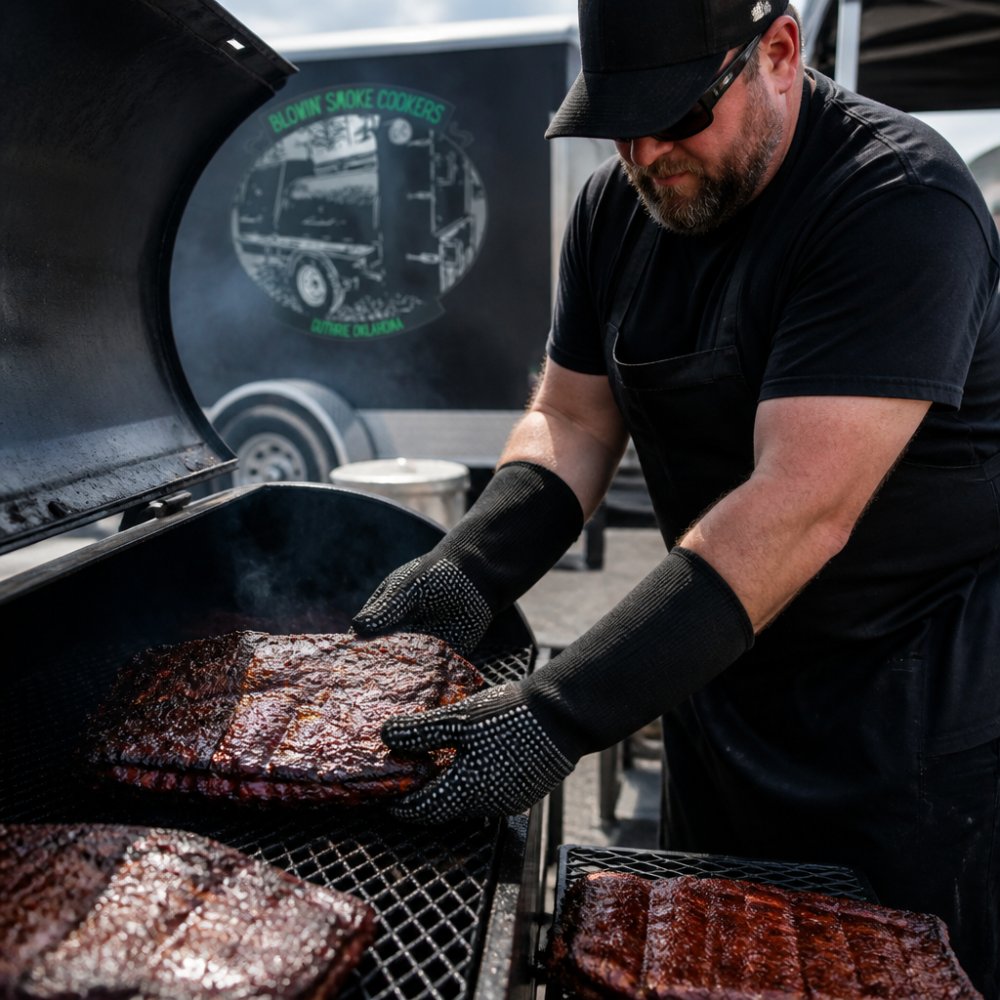
Heat resistant gloves pitmasters actually need aren't just about grabbing hot meat without burning your hands. At Blowin' Smoke Cookers, we understand that competition pitmasters and serious backyard cooks need gloves that protect without sacrificing the dexterity required to position ribs, adjust racks, or probe temperatures accurately.
The right pair keeps your hands safe while you maintain the control that separates a mediocre cook from a championship one.
Most pitmasters grab whatever heat-resistant gloves they find at a hardware store. Those fall apart after a season.
Best BBQ Gloves: Core Selection Criteria
Choosing heat-resistant grilling gloves comes down to three factors: how hot they can handle, how well you can grip and move with them, and whether they'll survive the abuse of a full season.
Heat Rating and Temperature Protection
The heat rating tells you the maximum temperature the gloves can safely handle. Most BBQ work happens between 300°F and 500°F, but you'll occasionally reach for hot grates or move items near 600°F+ zones.
Here's what matters: a glove rated to 500°F doesn't mean you can comfortably hold something at 500°F for 30 seconds. The rating is the threshold where the material begins to degrade. In practice, you'll want at least 100°F of safety margin between the glove's rating and what you're actually touching.
Grip and Dexterity for Meat Handling
A glove that protects your hands but makes you clumsy defeats the purpose. You need enough sensitivity to feel whether a rib is positioned correctly, enough grip to move a hot grate without it sliding, and enough flexibility to work around bones and curves.
Silicone-coated gloves typically offer the best grip on wet or oily surfaces. Leather gloves give you better feel but can absorb moisture and become slippery. Hybrid designs, leather palms with synthetic backing, split the difference.
Durability and Material Construction
Competition cooks use their gloves hard. You're dragging them across hot metal, exposing them to extreme temperature swings, and sometimes leaving them damp overnight. Seams matter. Reinforced stitching at stress points, especially around the fingers and wrist, will outlast single-stitched gloves by years.
Material quality determines how long the glove lasts. Genuine leather resists tearing better than synthetic leather. Aramid fiber (the material in firefighting gear) holds up longer than cotton blends.
Heat-Resistant Grilling Gloves: What Separates Competition Grade from Budget Options
Most pitmasters grab whatever heat-resistant gloves they find at a hardware store. Those fall apart after a season. The gloves that actually hold up, and let you work effectively, share specific characteristics worth understanding before you buy. Investing in durable hand protection serves as the foundation for your workflow, much like curating the proper pitmaster knife essentials to ensure every cut remains as precise as your temperature control.
The Four Glove Families You'll Actually See at a Cook
Nearly every heat-resistant glove on the market falls into one of four material families, and each behaves differently on a smoker:
- Aramid-lined gloves (the firefighting fiber). Aramid is the same class of fiber used in turnout gear and welding blankets. It resists sustained heat far better than leather and doesn't melt or drip. The trade-off is bulk, aramid liners add thickness that dulls your feel for a rib's bend or a brisket's probe slide.
- Silicone-coated knit gloves. A knit shell dipped in silicone gives you the best wet-grip of any family. Sauce, rendered fat, and brine roll right off. The weakness is the coating itself: it degrades with repeated high-heat cycles and can flake at the fingertips.
- Leather gloves (often welder-style). Genuine leather gives the best combination of feel and puncture resistance, which matters when you're working around bone or moving a loaded grate. Leather absorbs moisture, though, and a soaked leather glove conducts heat much faster than a dry one.
- Hybrid designs (leather palm, synthetic back). These split the difference, leather where you grip, breathable synthetic where you don't. They're the most common compromise for backyard cooks who want one pair to do everything.
What Actually Separates a Competition Pair
The difference between a bargain pair and a competition-grade pair isn't marketing. It shows up in four measurable places:
- Stitch density and seam placement. Budget gloves are single-stitched with seams running straight down the palm, exactly where you grip. Competition gloves use double or triple stitching and move seams to the sides of the fingers, away from contact points.
- Coating adhesion. On cheap silicone gloves, the coating is sprayed thin and peels after a handful of washes. On better gloves, the coating is applied thicker and bonded to a textured base so it grips even when saturated.
- Lining construction. A glove with a sewn-in liner moves with your hand. A glove with a loose liner bunches at the fingertips and forces you to re-grip mid-task, the last thing you want when you're sliding a rack out of a hot cooker.
- Heat-cycle tolerance. This is the spec nobody prints on the package. A glove can be rated to 500°F and still fail after 30 heat cycles if the coating cracks. Competition cooks care less about the peak rating and more about how the glove performs on cook number 40.
Match the Glove to the Task, Not the Label
A single pair rarely covers everything a pitmaster does. A common pattern among competition cooks is to keep two or three pairs on hand and rotate them by task:
- Grate and firebox work: a heavy leather or aramid glove, where protection beats dexterity.
- Meat handling and turn-in boxing: a thinner silicone-coated glove, where you need grip and feel.
- Wrapping and probing: a snug, low-bulk glove so you can feel the probe slide into the flat without overshooting.
The Real Cost of Getting It Wrong
When you're competing, you can't stop mid-cook to find a backup pair. When you're cooking for a crowd, you need gloves that won't fail halfway through service. That's where durability becomes worth the investment.
BBQ Glove Heat Rating: Understanding Temperature Limits
The heat rating printed on a glove's packaging tells you one thing: the material's thermal limit.
Most BBQ glove heat ratings use one of two standards: the ASTM F1060 test (used for firefighting gear) or manufacturer testing (less standardized).
In practice, leather gloves rated to 500°F perform well up to about 450°F sustained contact. Silicone-coated gloves rated to 500°F might feel uncomfortably warm at 400°F.
The real test is how the glove feels during your first few cooks.
How to Clean BBQ Gloves and Extend Their Life
Most pitmasters ruin their gloves by washing them wrong. Machine washing breaks down the heat-resistant coating and loosens stitching. Throwing them in the dryer accelerates deterioration.
Hand wash in warm water with mild soap. Focus on the palms and fingers where meat residue and sauce accumulate.
Inspect the seams and coating every few weeks during heavy use.
Store gloves in a cool, dry place away from direct sunlight. UV exposure breaks down synthetic materials.
Common Mistakes Pitmasters Make When Choosing Gloves
Most glove-buying mistakes aren't about picking a bad product, they're about picking the wrong glove for the cooker and the task in front of you. Here are the errors that cost pitmasters the most, plus how to avoid them.
Mistake 1: Buying One Pair for Every Cooker
Glove choice should follow your smoker type, because each one puts your hands in a different kind of danger:
- Offset stick burners. You're feeding splits into a firebox and reaching across a wide, hot cooking chamber. Long-cuff leather or aramid gloves protect your forearms from the firebox edge. Short silicone gloves leave your wrists exposed.
- Pellet grills. The auger and fire pot run hot, but the cook chamber is more controlled. A mid-weight silicone-coated glove handles most tasks, and the wet-grip advantage matters when you're pulling foil-wrapped pork.
- Kettle grills. Direct-heat work over coals means flare-ups and high radiant heat near the grate. Aramid-lined gloves earn their keep here; thin gloves will feel the heat through in seconds.
- Vertical and cabinet smokers. Racks slide out at chest height, so you're reaching in and up. Low-bulk gloves with good grip beat heavy gauntlets, which catch on rack edges and knock food loose.
If you cook on more than one type, that's the strongest argument for owning more than one pair.
Mistake 2: Ignoring Fit Until Competition Day
Many pitmasters buy gloves that are too large, thinking bigger means more protection. Oversized gloves bunch up, reduce sensitivity, and make precise work impossible. Your gloves should be snug enough that you can feel what you're handling, loose enough that your fingers can flex freely. Test the fit with your hands slightly damp, that's closer to how they'll feel mid-cook than a dry try-on in a store.
Mistake 3: Trusting the Rating Without a Safety Margin
A 400°F-rated glove seems fine until you reach for a 550°F grate and realize you're underprotected. Know your smoker's hot zones before you buy, and build in a margin. If your cooker regularly runs at 275°F but you occasionally grab a grate sitting over live coals, buy for the grate, not the chamber.
Mistake 4: Assuming All Heat-Resistant Gloves Feel the Same
Leather gloves feel different than silicone-coated gloves. Aramid-lined gloves have a different grip. Buy one pair, test them on your smoker, then decide if you need a different type for different tasks. What feels good in a store might feel wrong when your hands are sweating and you're moving fast.
Mistake 5: No Backup and No Packing Plan
A glove failure mid-cook is a disaster you can prevent. Competition cooks who travel to events build a simple glove kit into their packing list:
- Two working pairs (one heavy, one light) plus a spare.
- A dry towel to wipe gloves between tasks, wet gloves conduct heat faster.
- A resealable bag for damp gloves so they don't soak the rest of your gear.
- A quick seam inspection the night before, not the morning of.
Mistake 6: Washing Them Like Laundry
Machine washing breaks down the heat-resistant coating and loosens stitching. Hand wash in warm water with mild soap, rinse thoroughly, and air dry completely before storing. Soap left in the material attracts moisture and accelerates mildew.
Frequently Asked Questions
What type of gloves do pitmasters use?
Pitmasters use heat-resistant gloves rated for 300°F to 500°F depending on their cooking style. Competition pitmasters typically choose gloves with aramid fiber or silicone coatings for durability, leather palms for grip, and extended cuffs for forearm protection. The best BBQ gloves balance heat protection with dexterity, allowing precise meat handling and temperature probe insertion without fumbling.
How heat-resistant should BBQ gloves be?
For smoking and low-and-slow cooking, gloves rated 300°F to 400°F handle most tasks. For direct flame grilling or competition searing, choose 450°F to 500°F ratings. The BBQ glove heat rating indicates sustained protection; brief contact with hotter surfaces is often possible. Check the manufacturer's specification sheet, temperature ratings vary by material and construction method.
Are BBQ gloves machine washable?
Most heat-resistant gloves are not machine washable. Instead, hand wash with warm soapy water, rinse thoroughly, and air dry completely. Leather-palmed gloves require leather conditioner occasionally to prevent cracking. Machine washing damages the heat-resistant coating and degrades materials. Always check the care label; some premium gloves have removable liners that are machine washable while the outer shell requires hand cleaning.
Can heat-resistant gloves handle hot meat directly?
Yes, heat-resistant gloves rated 350°F and above safely handle hot meat fresh from the smoker. Silicone and aramid-coated gloves provide the best grip on wet, oily meat surfaces. Avoid cotton or basic leather gloves for this task, they offer inadequate heat protection. For competition cooking where precision matters, choose gloves with textured palms and fitted fingers to maintain control when moving brisket, ribs, or pork shoulder.